 Hello, folks. I am John Thorn, and some of you will know me for my work in baseball; I am Major League Baseball’s official historian, and I have written many books on baseball and other sports over the past four decades. But with a profession that may seem like a hobby, I have always felt that I ought to have serious interests outside the realm of sport. One of these has been, since prowling used-book stores on Fourth Avenue ca. 1960, New York City history. Occasionally I get to write on the subject, too, notably New York 400, which I created for the Museum of the City of New York for Gotham’s 400th birthday bash in 2009.
Would a city by any other name be as sweet? Many evidently have thought so, for New York has been called the Big Apple, Fun City, and the Melting Pot. It has been the City of Golden Dreams, the Capital of the World, and the City So Nice, They Named It Twice (though it might have to share that last one with Walla Walla). As early as 1784 George Washington dubbed New York the Seat of Empire, which soon became the enduring Empire City–and, by extension, State. But the most richly evocative of all the city’s nicknames may be one that, like Yankee Doodle, was originally intended by its English coiners as an insult: Gotham.
Let’s start with why our fair burg is called Gotham in the first place. For this I am going to focus on a unique artifact of baseball, long before anyone dreamed of forming a professional league.

Gotham Base Ball Club pin.
To give an idea of how large a story a trinket may tell, and how rich in association it may prove, allow me to present a baseball pin no larger than a dime, along with a common nursery tale: “Three wise men of Gotham went to sea in a bowl,” went the Mother Goose rhyme; “if the bowl had been stronger, then my rhyme had been longer.” Mother Goose, orSongs for the Nursery, was first published in London in 1760, based upon English and French sources, including Charles Perrault’s Contes de ma mère l’oye(1697). Not a propitious beginning for a baseball story, is it? But look at the accompanying photograph, of a pin worn by members of the Gotham Base Ball Club of New York in the 1850s. Let’s track the story back even further, to 1460, when the “Foles of Gotham” were first mentioned in print, and a century later, when the absurd doings of the people of that village (seven miles from Nottingham, in England) were collected in a book, Merrie Tales of the Mad Men of Gotham.
At that time the simplicity of the inhabitants was legendary. One absurdity attributed to them was the building of a thornbush round the cuckoo to secure eternal spring; another was an attempt to rid themselves of an eel by drowning it. But the archetypal tale of Gothamite behavior was when King John intended to establish a hunting lodge nearby. The villagers, fearful of the cost of supporting the court, feigned imbecility when the royal messengers arrived. Wherever the king’s men went, they saw the fools of Gotham engaged in some lunatic endeavor. When King John selected another spot for his lodge elsewhere, the “wise men” boasted, “We ween there are more fools pass through Gotham than remain in it.”
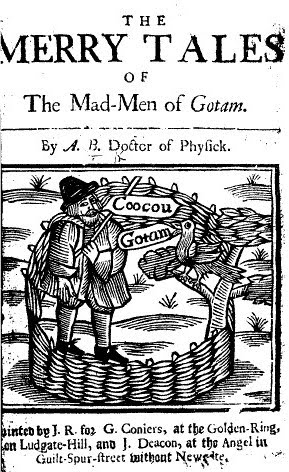
Merrie Tales.
How did this tale come to resonate with the members of the Washington Base Ball Club, formed in 1850 as the second club after the Knickerbockers–or, as its members claimed, formed before the Knicks, in the 1830s–and two years later renamed after the proverbial wise fools? Gotham is understood today as Batman’s hometown, but it is also a common synonym for New York and has been so since our English cousins began to refer to those “fools” who sailed from the mother country (three men in a tub) to make their fortunes in New York as residents of the “New Gotham.” Washington Irving also applied the name of Gotham to New York in 1807, in some of his Salmagundi letters from Mustapha-Rub-a-Dub Keli Khan. (“Rub-a-dub-dub, three men in a tub…”)
Proper businessmen scorned the young men who played baseball in the New York area around 1850 for acting like fools, trying to extend their youth beyond the time when men should give over childish things. So the Washington Base Ball Club, in a defiant stance against the British, cricket, and their elders’ puritanical attitudes toward play, renamed themselves the Gotham Base Ball Club and made up this little badge of honor for its members. This example, the only one known to survive, was issued to charter member Henry Mortimer Platt and was donated to the Hall in 1939 by his daughter.
Daniel Denton had written in A Brief Description of New York (1670): “Here those which Fortune hath frowned upon in England, to deny the man inheritance amongst their brethren, or such as by their utmost labors can scarcely procure a living—I say such may procure here inheritances of lands and possessions, stock themselves with all sorts of cattle, enjoy the benefit of them whilst they live, and leave them to the benefit of their children when they die.”
So New Yorkers adopted Gotham as their model, the city of “wise fools” who knew more than their English lords. Visitors might note that New York was not only crass but also dirty and crowded and mongrelized; residents would nod in agreement and set about their business. They liked their city just the way it was.
 gothamhistory
Do you have any evidence that it was the English that gave the name to New Yorkers, and not Irving in Salmagundi? Of course it comes from the English comical folklore, but I don’t think it was broadly applied to New York specifically until Irving. Why would they apply it to New York, and not to the larger colonial cities of Boston and Philadelphia? New York was arguably the least English of all of the cities, as its founders were Dutch (New Netherland). I also am not sure about how popular the King John story really was- it seems that the more ludicrous wise men of Gotham tales were more popular. Possibly you have a book or something not online about this? I think that it is more likely that Irving had heard the tales, and when he wanted to lampoon New York in Salmagundi he was inspired by the tales of Gotham, and then the nickname stuck.
LikeLike
You’re right that it was Irving’s application of Gotham to New York that stuck. Because New York, even at the dawn of the 19th century, had the reputation of a city concerned with nothing but moneymaking, it would seem fitting to call it–and not the higher-brow cities of Boston, Philadelphia, or Baltimore–Gotham, the home for wise fools.
LikeLike