 Below is an account of Henry Hudson’s second voyage in search of a Northwest Passage, of 1608, written by Emanuel Van Meteren in 1611 and published in The Hague three years later. Van Meteren (1535-1612) was a Flemish historian and Consul for “the Traders of the Low Countries” in London. When Hudson returned from his second voyage on behalf of the Muscovy Company of England he related to van Meteren that there had been a mutiny in 1608, originating in quarrels between Dutch and English sailors. Van Meteren had access to Hudson’s journals, charts and logbooks for his Historien der Nederlanden, en haar naburen oorlogen tot het iaar 1612 (published in 1614). It was, during the 1609 third voyage, in the Halve Maene, that once again foiled by summer ice, Hudson detoured toward Manhattan. A fourth voyage, in 1610-11, proved disastrous. Following a mutiny, Hudson, his teenage son, and seven crew members were set adrift in an open boat and were never heard from again.
We have said in the preceding book that the Directors of the East India Company in Holland had sent, in the month of March last past, in order to seek a passage to China by Northwest or Northeast, a brave English pilot named Henry Hudson, with a Vlie-boat, and about eighteen or twenty men, part English and part Dutch, well provided. This Henry Hudson sailed from Texel on the 6th of April, 1609, and doubled the Cape of Norway on the 5th of May; he laid his course toward Nova Zembia, along the northern coast, but found the sea as full of ice there as he had found it the preceding year, so that he was compelled to abandon all hope for that year; whereupon, owing to the cold which some who had been in the East Indies could not support, the English and Dutch fell into disputes among themselves.

Last Voyage of Henry Hudson, by John Collier
Whereupon the Master, Hudson, gave them their choice between two things, the first was, to go the coast of America in the fortieth degree of latitude, mostly incited to this by letters and maps which a certain Captain Smith had sent him from Virginia, and on which he showed him a sea wherein he might circumnavigate their Southern Colony from the North, and from thence pass into a Western sea. If this had been true (which experience up to the present time has shown to the contrary), it would have been very advantageous, and a short route to sail to the Indies.
The other proposition was, to search for the passage by Davis’ Straits, to which at last they generally agreed; and on the fourteenth they set sail, and, with favorable winds, arrived the last of May at the isle of Faro, where they stopped only twenty-four hours to take in fresh water. Leaving there, they reached, on the eighteenth of July, the coast of New-France in latitude forty-four, where they were obliged to make a stay to replace their foremast which they had lost, and where they obtained and rigged one. They found this a good place for catching codfish, and also for carrying on a traffic for good skins and furs, which they could obtain for mere trifles; but the sailors behaved very badly toward the people of the country, taking things by force, which was the cause of a strife between them.
The English, thinking they would be overpowered and worsted, were afraid to enter further into the country; so they sailed from there on the twenty-sixth of July, and continued at sea until the third of August, when they approached the land in latitude forty-two. From thence they sailed again until the twelfth of August, when they again approached the land at latitude thirty-seven and three-quarters, and kept their course thence along it until they reached the latitude of forty degrees and three-quarters, where they found a good entrance between two headlands. Here they entered on the twelfth of September, and discovered as beautiful a river as could be found, very large and deep, with good anchorage on both shores. They ascended it with their large vessel as high as latitude forty-two degrees and forty minutes, and went still higher up with the ship’s boat.
At the entrance of the river they had found the natives brave and warlike; but inside, and up to the highest point of the river, they found them friendly and civil, having an abundance of skins and furs, such as martens and foxes, and many other commodities, birds, fruits and even white and blue grapes. They treated these people very civilly, and brought away a little of whatever they found among them. After they had gone about fifty leagues up the river, they returned on the fourth of October, and again put to sea. More could have been accomplished there if there had been a good feeling among the sailors, and had not the want of provisions prevented them.
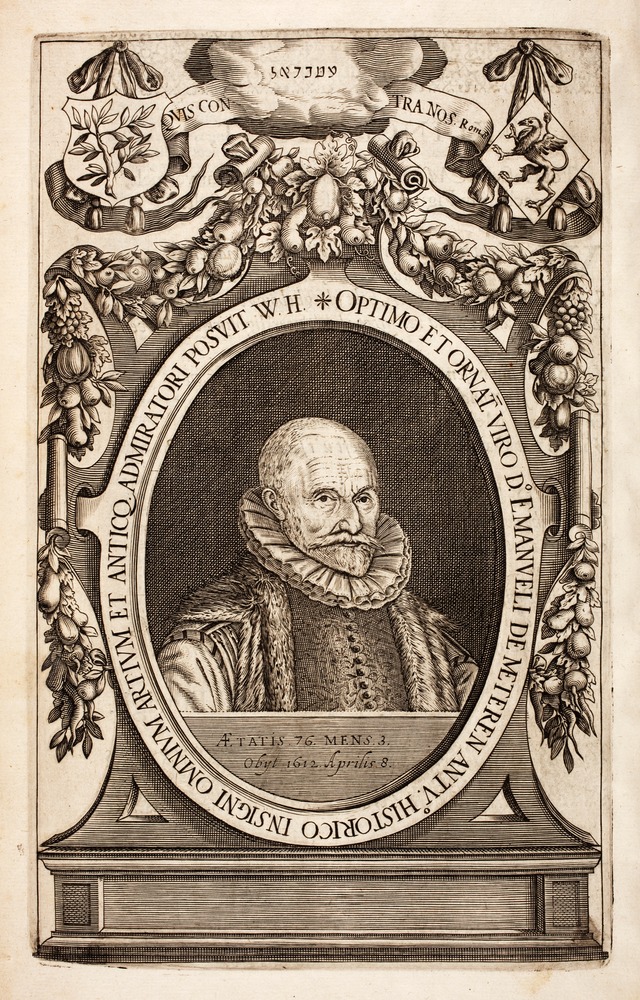
Title page, Emanuel van Meteren, Historien der Nederlanden, 1614
At sea there was a consultation held at which there was a diversity of opinion. The mate, who was a Dutchman, thought that they ought to go and winter in Newfoundland, and seek for the Northwest passage through Davis’ Straits. The master, Hudson, was opposed to this; he feared his crew would mutiny, because at times they had boldly menaced him, and also because they would be entirely overcome by the cold of winter, and be, after all, obliged to return with many of the crew weak and sickly. No one, however, spoke of returning home to Holland, which gave cause of further suspicion to the master. Consequently, he proposed that they should go and winter in Ireland, to which they all agreed, and at length arrived, November 7th, at Dartmouth in England. From this place they sent an account of their voyage to their masters in Holland, proposing to go in search of a passage to the Northwest if they were furnished with fifteen hundred guilders in money to buy provisions, in addition to their wages and what they had in the ship. He wished to have some six or seven of his crew changed, making the number up to twenty men, etc., and to sail from Dartmouth about the first of March, in order to be at the Northwest by the end of that month, and there pass the month of April and half of May in killing whales and other animals in the neighborhood of the isle of Panar; from there to go toward the Northwest….
 gothamhistory