 Petrus Stuyvesant, a native of Friesland, had formerly been director of the Company’s colony at Curapoa, whence, having lost a leg in an attack on the Portuguese settlement at Saint Martin’s, he had been obliged to return to Europe for surgical aid…. [He] replaced his leg by a wooden one with silver bands, which gave rise to [the nickname “Old Silver Nails” and] the tradition that he wore a silver leg….”
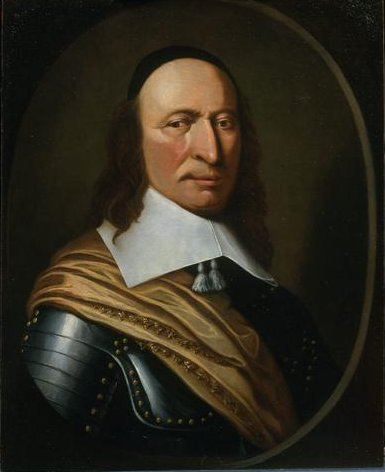
Peter Stuyvesant
The portrait (owned by the New-York Historical Society) … is half-length and therefore does not record which of Pieter’s legs was the “silver leg.” [Long thought to be a Rembrandt, it is now attributed to Hendrick Couturier.] This was a mystery, even to his remote descendants, for some two centuries, until, in 1926, Victor H. Paltsits, historian and linguist, read a group of Dutch versified manuscript letters, written to Stuyvesant by his English friend Johan Farret. Therein is a playful allusion to the amputation and burial in Curacao of Pieter’s right leg.
“Old Silver Nails,” from History of the City of New York, by Mary L. Booth, 1867.
***
PETER STUYVESANT Letter to the Dutch Towns on Long Island.
Honorable, Dear, Faithful:
You as well as we can sufficiently infer from the arrival of the English frigates at the Narrows, of some ships with ammunition and provisions at Hellgate, as well as from the arming of the English both on the Mainland and on Long Island and other places, that this Capital is the object aimed at, which if lost, all is lost, there being no other place capable of offering any resistance. It is, therefore, requisite and in the highest degree necessary, that it should be protected and defended with all possible might and main; for the better effecting and accomplishing of this purpose, you are hereby earnestly required and requested to act in this most critical conjuncture as faithful subjects of the High and Mighty the Lords States General and the Honorable the Directors of the Incorporated West India Company are bound and ought to do, and to reinforce us with every third man from your town.
Relying thereupon, we, after cordial salutation, &c.
Fort Amsterdam in New Netherland,
28th August, 1664.
Their answer:
Honorable, Most Wise, Right Honorable, the Director-General and Council of New Netherland:
Having received your Honors’ letter, and the same, with the request made in great friendship, being read to us by the Schout and Schepens, we unanimously answer, that it is impossible for us to comply with it, as we ourselves are living here on the Flatland without any protection and must leave wives and children seated here in fear and trembling, which our hearts would fail to do. And, moreover, the English are themselves hourly expected; ignorant of what we have to expect from them ; not sure either of life or property, we yet heartily wish it were in our power to assist your Honors.
Herewith ending, we wish your Honors the gracious protection of the Most High and a favorable peace and prosperous government unto salvation. Furthermore, commending ourselves to your Honors’ good favor, we shall be and remain,
Right Honorable,
Your subjects and servants,
The Court and Commonalty of the town of Midwout
***

Asher Durand’s “Dance on the Battery in the Presence of Peter Stuyvesant.”
RESOLUTION TO EXEMPT THE JEWS FROM MILITARY SERVICE, the Burgher Council (1655)
August 28, 1655.
The Captains and officers of the trainbands of this City baring asked the Director General and Council, whether the Jewish people, who reside In this City, should also train and mount guard with the Citizens’ bands, this was taken in consideration and deliberated upon: first the disgust and unwillingness of these trainbands to be fellow-soldiers with the aforesaid nation and to be on guard with them in the same guard house and on the other side, that the said nation was not admitted or counted among the citizens, as regards trainbands or common citizens’ guards neither in the Illustrious City of Amsterdam nor (to our knowledge) in any city in Netherland; but in order that the said nation may honestly be taxed for their freedom in that respect. It is directed by the Director General and Council, to prevent further discontent, that the aforesaid nation shall, according to the usages of the renowned City of Amsterdam, remain exempt from the general training and guard duty, on condition that each male person over sixteen and under sixty years contribute for the aforesaid freedom towards the relief of the general municipal taxes sixty five stivers* every month and the military council of the citizens is hereby authorized and charged to carry this into effect until our further orders and to collect pursuant to the above the aforesaid contribution once in every month and in case of refusal to collect it by legal process. Thus done in Council at Fort Amsterdam, on the day as above. [It was signed:]
P. Stuyvesant, Nicasius de Sille, Cornelius Van Tienhoven
—Col. Docs, N.Y., xii. 96.
FROM: Ecclesiastical Records, State of New York, 1901.
***
HENRICUS SELYNS, First Dominie of Breuckelen
EPITAPH ON GOVERNOR STUYVESANT. —The last volume of the Bradford Club has, among the poems of Domine Henricus Selyns, this epitaph on Stuyvesant:
Graafschrift Voor Petrus Stuyvesant, Gewesen Generael van Niew Nederlandt
Stuyft niet te seer en’t sandt, want daer legt Stuyvesant
Die eerst was ‘t opperhooft van gantsch Niew Nederlandt
En gaf met wil of geen het landt den vyandt over
So naween en berouw treft ¡emans hert syn hert
Stierf duysentmaal, en droog onlydelycke smert,
In’ t eerste al to ryck, op ‘t laaste al te pover.

Petrus Stuyvesant vault cover, St. Mark’s Church in-the-Bowery
Thus translated by the accomplished Mr. Murphy, to whom the old poets of the colony are indebted for the laurels now so tardily placed on their brows [Stuyvesant translates as “shifting sand”]:
Stir not the sand too much, for there lies Stuyvesant,
Who erst commander was of all New Netherland;
Freely or no, unto the foe, the land did he give over.
If grief and sorrow any hearts do smite, his heart
Did die a thousand deaths, and undergo a smart
Insuff’rable. At first, too rich; at last, too pauvre.
FROM: The Historical Magazine and Notes and Queries Concerning the Antiquities, History and Biography of America. January 1865.
 gothamhistory