
This is the first guest column at Gotham History, and I can think of no one I could be happier to welcome than my friend of some 35 years, Vernon Benjamin. This year he published a work two decades in the making, the indispensable The History of the Hudson River Valley: From Wilderness to the Civil War. The story below is excerpted from its sequel, The History of the Hudson River Valley: 1865-2015, forthcoming from Overlook Press in 2016.
In politics, in religion, in economics, in sociology, everything seems to be out of date, and is being re-examined! . . . Nothing is safe—nothing is sacred from the clamor of the reformers, from the outcry of the radicals, from the intrusion of the iconoclasts. . . .
–Seymour Van Santvoord, Troy, February 2, 1924
Modern times in the Hudson River Valley officially began on May 29, 1910, when Glenn Curtiss (1878-1930) took off from a makeshift airport on Westerlo (Castle) Island at Albany and flew for two hours and 51 minutes to Manhattan, demonstrating the viability of long-distance air travel to the world.

Glenn Curtiss, c. 1910
Curtiss, 32, came to collect a $10,000 prize offered by the New York World for the 152-mile flight. He built his “monster violin” at his home in Hammondsport on Keuka Lake, called it the Albany Flyer, and shipped the plane by barge to Albany for the occasion. It was a curious contraption, a double set of wings covered in rubberized silk with a balloon cloth attached containing five inflatable bags and metal drums on the underside of each wing, all for flotation in case he crashed into the river.
“It was the world’s first seaplane,” historian Reed Sparling wrote, although the flotation devices were not put to the test.
Curtiss reconnoitered the river by boat to determine wind currents and find potential landing sites. His principal fear concerned the Hudson Highlands and its notorious winds. The World allowed for two stops on the route, but he thought he could make the flight with just one stop for fuel. He chose a field just south of Poughkeepsie. Bad weather delayed the takeoff for three days, enough to sour the interest of thousands of onlookers who had come to see the plane. Fewer than a hundred spectators were on hand on the fated day, although downriver the audience of shoreline watchers grew sizeable with anticipation.
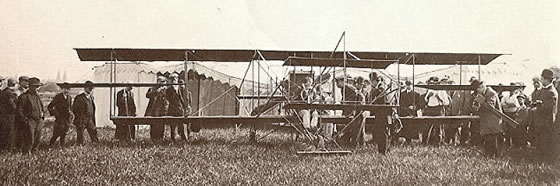
The Albany Flyer
The Poughkeepsie Daily Eagle likened the takeoff to a partridge “running to get its wings,” the noise of the aircraft even mimicking the beating of the bird’s wings. Curtiss averaged 52 miles per hour, “going like H—!” as a telegraph operator related when the plane flew over Catskill. He toyed with the idea of flying under the Poughkeepsie railroad bridge, but flew over instead and landed at his designated site. His fuel supplier failed to appear, however, so Curtiss topped off his ten-gallon fuel tank with eight gallons provided by two New Jersey motorists who were on hand for the occasion.
He had been flying at 700 feet, but rose to 2,000 for the Highlands and still experienced jolting gusts of wind that forced the craft into a 200-foot fall at one point, “the worst plunge I ever got in an aeroplane,” Curtiss later said. As cadets on the plains at West Point saluted the airman as he flew by, Curtiss mused at the ease with which he might drop bombs on them from the air.

May 29, 1910: Curtiss over West Point
An oil leak forced him to land in Manhattan just south of the Spuyten Duyvil kill, where a startled homeowner was enjoying his Sunday papers on the porch. The brief stopover turned the man’s back lawn into a “fairgrounds” as people came rushing to watch Curtiss take off for the last three miles of his journey. All Manhattan was out on the rooftops, the tugs and larger boats hooting in the bay as Curtiss flew around the Statue of Liberty and landed on Governor’s Island. Scientific American gave him a trophy for his deed.
Later that year, Molly Ahearn reported, the big event at the Dutchess County Fair in Washington Hollow was a race involving a small Curtiss biplane, piloted by Eugene Ely, and Ralph DePalma’s 45-horsepower red Fiat. The local paper called Ely “man bird” and “birdman,” but he was not that on this day. He lost all the heats to the Fiat, and on the last one crashed in a nearby field, breaking a rudder and some of his pride.
Twenty years after the Curtiss flight, four major airlines were in business (including the predecessor of American Airlines, founded by W. A. Harriman in 1929), and aviators with licenses were giving passenger rides and performing parachute jumps at ball fields and cow fields all along Curtiss’s route. LeRow Field in Westchester County (1929-38) featured parachute jumps as well as charter flights; a German chutist named Paul Wintermeyer was killed there in 1929. Eddie DeAlmo contracted with Harry Beers to run his Waco 10 plane next to the Driving Park in Saugerties in 1929. Twenty-year-old Alice Voerg (1909-90) got two rides that day, one with each of her younger brothers—her father Will refused to ride in such a contraption but did not want them to ride alone.
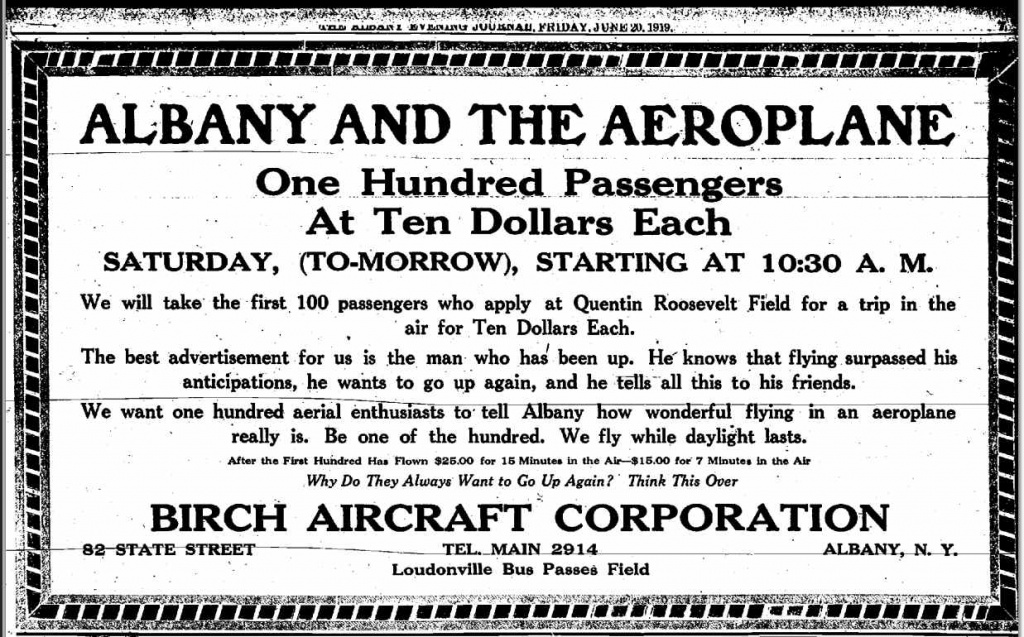
Quentin Roosevelt Field
Castle Island hosted the first important long-distance air field in America, thanks to Curtiss. The field that he used was named the Quentin Roosevelt Memorial Field after 1918 and operated until 1928. After returning from France, Colonel Charles A. Lindbergh landed the Spirit of St. Louis here on July 27, 1927, while undertaking a 22,000-mile hop-scotch across America, a feat considered even more astonishing than his Paris flight because he was never more than ten minutes late for any stop along the way.
Mayor John Boyd Thatcher II showed Lindbergh a Shaker farm on the Albany-Shaker Road where Thatcher was planning a much larger airport. The remains of Mother Ann Lee and her brother William were removed to a nearby Shaker cemetery when the construction began in the following year. The Albany Municipal Airport opened as a mail run on June 1, 1928, and by October passengers were flying to Montreal and Newark. Greater Albany soon expanded its water-borne footprint into the oceans of the world when the dredging of the Hudson River with a 27-foot channel as far south as Hudson allowed for the creation of the Port of Albany (1931) on 200 acres along the river in Albany and 35 in Rensselaer County.
Copyright © 2015, Vernon Benjamin.
 gothamhistory