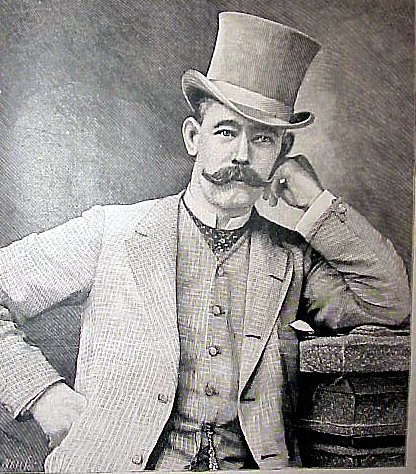
Richard K. Fox, 1883
Richard K. Fox is best known as the editor of The National Police Gazette, which he purchased in 1877, its 33rd year of publication. Fox was what was known then as a sport, and he had added sporting coverage to the venerable scandal sheet’s specialties of murder and mayhem. The weekly’s pink-sheeted parade of buxom beauties in imminent danger of the unthinkable fueled the ascent of many boys into manhood, by way of the local tonsorial parlor. Not for nothing was The Police Gazette termed the “Bible of the Barbershop.” As it surpassed the circulation of The New York Clipper in the 1880s, an editor of that publication opined: “Now the circulation of the Gazette is 140,000 per week. Fox publishes several other equally vile publications, and it is said that he prints without charge two religious papers, and doubtless draws his own conclusions on the smallness of their circulation as compared to his wicked sheets. He is a natty, round-shouldered young fellow of quick manners, shrewd and plucky. He caters to the rougher sporting element and is naturally the ‘boss’ of that class. Here is a sweet bit from one of the aforementioned “vile publications,” Coney Island Frolics: How New York’s Gay Girls and Jolly Boys Enjoy Themselves by the Sea! (1883).
There are various ways of bathing at Coney Island. You can go in at the West End, where they give you a tumble-down closet like a sentry box stuck up in the sand, or at the great hotels where more or less approach to genuine comfort is afforded. The pier, too, is fitted up with extensive bathing houses, and altogether no one who wants a dip in the briny and has a quarter to pay for it need to go without it. 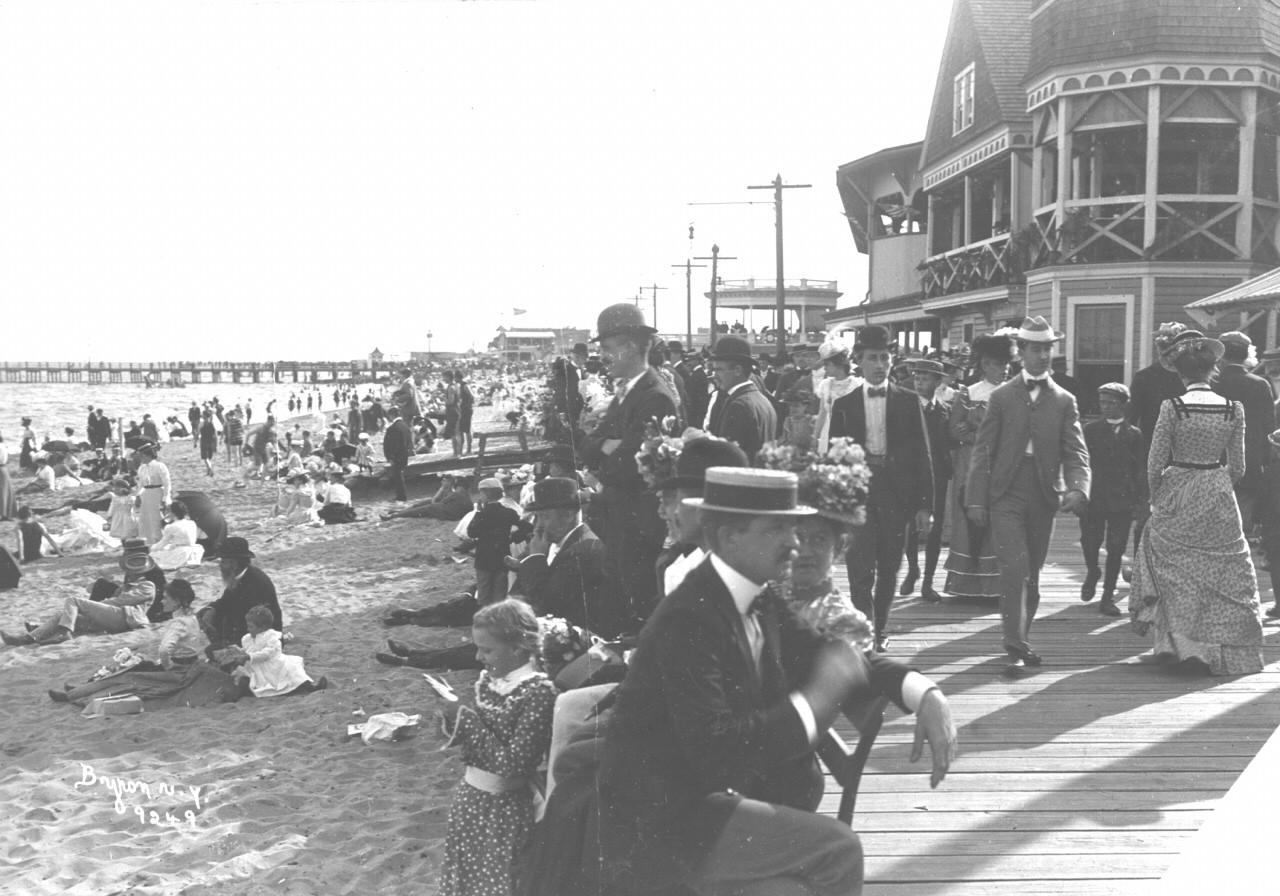 If a man is troubled with illusions concerning the female form divine and wishes to be rid of those illusions he should go to Coney Island and closely watch the thousands of women who bathe there every Sunday. A woman, or at least most women, in bathing undergoes a transformation that is really wonderful. They waltz into the bathing-rooms clad in all the paraphernalia that most gladdens the feminine heart. The hair is gracefully dressed, and appears most abundant; the face is decorated with all that elaborate detail which defies description by one uninitiated in the mysteries of the boudoir; the form is molded by the milliner to distracting elegance of proportion, and the feet appear aristocratically slender and are arched in French boots.
  Thus they appear as they sail past the gaping crowds of men, who make Coney Island a loafing place on Sundays. They seek out their individual dressing-rooms and disappear. Somewhere inside of an hour, they make their appearance ready for the briny surf. If it were not for the men who accompany them it would be impossible to recognize them as the same persons who but a little while ago entered those diminutive rooms. . . . The broad amphitheater at Manhattan Beach built at the water’s edge is often filled with spectators. Many pay admission fees to witness the feats of swimmers, the clumsiness of beginners and the ludicrous mishaps of the never-absent stout persons. Under the bathing house is a sixty horse-power engine. It rinses and washes the suits for the bathers, and its steady puffing is an odd accompaniment to the merry shouts of the bathers and the noise of the shifting crowd ashore. . . .
  A person who intends to bathe at Manhattan or Brighton Beach first buys a ticket and deposits it in a box such as is placed in every elevated railroad station. If he carries valuables he may have them deposited without extra charge in a safe that weighs seven tons and has one thousand compartments. He encloses them in an envelope and seals it. Then he writes his name partly on the flap of the envelope and partly on the envelope itself. For this envelope he receives a metal check attached to an elastic string, in order that he may wear it about his neck while bathing. This check has been taken from one of the compartments of the safe which bears the same number as the check. Into the same compartment the sealed envelope is put. When the bather returns from the surf he must return the check and must write his name on a piece of paper. This signature is compared with the one on the envelope. Should the bather report that his check has been lost or stolen his signature is deemed a sufficient warrant for the return of the valuables. The safe has double doors in front and behind. Each drawer may be drawn out from either side. When the throng presses six men may be employed at this safe.
 gothamhistory