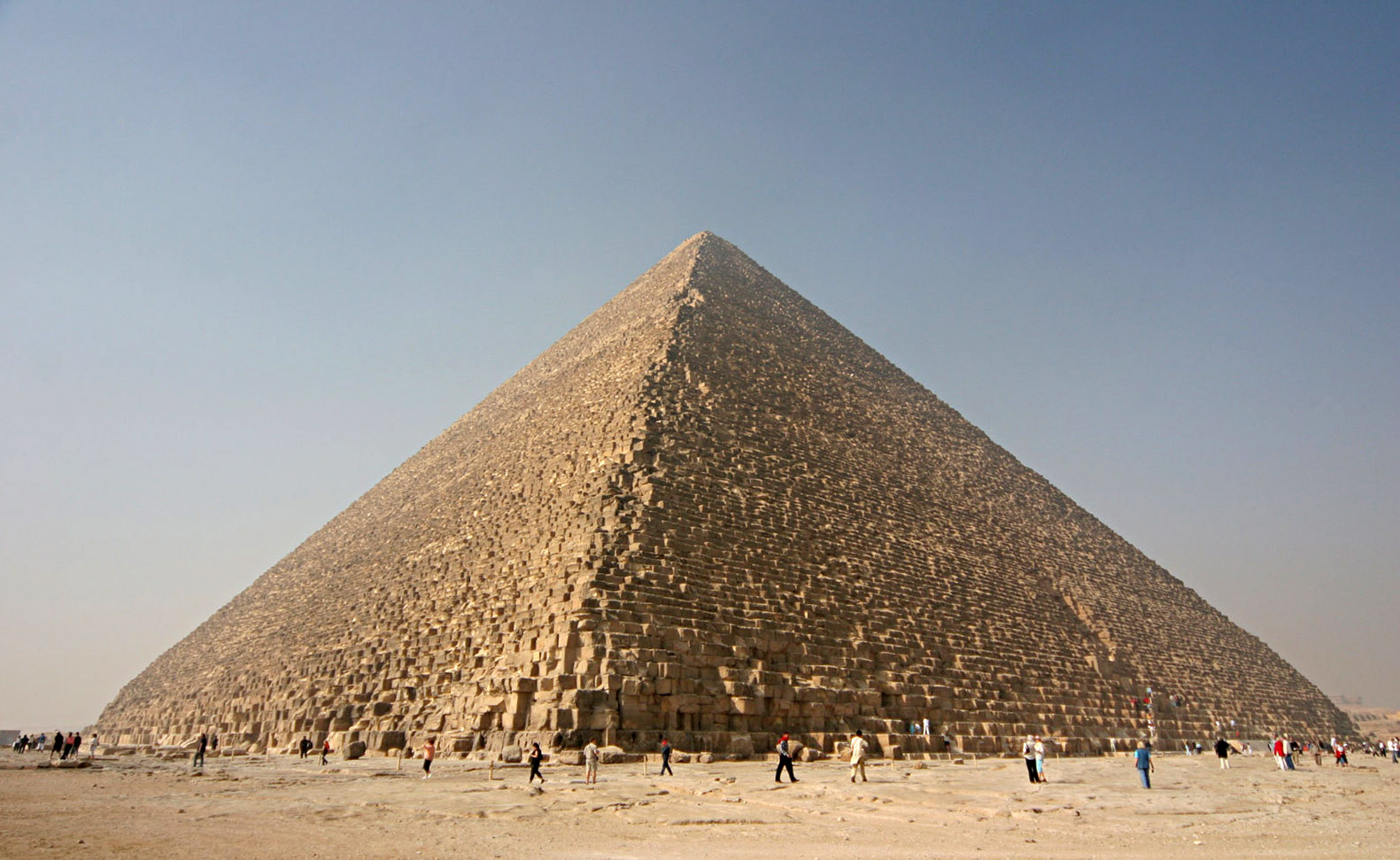
Granary
This post came to me via email this morning from Peter Feinman of the Institute of History, Archaeology, and Education, in Purchase, NY. While it is not directly about New York City history, it is about the prismatic versions of history as they come to us via, in some part, our media capital.
“In the Cold War period, there was a Soviet propaganda machine. Every day it created different lies. They would believe them and expect the world to believe them.” Ahmet Davutoghu, Prime Minister, Turkey (NYT 12/4/15)
When she left the White House, she was dead broke.
Obama is foreign-born.
Joseph built the pyramids.
She is a lifelong Yankee fan.
Obama is a Moslem.
The pyramids were granaries.
All her grandparents were immigrants.
Obama has an anti-American colonialist agenda.
Jefferson wrote the Constitution.
She made $100,000 by reading the financial pages.
Moslems in Jersey City danced in the streets in celebration of the attack on 9/11.
China is in Syria.
She was shot at on the tarmac.
Murdered white people primarily are killed by blacks.
Her loving husband was stalked by a loony-toon.
Bill Gates can “close up” the internet.
She wanted the convenience of one electronic device.
So many Union and Confederate soldiers died at the river by the 14th hole of his golf course that it became known as “The River of Blood.”
I’m qualified to be president.
All of these items are true. In Hillaryland. In Trumptown. In Carson City. None of them are true in the real world. None of that matters to Rodhamites. None of that matters to Trumpies. None of that matters to Carsonists. Why not? What is going on?
The killing of Bin Laden in Pakistan by a United States Navy SEAL team had to
have been faked, because the Qaeda leader was not even in Pakistan according to
Pakistani television host and commentator Zaid Hamid (NYT 12/17/15).

Osama Bin Laden
We are a storytelling species. Our stories exist not by chance but with purpose. On one level stories may seem like entertaining yarns that help us to pass the time of day in a enjoyable way. On another level, they are the glue that holds individuals, families, nations, religions, and humanity together. A people, a nation, or a religion without stories to tell or the means to tell them is a people, nation, or religion doomed to the dustbin of history. We cannot survive without them without losing our sanity.
One key story we tell over and over again throughout time and across the planet is the most basic and simple of ones. It is the story of fight or flight that so dominates our reactions to phenomena in nature. Are you friend or are you foe? The need to decide is quick since one’s life may hang in the balance.
This story becomes generalized into another either/or story of the one between the forces of light and the forces of darkness – the story of the triumph over adversity, the story of victory against the odds, the story of success where death and defeat stared us in the face. The stories take various forms and shapes depending on time, place, and culture but they all share basic characteristics because we are all human beings living on the planet earth. From Gilgamesh to Katniss Everdeen, from the Exodus to Frodo, from the Book of Revelation to Star Wars, we sing the song that we shall overcome someday and that the world will be a better place for this.
Sometimes, such faith in the future is more difficult to sustain. A recent article begins with “‘Get off of my plane,’ growls the president of the United States to a terrorist hijacker in the 1997 movie ‘Air Force One,’ before snapping the enemy’s neck and shoving him out the cargo door” (“Skittish Over Terrorism, Some Voters Seek a Gutsy Style of Leader,” NYT 12/3/15). This is a great scene of triumph pre-9/11 that enables us to feel good again for its money we had and peace we lacked. We enjoy that scene and the one when the bad guy is gunned down just as he thinks he is leaving the Russian prison to wreak havoc on the world. Gotcha, you son of a bitch. We defeated you in the heavens and we defeated you on the ground.
The same scenario plays out in “Independence Day,” also cited in the article (sequel coming soon to a theater near you). Once again, a president rises to the occasion demonstrating the right stuff to go into the arena and emerge victorious having kept us safe from the alien threat. There is a stirring speech on the ground and then the president takes to air because that is where he belongs. Once again the forces of darkness are defeated in the heavens and on the earth. The mother ship explodes and “Joe America” pounds the daylights out of one alien who crash-landed. Get off of my planet.
As the article notes, our cerebral President, who is an American-born Christian, lacks the right stuff to make us feel safe at the visceral level. He didn’t campaign to be commander in-chief and leader of the free world nor did we want such a president then. Times have changed. “We haven’t heard a lot about Ronald Reagan’s city on a hill” commented Hugh Hewitt in the recent Republican presidential debate.
Jessica Stern, co-author of ISIS: The State of Terror, wrote: “We are not used to living [amid] such bewildering uncertainty… We feel vulnerable in many different places where we used to feel safe….” (“How Terror Hardens Us,” NYT 12/6/15).
In such times of uncertainty we are more likely to grasp for straws. Maria Konnikova, author of The Confidence Game: Why We Fall For It… Every Time, writes about “a deep need to believe in a version of the world where everything really is for the best – at least when it comes to us” (NYT 12/6/15). Or as Daniel Sullivan, a professional cult infiltrator, said, “When people want to believe what they want to believe, they are very hard to dissuade….(H)uman nature is wired toward creating meaning out of meaningless.” The much-reviled Common Core asks teachers through the use of primary sources to inspire curiosity, to form and craft arguments, to construct knowledge based on our evaluations and to communicate the conclusions. No wonder there is such opposition to it, that is exactly what presidential candidates and their cult followers don’t do.
The more uncertain the times, the more the denial of the truth. The more uncertain the times, the more effective the skilled con artist in exploiting the frailties of an individual. The more uncertain the times the more willing we are to accept truthiness as the standard. Nobody thinks they are joining a cult according to Daniel Sullivan but Rodhamites, Trumpies, and Carsonists have drunk the kool aid. “Tell me the story I want to hear. Who cares about anything else?”
“Trump’s supporters don’t particularly care whether he’s lying or not. Our brain
doesn’t really care…. All of us, Republicans, Democrats, we are all afflicted with
this inclination to believe what we believe, and it doesn’t matter what the facts
say …. we don’t want the truth. We want our version of the truth.” (Rick
Shenkman, editor of History News Network, in “Your Brain Is Hard-
Wired to Love Trump,” Politico, 12/16/15,
http://www.politico.com/magazine/story/2015/12/donald-trump-2016-evolutionary-psychology-213444
History pays a price for this. The study of history is not immune from the surrounding cultural experiences. The image of the ivory tower scholar is a myth in its own right. What we want now in history is the story that makes us feel good.

“There is an endless controversy about whether the Americans ever reached the
Moon with the Apollo spacecraft,” wrote blogger Vitaly Egorov, one the founders
of a crowdfunded Moon mission organized by Russian engineers (“Proving the
Moon Landing, One Ruble at a Time,” Russia Beyond the Headlines, 11/25/15).
Consider the current situation at Amherst College. The issue is Lord Jeffrey Amherst after whom the college in named. During the American Revolution, this British commander championed what today would be considered germ warfare. Here it’s not just a flag or a monument but the very identity of the college itself that is called into question. The college has become another battlefront in the war of identity politics that continues to divide the country into ever smaller fragments at war with each other. The Amherst controversy led to a response from an alum from 1965, the time when all was calm and peaceful on college campuses: “The trouble is that diversity in and of itself doesn’t really do anybody much good if separate little groups come to Amherst to study their own particular points of interest and they don’t talk to each other. As alumni, many of us have tried to encourage the college to try to bring common intellectual ground, so when you leave college, you leave not just with nostalgia and friendship, but with sense of common intellectual interest” (Paul Roxin, quoted in “With Diversity Comes Intensity in Amherst Free-Speech Debate,” NYT 11/29/15). To many alumni, the goal of the protesters is to erase history and not to understand it. “We sterilize history by eliminating the mascot [Lord Jeff]…We’re not proud of the story. But we live with history unaltered, to avoid repeating it,” posted William H. Scott.
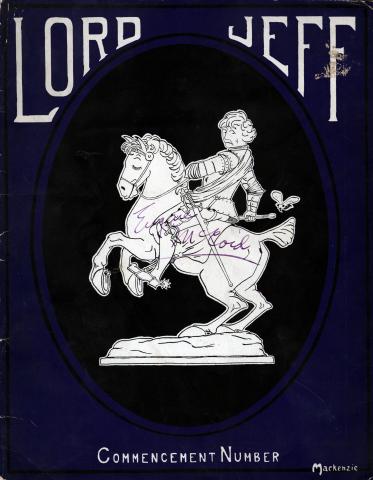
Lord Jeff, Issue 1, June 1920, Amherst
What’s so great about having a common intellectual interest at a college anyway? We’re not one college. Why should Americans share a common national narrative? We’re not one country. Why should a local history museum tell a shared story of the area from the Ice Age to Global Warming? We’re not one community. Why can’t there be separate histories for each group? Shouldn’t history museums tailor their stories to each identity group the way politicians do? Shouldn’t every group have their own story that makes them happy? Shouldn’t slavery exhibits be banished or require trigger warnings because precious child of all ages will be traumatized if they see them? If presidential candidates can lie, fabricate, have no curiosity, and be superficial, shouldn’t history museums be able to do the same?
We are not the first to raise such questions. Psychologist Seymour Epstein said, “It is no accident that the Bible, probably the most influential Western book of all times, teaches through parables and stories and not through philosophical discourse.” One such story is of the Tower of Babel. Once upon a time everyone spoke the same language. Then they didn’t. Creating a shared narrative was no longer possible. Getting a mixed multitude to enter into a covenant was a challenge. Getting a melting pot to constitute itself as a people is an ongoing ordeal.
In American history there was a time when we divided, when people read the same source documents and derived opposite conclusions, when hundreds of thousands died, and when the united States weren’t the United States. Our president spoke of malice towards none, words no presidential candidate would dare utter today. Our president spoke of what “our fathers” had brought forth four-score and seven years earlier, sentiments no presidential candidate would dare express today. Our president spoke of the world little noting and not long remembering what we say here, words that certainly apply to our presidential candidates today who don’t dare utter the name Lincoln.

Hamilton on Broadway
Strangely enough the one person on the national level who has dared to embrace the message of Lincoln isn’t a politician but an artist, Lin-Manuel Miranda whom I first wrote about in April 2012. With Lincoln at Gettysburg, the American Revolution was reborn. Now with Hamilton it has been reborn again. Miranda has demonstrated the curiosity, research, and honesty in his biography and storytelling that is missing from the candidates with their algorithms that target us by our hyphens. Candidates may see his show but they don’t express his vision. So to the history museums located throughout the communities of this country, when you think of the shared narrative to tell about your community and our country, think of Hamilton and not our presidential candidates.
San Bernadino Syed Rizwan Farook and Tashfeen Malik clearly were executed in
order to blame Pakistan for the crime. They were handcuffed and sitting in their
car when the police killed them according to Pakistani television host and
commentator Zaid Hamid (NYT 12/17/15).
 gothamhistory