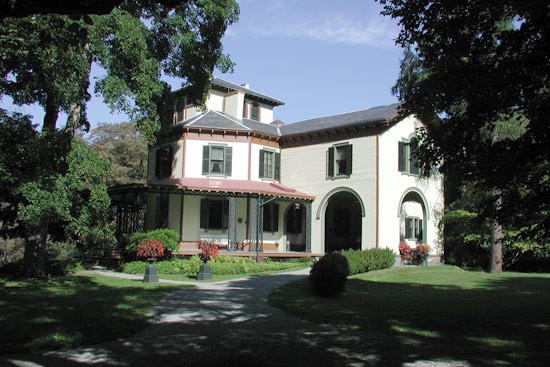
Alexander Jackson Davis, Picturesque American

An old story, reawakened by social media posts

Oliver Bronson House in Hudson, NY (2016); photo, Adam Tarsia

Should History Museums Be Held to a Higher Standard than Presidential Candidates?

Granary

Granary

This post came to me via email this morning from Peter Feinman of the Institute of History, Archaeology, and Education, in Purchase, NY. While it is not directly about New York City history, it is about the prismatic versions of history as they come to us via, in some part, our media capital.

“In the Cold War period, there was a Soviet propaganda machine. Every day it created different lies. They would believe them and expect the world to believe them.” Ahmet Davutoghu, Prime Minister, Turkey (NYT 12/4/15)

When she left the White House, she was dead broke.
Obama is foreign-born.
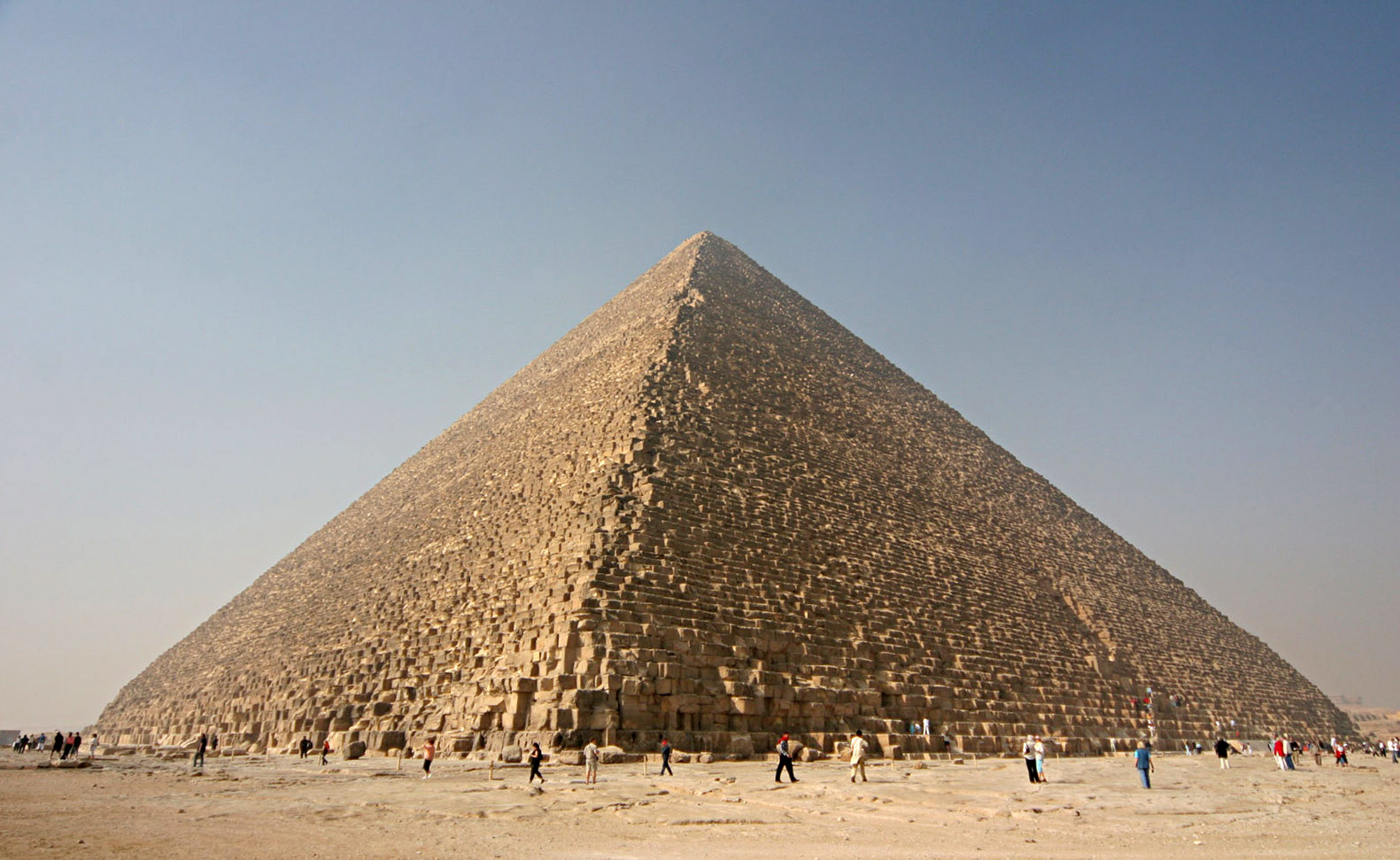
Joseph built the pyramids.
She is a lifelong Yankee fan.
Obama is a Moslem.
The pyramids were granaries.
All her grandparents were immigrants.
Obama has an anti-American colonialist agenda.
Jefferson wrote the Constitution.
She made $100,000 by reading the financial pages.
Moslems in Jersey City danced in the streets in celebration of the attack on 9/11.
China is in Syria.
She was shot at on the tarmac.
Murdered white people primarily are killed by blacks.
Her loving husband was stalked by a loony-toon.
Bill Gates can “close up” the internet.
She wanted the convenience of one electronic device.
So many Union and Confederate soldiers died at the river by the 14th hole of his golf course that it became known as “The River of Blood.”
I’m qualified to be president.

All of these items are true. In Hillaryland. In Trumptown. In Carson City. None of them are true in the real world. None of that matters to Rodhamites. None of that matters to Trumpies. None of that matters to Carsonists. Why not? What is going on?

The killing of Bin Laden in Pakistan by a United States Navy SEAL team had to
have been faked, because the Qaeda leader was not even in Pakistan according to
Pakistani television host and commentator Zaid Hamid (NYT 12/17/15).

Osama Bin Laden

Osama Bin Laden

We are a storytelling species. Our stories exist not by chance but with purpose. On one level stories may seem like entertaining yarns that help us to pass the time of day in a enjoyable way. On another level, they are the glue that holds individuals, families, nations, religions, and humanity together. A people, a nation, or a religion without stories to tell or the means to tell them is a people, nation, or religion doomed to the dustbin of history. We cannot survive without them without losing our sanity.

One key story we tell over and over again throughout time and across the planet is the most basic and simple of ones. It is the story of fight or flight that so dominates our reactions to phenomena in nature. Are you friend or are you foe? The need to decide is quick since one’s life may hang in the balance.

This story becomes generalized into another either/or story of the one between the forces of light and the forces of darkness – the story of the triumph over adversity, the story of victory against the odds, the story of success where death and defeat stared us in the face. The stories take various forms and shapes depending on time, place, and culture but they all share basic characteristics because we are all human beings living on the planet earth. From Gilgamesh to Katniss Everdeen, from the Exodus to Frodo, from the Book of Revelation to Star Wars, we sing the song that we shall overcome someday and that the world will be a better place for this.

Sometimes, such faith in the future is more difficult to sustain. A recent article begins with “‘Get off of my plane,’ growls the president of the United States to a terrorist hijacker in the 1997 movie ‘Air Force One,’ before snapping the enemy’s neck and shoving him out the cargo door” (“Skittish Over Terrorism, Some Voters Seek a Gutsy Style of Leader,” NYT 12/3/15). This is a great scene of triumph pre-9/11 that enables us to feel good again for its money we had and peace we lacked. We enjoy that scene and the one when the bad guy is gunned down just as he thinks he is leaving the Russian prison to wreak havoc on the world. Gotcha, you son of a bitch. We defeated you in the heavens and we defeated you on the ground.

The same scenario plays out in “Independence Day,” also cited in the article (sequel coming soon to a theater near you). Once again, a president rises to the occasion demonstrating the right stuff to go into the arena and emerge victorious having kept us safe from the alien threat. There is a stirring speech on the ground and then the president takes to air because that is where he belongs. Once again the forces of darkness are defeated in the heavens and on the earth. The mother ship explodes and “Joe America” pounds the daylights out of one alien who crash-landed. Get off of my planet.

As the article notes, our cerebral President, who is an American-born Christian, lacks the right stuff to make us feel safe at the visceral level. He didn’t campaign to be commander in-chief and leader of the free world nor did we want such a president then. Times have changed. “We haven’t heard a lot about Ronald Reagan’s city on a hill” commented Hugh Hewitt in the recent Republican presidential debate.

Jessica Stern, co-author of ISIS: The State of Terror, wrote: “We are not used to living [amid] such bewildering uncertainty… We feel vulnerable in many different places where we used to feel safe….” (“How Terror Hardens Us,” NYT 12/6/15).

In such times of uncertainty we are more likely to grasp for straws. Maria Konnikova, author of The Confidence Game: Why We Fall For It… Every Time, writes about “a deep need to believe in a version of the world where everything really is for the best – at least when it comes to us” (NYT 12/6/15). Or as Daniel Sullivan, a professional cult infiltrator, said, “When people want to believe what they want to believe, they are very hard to dissuade….(H)uman nature is wired toward creating meaning out of meaningless.” The much-reviled Common Core asks teachers through the use of primary sources to inspire curiosity, to form and craft arguments, to construct knowledge based on our evaluations and to communicate the conclusions. No wonder there is such opposition to it, that is exactly what presidential candidates and their cult followers don’t do.

The more uncertain the times, the more the denial of the truth. The more uncertain the times, the more effective the skilled con artist in exploiting the frailties of an individual. The more uncertain the times the more willing we are to accept truthiness as the standard. Nobody thinks they are joining a cult according to Daniel Sullivan but Rodhamites, Trumpies, and Carsonists have drunk the kool aid. “Tell me the story I want to hear. Who cares about anything else?”

“Trump’s supporters don’t particularly care whether he’s lying or not. Our brain
doesn’t really care…. All of us, Republicans, Democrats, we are all afflicted with
this inclination to believe what we believe, and it doesn’t matter what the facts
say …. we don’t want the truth. We want our version of the truth.” (Rick
Shenkman, editor of History News Network, in “Your Brain Is Hard-
Wired to Love Trump,” Politico, 12/16/15,
http://www.politico.com/magazine/story/2015/12/donald-trump-2016-evolutionary-psychology-213444

History pays a price for this. The study of history is not immune from the surrounding cultural experiences. The image of the ivory tower scholar is a myth in its own right. What we want now in history is the story that makes us feel good.

NASA, photo ID as15-88-11863

“There is an endless controversy about whether the Americans ever reached the
Moon with the Apollo spacecraft,” wrote blogger Vitaly Egorov, one the founders
of a crowdfunded Moon mission organized by Russian engineers (“Proving the
Moon Landing, One Ruble at a Time,” Russia Beyond the Headlines, 11/25/15).

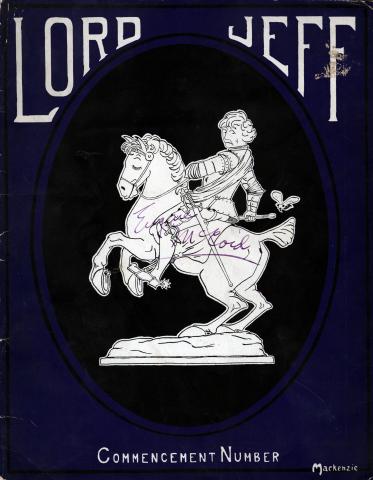
Consider the current situation at Amherst College. The issue is Lord Jeffrey Amherst after whom the college in named. During the American Revolution, this British commander championed what today would be considered germ warfare. Here it’s not just a flag or a monument but the very identity of the college itself that is called into question. The college has become another battlefront in the war of identity politics that continues to divide the country into ever smaller fragments at war with each other. The Amherst controversy led to a response from an alum from 1965, the time when all was calm and peaceful on college campuses: “The trouble is that diversity in and of itself doesn’t really do anybody much good if separate little groups come to Amherst to study their own particular points of interest and they don’t talk to each other. As alumni, many of us have tried to encourage the college to try to bring common intellectual ground, so when you leave college, you leave not just with nostalgia and friendship, but with sense of common intellectual interest” (Paul Roxin, quoted in “With Diversity Comes Intensity in Amherst Free-Speech Debate,” NYT 11/29/15). To many alumni, the goal of the protesters is to erase history and not to understand it. “We sterilize history by eliminating the mascot [Lord Jeff]…We’re not proud of the story. But we live with history unaltered, to avoid repeating it,” posted William H. Scott.

Lord Jeff Issue 1, June 1920, Amherst

Lord Jeff, Issue 1, June 1920, Amherst

What’s so great about having a common intellectual interest at a college anyway? We’re not one college. Why should Americans share a common national narrative? We’re not one country. Why should a local history museum tell a shared story of the area from the Ice Age to Global Warming? We’re not one community. Why can’t there be separate histories for each group? Shouldn’t history museums tailor their stories to each identity group the way politicians do? Shouldn’t every group have their own story that makes them happy? Shouldn’t slavery exhibits be banished or require trigger warnings because precious child of all ages will be traumatized if they see them? If presidential candidates can lie, fabricate, have no curiosity, and be superficial, shouldn’t history museums be able to do the same?

We are not the first to raise such questions. Psychologist Seymour Epstein said, “It is no accident that the Bible, probably the most influential Western book of all times, teaches through parables and stories and not through philosophical discourse.” One such story is of the Tower of Babel. Once upon a time everyone spoke the same language. Then they didn’t. Creating a shared narrative was no longer possible. Getting a mixed multitude to enter into a covenant was a challenge. Getting a melting pot to constitute itself as a people is an ongoing ordeal.

In American history there was a time when we divided, when people read the same source documents and derived opposite conclusions, when hundreds of thousands died, and when the united States weren’t the United States. Our president spoke of malice towards none, words no presidential candidate would dare utter today. Our president spoke of what “our fathers” had brought forth four-score and seven years earlier, sentiments no presidential candidate would dare express today. Our president spoke of the world little noting and not long remembering what we say here, words that certainly apply to our presidential candidates today who don’t dare utter the name Lincoln.

Original Broadway production of Hamilton

Hamilton on Broadway

Strangely enough the one person on the national level who has dared to embrace the message of Lincoln isn’t a politician but an artist, Lin-Manuel Miranda whom I first wrote about in April 2012. With Lincoln at Gettysburg, the American Revolution was reborn. Now with Hamilton it has been reborn again. Miranda has demonstrated the curiosity, research, and honesty in his biography and storytelling that is missing from the candidates with their algorithms that target us by our hyphens. Candidates may see his show but they don’t express his vision. So to the history museums located throughout the communities of this country, when you think of the shared narrative to tell about your community and our country, think of Hamilton and not our presidential candidates.

San Bernadino Syed Rizwan Farook and Tashfeen Malik clearly were executed in
order to blame Pakistan for the crime. They were handcuffed and sitting in their
car when the police killed them according to Pakistani television host and
commentator Zaid Hamid (NYT 12/17/15).

Pirates of New York: Captain Kidd

Rackaham, KiddLast week, in reviewing the long, strange trip of the Saugerties Bard from anonymity to celebrity and back again, we devoted considerable space to Albert W. Hicks, the “pirate” (or at least nautical brigand) whose execution in 1860 took place at the Bedloe’s Island, current site of the Statue of Liberty. Reflecting on Hicks and especially his sad end has set to me thinking about other notable pirates of New York, and the first name that springs to mind is that of Captain William Kidd (1645-1701), who, like Hicks, was executed, though not in New York, where he maintained a residence through the 1690s. What follows is an impressionistic portrait of the man hanged as a murdered yet honored as a government-sponsored privateer and as a the contributor, according to historical records, of the runner and tackle from his ship for hoisting stones in the construction of Trinity Church in 1698.thorn_ourgame

Ferdinand S. Bartram wrote in 1888 (Retrographs: Comprising a history of New York City prior to the Revolution; Biographies of George Washington, Alexander Hamilton, Nathan Hale; Sketches of John Andre and Beverly Robinson; Schemes of Aaron Burr, Benedict Arnold. New York: Yale Publishing Company, 1888.):

“The history, in detail, of the governmental administration of affairs of the city of New York during the first one hundred years presents a pitiful record of inefficiencies, inconsistencies, extortions and corruptions that seem almost incredible of belief. This was a fruitful field for unprincipled speculators, foreign and domestic, and of rapacious villains, private and official. It was the scene of constant and interminable disputes, disorders, of acts of lawlessness, of brutalities and horrors of every conceivable description, such as had never before fallen to the lot of any other people upon this hemisphere to witness and endure, and the end was not yet.

“The whole coast was now infested with pirates, who were capturing ships and burning them, thus threatening destruction to their commerce, which was their principal means of sustenance. Petitions, protests and entreaties availed nothing: the Government officials were suspected of being parties to, or participants of, the spoils, even to the Governor, who was at last recalled.

Captain Kidd in New York Harbor, by Jean Leon Gerome Ferris

Captain Kidd in New York Harbor, by Jean Leon Gerome Ferris

“In 1695 Lord Bellamont was appointed, but did not assume authority until nearly three years afterward, during which time piracy reigned supreme upon the ocean, and anarchy and poverty again invaded the city. When he did arrive, the British Government was implored to furnish a naval force to scour the seas and exterminate piracy, but a war with France was then in progress and all its vessels were needed for the coast defense of England. Governor Bellamont finally organized a stock company which fitted out a privateering expedition, consisting of five ships, carrying sixty men and thirty guns, entrusting the command to one Captain William Kidd, who had been recommended by some of the most eminent citizens, Robert Livingston among others. Kidd had a wife and child, resided in Liberty Street, and was regarded as capable and conscientious. His history is well known, having soon turned pirate himself and for two years continued upon a course of plunders and outrages that made all former offenders appear innocent by comparison. When it became apparent that there were few ships left to burn and plunder, he steered homeward, landing on Gardiner’s Island, where he is alleged to have buried most of his treasure, and proceeded to Boston, where he engaged in business under an assumed name, leaving his wife and child still in New York. He was at last discovered, arrested, sent to England for trial, found guilty, and hung upon May 12, 1701.”

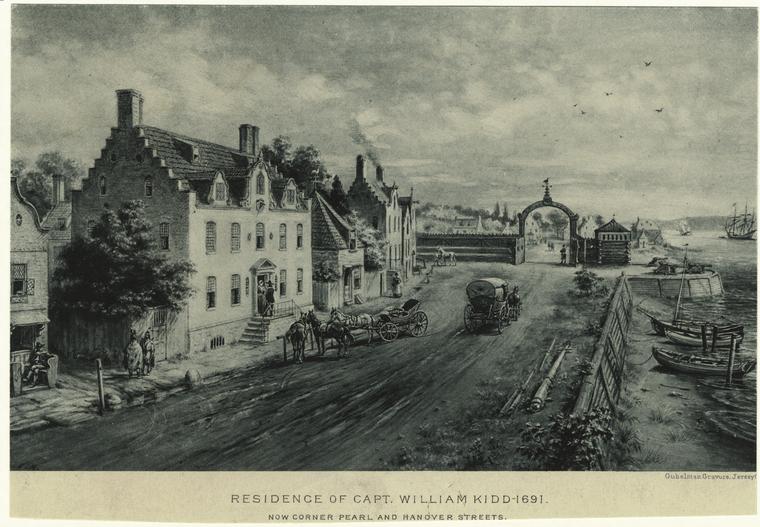
New York Residence of William Kidd and family

New York Residence of William Kidd and family

Another accounting, this one from: D.T. Valentine in his History of the City of New York, G.P. Putnam & Company, 1853.

“During the early years of the British colonial era, Great Britain was involved in a series of maritime wars with rival European powers. As part of this conflict, many leading New York City merchants operated as privateers or legally commissioned pirates whose ships attacked and looted Britain’s enemies.

“Benjamin Fletcher, the British governor of the colony, allowed the privateers open access to the port of New York in exchange for 100 Spanish dollars. The list of merchant pirates included Frederick Philipse, Nicholas Bayard (the son-in-law of Peter Stuyvesant), Stephanus Van Cortlandt and Peter Schuyler.

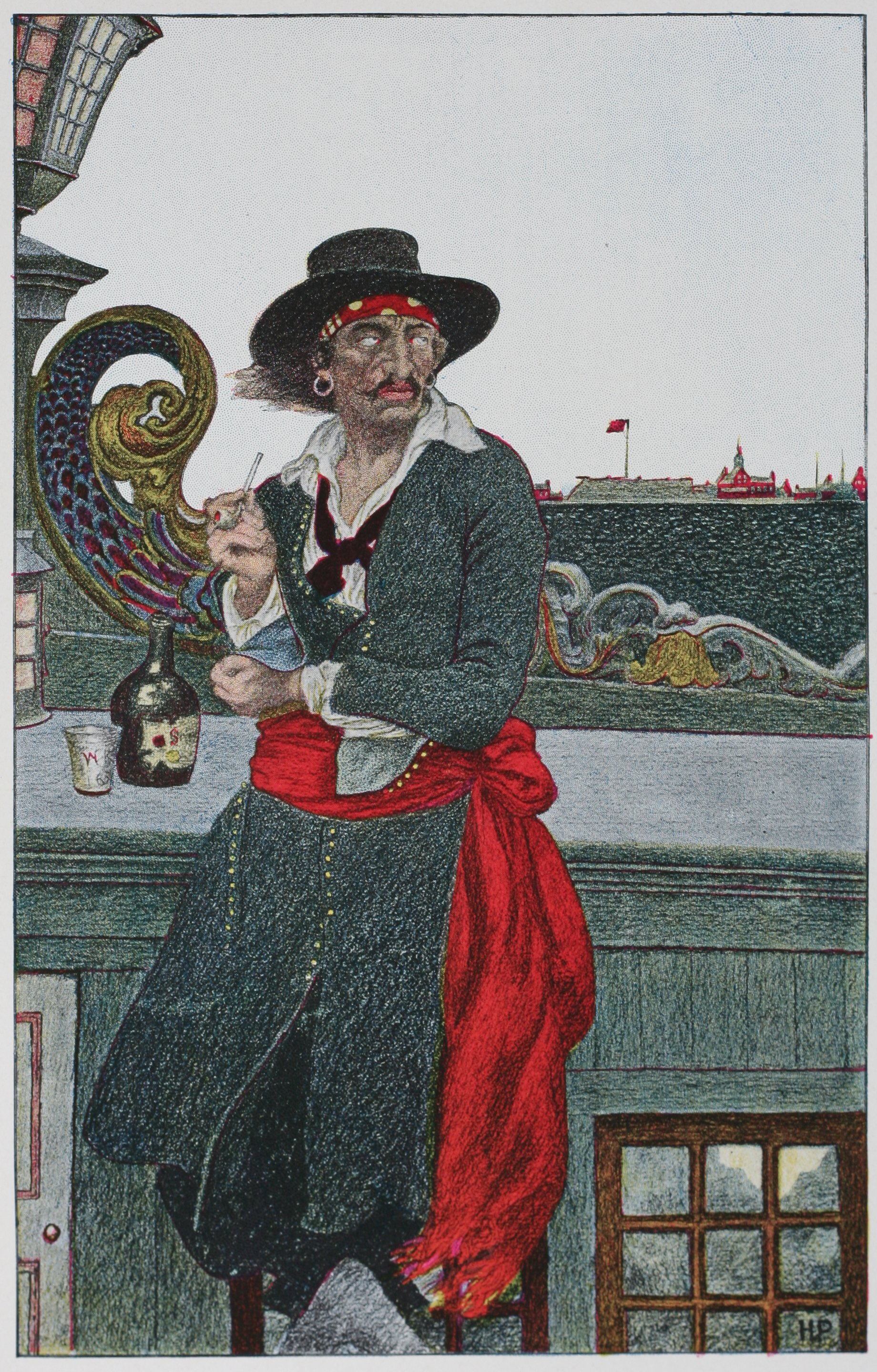
Kidd aboard his "Adventure Galley," in New York Harbor, Howard Pyle

Kidd aboard his “Adventure Galley,” in New York Harbor, Howard Pyle

“Many also were involved in the slave trade. When war broke out between Britain and France in 1688, William Kidd received a commission as a privateer from a British official in the Caribbean. In 1691 he married a wealthy local widow, settled in New York City in a house on Wall Street, and contributed to the construction of Trinity Church. In 1695, Robert Livingston and members of the local elite including Governor Bellomont helped finance a pirating expedition by Kidd to the East coast of Africa. However, by the time Kidd returned to New York in 1699, he had been abandoned by his financial supporters. Kidd was arrested and sent to London where in 1701 he was executed as a pirate.

“The slave trade being a legitimate pursuit and followed as a regular branch of foreign trade for many years, both previous and subsequent to the period now referred to, was exceedingly profitable though somewhat hazardous owing to a piratical adventurers who followed them into their remote trading places and often, as in the instance above related, robbed them of their stores and money used in the purchase of the negroes. The practice became so great a pest that efforts were made by influential merchants to induce the English ministry to assist them in fitting out a cruising vessel, properly armed. . . .

“Col. Robert Livingston of New York, an active and influential citizen, brought this matter before the English Government and introduced Captain William Kidd of New York as an efficient and well-known commander, whose fitness for such service was well understood in New York. He was a man of family and had resided in this city for several years. It was proposed to engage in this enterprise on the footing of a private adventure, although it was desirable for some purposes that the scheme should receive the official countenance of the Government. The King, Lord Somers, the Earl of Romney, the Duke of Shrewsbury, the Earl of Oxford and Lord Bellamont joined in making up the necessary expenses of a proper vessel, Col. Livingston also contributing a proportion. The profits were to be divided among the owners of the ship, allowing a liberal share to Kidd.

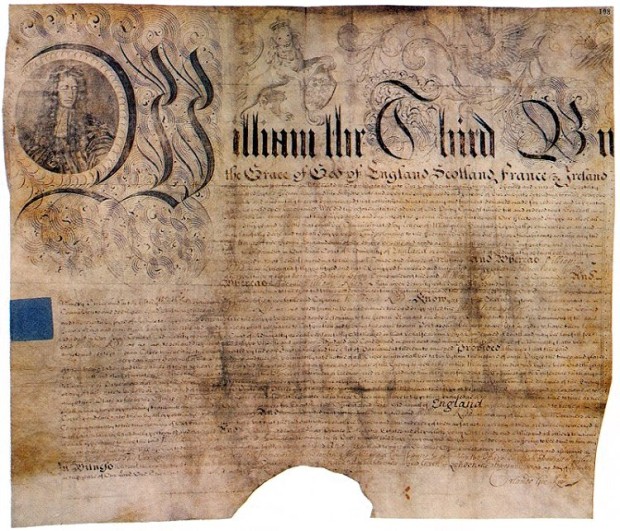
Letter of Marque, issued by King William III to Captain William Kidd in 1695

Letter of Marque, issued by King William III to Captain William Kidd in 1695

“A commission was issued December 11, 1695, under the great seal of England, directed ‘to the trusty and well beloved Captain William Kidd, commander of the ship Adventure Galley.’ He set sail from Plymouth in April, 1696, and arrived on the American coast, where he continued for some time, occasionally entering the harbor of New York and visiting his family in the city. He was considered useful in protecting our commerce, for which he received much applause, and the assembly of the province voted him the sum of two hundred and fifty pounds as a complimentary return for his services.

“Soon after he left this vicinity for more active operations on the coast of Africa and it was not long ere the astounding news arrived that Kidd had commenced the trade which he had been engaged to subvert and had committed several piracies.

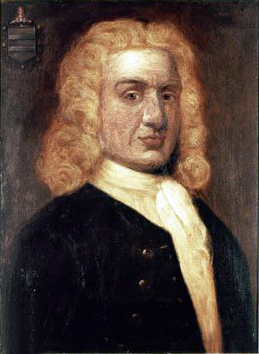
William Kidd, by Sir James Thornhill.

William Kidd, by Sir James Thornhill

“The report of these facts coming to the public knowledge in England, the circumstance was made the subject of a violent attack upon the Government by the opposition party, and in the excess of party zeal it was alleged that the King himself and those concerned in the expedition were privy to the piratical adventure and shares in its profits. This charge having some color of foundation from the actual circumstances of the case, made the question a subject of State inquiry, and thus the name of Kidd, though perhaps personally less obnoxious to the odious characteristics of his profession than many others in history became from its association with a partisan warfare between the great men of the State, the most famous among the pirates of the world. The noblemen engaged in the enterprise underwent the form of a trial for their lives, but were acquitted. The principal scenes of Kidd’s piracies were on the eastern coast of Africa, at Madagascar and the vicinity, where he captured and rifled several vessels, without, however, so far as we have been informed by history committing extreme cruelties upon his captives, the only person proven to have been killed by him being a seaman of his own named William Moore, whom he accidentally slew by hitting him with a bucket for insubordination.

Captain Kidd hanging in chains (gibbeted)

Captain Kidd hanging in chains (gibbeted)

“Kidd having amassed a fortune by this cruise, shaped his course homeward, seeming with a strange fatuity to have supposed that no information of his depredations in those remote parts of the world had reached the scenes of his home. It brought his vessel into Long Island Sound in the year 1699 and went ashore at Gardiner’s Island, then owned and occupied by Mr. John Gardiner, to whom, from some undiscoverable motive, he made known his desire to bury a quantity of treasure on the island, and did, accordingly, deposit in the ground a considerable quantity of gold, silver and precious stones in the presence of Mr. Gardiner, but under strict injunctions of secrecy. This deposit consisted of eleven hundred and eleven ounces of coined silver, two thousand three hundred and fifty ounces of silver, seventeen ounces of jewels and precious stones, sixty-nine precious stones, fifty-seven bags of sugar, forty-one bales of merchandise, seventeen pieces of canvas, one large loadstone, etc.

“Having thus disburdened his ship, he departed for Boston, with the desire, it is supposed, of selling his vessel. While there, however, he was recognized in the street and apprehended. He was sent to England for trial and indicted for the murder of William Moore, before spoken of, and, being convicted, was hanged in chains at Execution Dock, May 12, 1701. The wife of Kidd continued her residence in this city after his death, herself and daughter living in seclusion in a habitation on the east side of the town.”


Murder and Mayhem, Tra-La!

thorn_ourgameI have lived in the Hudson Valley of New York for nearly forty years now, with most of them spent in the village of Saugerties. I now live in Catskill, but when I was still a Saugertesian I attempted an idle late-night Internet search for “Saugerties” in the splendid American Memory collection of the Library of Congress. Of the twenty-five hits, ten were linked to nineteenth-century song sheets about murders and riots and prize fights by the otherwise nameless “Saugerties Bard.” The game was afoot; I had to find out more.

As it turned out, the life story of the Bard, an itinerant folklorist named Henry Sherman Backus, has itself taken on folkloric dimensions: what was strictly factual has become jumbled up with romantic twaddle, especially around his melancholic demise. It seemed to me that the songs, early on dismissed as doggerel, were very good indeed and more worthy of attention than the composer. What was his place in the long tradition of balladry and broadside, the people’s press? Was he, like Bob Dylan and Woody Guthrie, a moralist in musician’s clothing? Or was he a mere entertainer and narcissist, a Catskills comic before his time? Read on. The verses interspersed below are from the Saugerties Bard’s ballad, “The Murdered Pedlar,” printed in Catskill in 1854.

Henry S. Backus as Remembered by J. H. Kerbert

Henry S. Backus as Remembered by J. H. Kerbert

On Friday, August 19, 1853, Hiram Williams, an itinerant peddler of German-Jewish origins, was on the first leg of his journey home to 113 Walker Street in New York City. He had completed a successful tour of the villages of Ulster and Greene counties, during which he had sold one hundred dollars worth of jewelry and lace. Arriving in Greenville too late to make the Austin Line stage coach to Coxsackie, he was prepared to wait for the next one until he crossed paths with an inebriated thirty-year-old alumnus of Sing Sing prison, who had likewise missed a stage from Albany to Durham and was walking east.

On the Plank-Road, in Greenville town,
A Jewish Pedlar was shot down.
Ah, by a wretch, called Warren Wood,
Who shot the Pedlar in cold blood.

With murder rankling in his heart
From the Empire City did depart,
Arm’d with revolver, six-barrel’d true,
With which he shot the peddling Jew.

In a statement the mortally wounded Williams was able to give while clinging to life, he said that his assailant had come up to him and, after some perfunctory repartee, said, “You are a foolish fellow to take the stage; if you walk down with me, we can get there before the stage does, and you will save your money.” Persuading the peddler to stop at taverns along the way on this hot summer’s day, Warren Wood inquired how much money the peddler typically made on such a trip. “I said sometimes one, and sometimes two hundred dollars; as we came near the bridge, about half way down the hill, Wood stepped back, and I saw him pull a pistol from his pocket; he fired it and shot me down; the ball entered my back, and passed through my body, so that the doctor took it out of my abdomen; he shot again, twice, striking me about the head; I fell on the road, and he took me by the legs and threw me off the bridge and threw down my pack; he then dragged me to one corner, under the bridge, and asked me what I had in my small box, and I told him nothing but spectacles; he then threw stones on me, and went away.”  (“Greene County,” 1853).

When first he shot, the Pedlar cried,
Whate’er you want shall be supplied.
His pocket-book to Wood he gave,
In hopes by this his life to save.

Again he shot! O, cruel man!
What mortal can your feelings scan.
Infernal spirits astonish’d stood,
Awhile to gaze on Warren Wood,

Who did the Pedlar’s head then pound
As he lay bleeding on the ground,
Until he thought him truly dead,
And then the monster quickly fled.

In an affidavit following his capture in New York City, Wood admitted he had shot Williams “two or three times” but denied other seemingly less pertinent details. “The peddler handed me his pocket-book; I never asked him for it; neither did I pile any stones on him, or ill-use him. If he went off the bridge, he must have fell off himself; I did not throw him off.” Tossing his revolver into a swamp, after which he “felt somewhat easier,” Wood paid a local farmer the large sum of “one gold dollar, a fifty cent piece and two quarter dollars” to drive him to Catskill Point. From there he crossed the Hudson, took the train to Tivoli, and then the express to New York, where he arrived near midnight that same Friday (“Greene County,” 1853).

Crystal Palace, NYC, 1853, Bachmann

Crystal Palace, 1853, by John Bachmann

In Gotham he hooked up with his paramour, Emma, who noted that he had more money at hand than was usual; on Saturday, with the ill-gotten gain, they visited the Great Exhibition of Art and Industry at the Crystal Palace—on the site of today’s New York Public Library—which had opened its doors to the public barely a month earlier, and a Daguerrean parlor where the capture of Emma’s likeness was to aid in the capture of her lover. When Wood was apprehended in New York, he had among his possessions several items that indisputably belonged to the peddler. Hauled back upstate, before being incarcerated at the Catskill jail, he was brought before the dying Williams, who could not be moved from his bed at Moore’s Tavern near Greenville.

Back to New York he sped his way,
To promenade with Ladies gay.
In Cherry Street they did him take:
He now his pleasure must forsake.

Though filled with dread and guilty fear,
Before the Pedlar must appear,
Thou art the man, the pedlar said,
As he then raised his dying head.

I know that coat, the boots likewise—
A dying man will tell no lies,
To Jail the murderer then was sent,
His awful crimes there to lament.

Hiram Williams died on September 2 and was buried after services at the Albany synagogue. The charge against Wood was no longer for attempted murder. In the trial that took place on November 25, he was convicted and sentenced to hang on January 20, 1854. In between those two milestones in Wood’s wretched life, a ballad was printed in the job shop of the Greene County Whig. That ballad, quoted throughout this article, was composed by Henry Sherman Backus, a sometime Saugerties resident who may have felt an affinity for Williams, as he too was an itinerant peddler, although his pack was filled with songs rather than notions. Publishing under the pen name of the Saugerties Bard, Backus specified that “The Murdered Pedlar” was to be sung to the tune of “Burns’ Farewell,” an air of distant times that was known to anyone who had spent a bit of time in a saloon or roadhouse. Though an accomplished musician who accompanied his recitations with fiddle and fife, Backus never composed original music for the ballads he published, as the convention in the ballad business, unlike the bustling sheet music trade, was to supply buyers with lyrics to tunes they already knew.

In Christ, the Saviour of mankind,
Repentance he may truly find:
O, soon he will suspended be,
To pay the law’s just penalty.

A faithful Jury did convict,
The Sheriff must the law inflict,
The penalty to justice due,
To all the guilty, as to you.

No costly gems or diamonds bright,
Disarms the law or aids his flight,
Nor thousand tons of shining gold,
Yet for a groat Wood’s life was sold.

No more, poor man, while here you stay,
The birds will chaunt their cheering lay,
Or friendly neighbors greet again
The wretch that hath the Pedlar slain.

On January next, the twentieth day,
The Sheriff must the law obey,
Upon the gallows him suspend,
And thus poor Wood his life will end.

Let all a solemn warning take,
And every wicked way forsake,
For soon we all will ush’rd be
Into a vast eternity.

On the day that he was appointed to meet his Maker, only twenty minutes before being led to the Catskill jail’s rigged-up gallows, Wood made a long and rambling statement, the essence of which was that yes, he shot the peddler, but he didn’t know what he was doing or why. Then he attacked the integrity of his attorney, the officers who arrested him in New York, a reporter for the New York Herald, and one other: “A man from Saugerties has written some verses about me, and they have been published by the publishers of the Green[e] County Whig, and circulated over the country at sixpence apiece. I want to ask one question, and that is, if a man in my situation is not entitled to sympathy, rather than to be held up to ridicule and abused in that way? . . . Those degraded, low, mean, miserable verses are not worthy of the respect of any man, and I am sorry that anyone claiming responsibility [by which he meant the editor of the Whig], should suffer his press to give to the public such verses, and shamefully abuse me.” Mr. Ward, the editor, concluded his story of the execution and the strange scenes preceding it with Wood “suspended by the neck until he was dead. His body hung fifteen minutes, when it was taken down, placed in the coffin, and conveyed in front of the jail, where the spectators might view it. The body was buried about 2 o’clock, in the village burial yard” (“Execution of W,” 1854).

Hudson Lunatic Asylum, 1841

Hudson Lunatic Asylum, 1841

The brutal detail is offered here because life was more short and brutish then, with death and retribution the stuff of everyday concourse and consequently grist for ballads and folklore, too. Murder, disaster, tragedy, and sorrow were the stock in trade of the Saugerties Bard. Henry Backus was beginning to earn a reputation as a folk balladist, an honored practitioner of the people’s press that links seventeenth-century one-sheets and broadsides to nineteenth-century penny dreadfuls and dime novels, on up to story songsters Woody Guthrie, Pete Seeger, and Bob Dylan. Backus was perhaps a better social historian than he was a poet, but he was a master of brevity, able to tell a story that would go straight to the heart in a way that myriad columns in the newspaper could not. While ballads have traditionally been about the proximity of the rose and the briar—love and death—the Saugerties Bard found his calling in the briar patch, perhaps because life had strewn few roses in his path. His existence, which commenced on February 4, 1798, in Coxsackie, New York, has been festooned with so many garlands of whimsy if not outright fakery that it is difficult to separate the man from the myth. His death on May 20, 1861, followed by a pauper’s burial in Saugerties, concludes a tale so sad that it is a pity Backus himself could not have used it as a subject. In between those dates, he endured the death of his father in the War of 1812, became a schoolteacher, wed, had children, buried his wife and one of his children, became estranged from the others, and spent some time in the insane asylum in Hudson (today that city’s public library).

It is a life worth recounting in brief, but engaging as it may be, the romantic figure of this balladist—a combination of poet, moralist, entertainer, lunatic, and huckster— has received more attention from this century’s observers than the ballads themselves. The Saugerties Bard has become equal parts folklorist and folklore.

Composing sad songs about murderers and their victims, he pandered to the public’s taste for sensationalism with a winking touch of piety. As John Wesley is said to have grumbled before setting down his five directions for singing hymns, “It’s a pity that Satan should have all the best tunes” (Lomax 1934, vii).

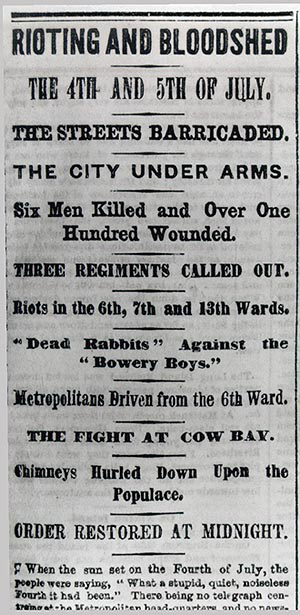
'Gangs of New York' Riots, 1857.

‘Gangs of New York’ Riots, 1857.

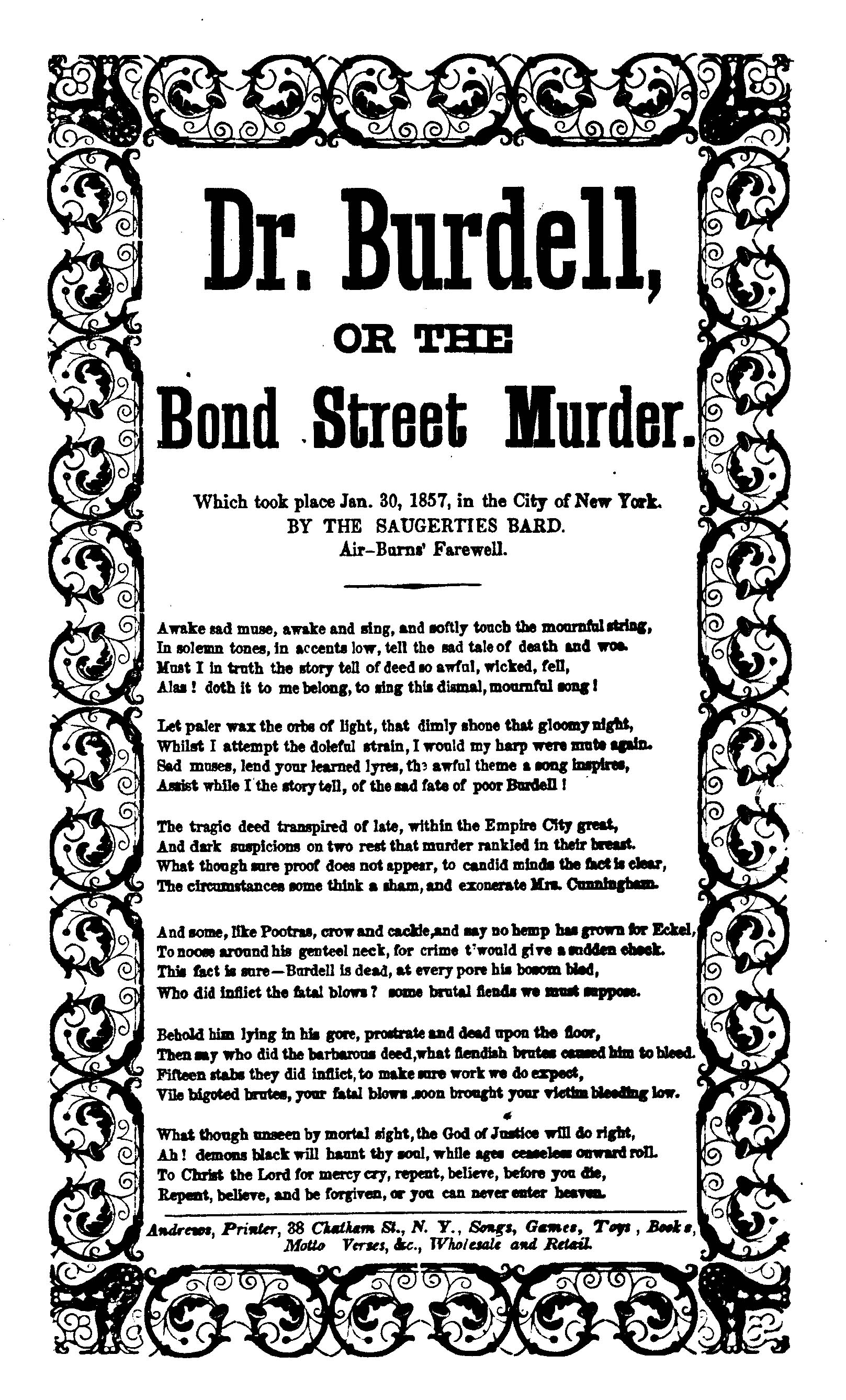
As time wore on, the life of Henry Sherman Backus became less eventful and his balladry more so—and arguably more proficient as well. With his Saugerties family falling away from him in the 1850s he beat a path south to New York City, where he composed some of his most notable works. In the latter half of that decade he wrote ballads about famous murders (for example, the unfortunate Dr. Burdell and his scheming wife), riots (notably the July 4, 1857, fracas involving the Dead Rabbits, Plug Uglies, and Bowery Boys, brought to screen in Martin Scorsese’s Gangs of New York), and executions, especially those of the antisocial lad James Rodgers and my personal favorite, the “pirate” Albert Hicks. Some of the Saugerties Bard’s ballads, notably “Uncle Sam’s Farm” and “The Dying Californian,” have conventionally been assigned to other pens, but nineteenth-century writers gave credit to Backus. Full lyrics survive for most of them, as do MIDI versions of the tunes or—in a handful of cases—newly recorded versions.

Backus was something of an entrepreneur, paying job printers to run off his ballads, then selling them from his pack as he roamed from town to town. He even produced a now exceedingly scarce Ulster County Almanac for 1855, which he promoted with an advertisement in the Saugerties Telegraph: “[It] contains besides a good calendar some of the best effusions of the author. The bard will present it to the inspection of the public as soon as issued and probably sing most of the ballads as he is wont to do, accompanied by instrumental music. The approach of the Almanac will be announced by music from fiddle and flute” (qtd. in Jones 1942, 141).

Broadside of the ballad “Hicks the Pirate,” published in March 1860.

Broadside of the ballad “Hicks the Pirate,” published in March 1860.

Benjamin Myer Brink, in his Early History of Saugerties, wrote in 1902: “All through the counties of Ulster and Greene, at least, was he well known in the years from 1835 to 1860; and often was he seen all down the Hudson River valley, and even upon the streets of New York, and westward along the Mohawk he had occasionally wandered, and into Canada. He was harmless, eccentric, impulsive, and at times incoherent, with a faculty for impromptu rhyming. . . . The writer can see him now pass by, clad in a suit of gray, with long gray locks covered with a cap.” (310–1)

Louis C. Jones offered another view forty years later: “Although Backus died in 1861 a few old people in the Saugerties area still cherish him among their earliest memories. Mr. J. H. Kerbert, a bard himself, recalled him with remarkable clearness. I have in my possession a drawing made from memory by Mr. Kerbert, which shows Backus in his big hat, with long hair, grizzled beard, pegleg, and cane” (1942, 140).

But how did this son of Greene County become the bard of Saugerties, in Ulster County? This has been a mystery that eases a bit through genealogical research—only recently simplified by the digitization of federal, state, and local records—yet is by no means settled. Henry’s father, Electus Mallory Backus (1765–1813), and mother, Sabra Judson Backus (1764–1838), had both been born in Connecticut, where they wed in 1784. They relocated to West Camp, New York, sometime before 1787, and thence to Coxsackie. Of their eleven children, all but one lived to adulthood and married—so Henry, the seventh, would enjoy a cornucopia of nieces and nephews, a fact difficult to gibe with his later solitary life and death.

Teacup Tales, by Pauline Hommell

Teacup Tales, by Pauline Hommell

Electus Mallory Backus was a military man by election, before the outbreak of war in 1812. Commissioned as major of the First Light Dragoons in October 1808, he would die in action at Sackett’s Harbor in June 1813. (For decades thereafter Sabra Backus petitioned Congress unsuccessfully to provide her with a widow’s pension.) Henry’s younger brother Electus Jr. would also become a military man, matriculating at West Point and serving with distinction in the Mexican and Civil Wars. According to Brink, Henry too “grew to manhood with a passion for what concerns a soldier. He possessed a peculiarly correct ear for martial music, and in early years was an efficient teacher of the fife, the drum, and the bugle. Later he taught school, and coming to Saugerties he married a Miss Legg, with whom he lived for a number of years. After her death his mind received a peculiar bias and he began to lead the life of a wandering minstrel” (1902, 312).

According to Pauline Hommell, a Saugerties schoolteacher and historian who wrote an anecdote-laden profile of Backus in her 1958 volume Teacup Tales, Miss Legg was an orphan. In Hommell’s ghostly tale “The Face at the Window,” she contrives this comment from Cornelis [Cornelius] Post to Backus, recently arrived in Saugerties to accept a position as schoolteacher: “‘You’ve been seeing our neighbor’s cousin, Alida Legg. Ach, but she is good to feast one’s eyes on” (1958, 34). Hommell was not above inventing dialogue and spooky stories, but I do not suspect her to have been a fabricator of basic fact. Katsbaan Church records show that an Alida was born to Lodewijk Smit [Anglicized as Lodowick Smith in the 1800 census] and Neeltje Post on March 3, 1799, and when she was baptized seventeen days later, her sponsors were William Legg and Debora Post. Born to Alida’s parents five years earlier had been Debora Smit, sponsored by Petrus Post and Debora Post (Katsbaan Church records, entries 1830 and 2203). According to Hommell, Alida wed Henry in the early 1820s and died in May 1845, although Teacup Tales makes no mention of children.

Homes of the New York City Rioters

Homes of the New York City Rioters

Other sources give Mrs. Backus the name Eliza or Ann Eliza—possibly Anglicizations, possibly a confusion with Henry’s older sister Eliza. Alida/Eliza is also given a maiden name of Legg, which she might well have taken upon her adoption. In the 1830 census the age of Henry “Baccus” of Saugerties is listed as over thirty but under forty. He has one daughter older than five but younger than ten. His wife is listed as over twenty but under thirty, close enough to the truth and perhaps flattering. Burial records of Mountain View Cemetery show that their daughter Sara Ann died June 6, 1830, at the age of one year and twelve days (Poucher and Terwilliger 1931). In the 1840 census Backus, still residing in Saugerties, presides over a household of six females: two daughters under five, two more between five and ten, another between fifteen and twenty, and his wife. Yet in the 1850 census, he shares an abode only with laborer Abraham Wing, age fifty-eight; he himself is listed with no profession. At some point in the 1840s he is said to have spent time in the lunatic asylum in Hudson. The likely dispersal of his daughters to other homes following his commitment or the death of his wife might have driven any man to despair; it sent Henry Backus on the road.

Dr Burdell, or, The Bond Street Murder

Dr Burdell, or The Bond Street Murder

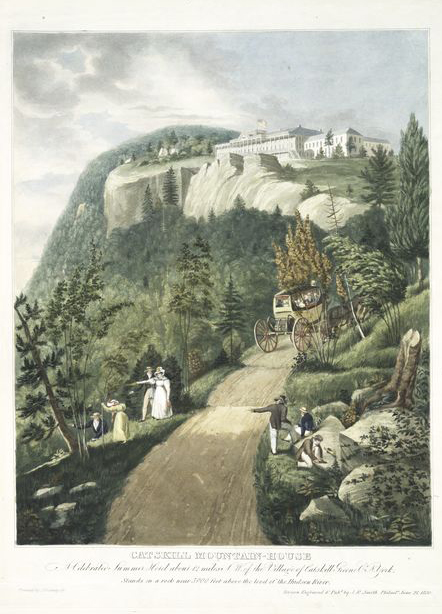
So may we conclude that the Saugerties Bard’s odd demeanor was born of trauma? Or might it have been at least in some measure calculated? In The Catskills Alf Evers wrote, “Local eccentrics found the [Catskill] Mountain House an irresistible target and they often served to brighten a dull day. Among them was Henry Backus, ‘the Saugerties Bard, a Cosmopolitan, a Travelling Minstrel,’ as he was inscribed on the hotel register. Backus sang songs he composed and sold printed copies of them to guests. He put together a Mountain House ballad in 1856” (1972, 458). Clearly eccentricity was a solid marketing tactic then as now; Backus may have been the Tiny Tim of his day, ridiculed by his audience but laughing all the way to the bank. Certainly his mind was sufficiently composed to produce lyrics that generally scanned and always told a story.

Reviewing his list of songs, it is clear that the “Catskill Mountain House Ballad,” printed June 30, 1856, marked very nearly the end of Henry Backus’s rural phase. His brother Electus had been installed as the army’s superintendent of general recruiting services at Fort Columbus on Governor’s Island in New York harbor. He and his brother had seen little of each other for decades, but the Saugerties Bard nevertheless boldly headed south to the city of lights and shadows. In the four years remaining to him he would publish at least fifteen (and perhaps many more) ballads with the three prolific New York song-sheet publishers, Andrews, Wrigley, and De Marsan. Indeed, no one knows precisely how many song sheets, slip ballads, and poetical broadsides the Saugerties Bard may have composed or published, and additional ones may yet be identified, especially those that may have been printed in newspapers but not distributed as broadsides.

Catskill Mountain House 1830

Catskill Mountain House 1830

Living in New York and Hoboken, Backus, nearing the age of sixty, did some of his best work. There were the songs about famous riots (“The Great Police Fight [Riot at City Hall], June 15, 1857”), boxing matches (the 156-round affair celebrated in “Bradley & Rankin’s Prize Fight for $1000 a Side”), and especially notorious villains such as Mrs. Cunningham (“Dr. Burdell, or the Bond Street Murder”), Francis Gouldy (“Heart Rending Tragedy”), and my favorite murderer, Albert W. Hicks (“Hicks the Pirate”), the man who for a few months pushed Abe Lincoln and secessionist rumbling off the front page.

Hicks was a waterfront thug, not a pirate, who in March 1860 was drugged by a rival gang member and woke up to find himself “shanghaied” onto the oyster sloop E. A. Johnson and bound for Virginia. Knowing from past practice just what to do, he murdered the entire crew—the skipper Captain Burr and the brothers Watts—with an axe, gathered up their clothing and valuables, and threw them overboard. Managing the sloop badly as he turned it back toward New York, he collided with the schooner J. R. Mather, outbound for Philadelphia. Hicks lowered a boat piled high with his victims’ belongings and made for shore at Staten Island. When the wrecked E. A. Johnson was brought ashore awash in blood, Hicks’s day of reckoning neared. Chased from New York to Providence, Hicks was apprehended, tried on federal charges of piracy on the high seas, and won a nickname that he took to his grave … and beyond.

From: The life, trial, confession and execution of Albert W. Hicks, the pirate and murderer, executed on Bedloe's Island, New York Bay on the 13th of July 1860 for the murder of Capt. Burr, Smith and Oliver Watts on board the oyster sloop E.A. Johnson : containing the history of his life; DeWitt 1860.

From: The life, trial, confession and execution of Albert W. Hicks, the pirate and murderer, executed on Bedloe’s Island, New York Bay on the 13th of July 1860 for the murder of Capt. Burr, Smith and Oliver Watts on board the oyster sloop E.A. Johnson : containing the history of his life; DeWitt 1860.

There would be no schoolboy mewling for this hardened criminal who, with a twentyfirst- century sense of commerce, hired a writer to make his confession suitably bloodcurdling to sell to a publisher, with the proceeds to go to his widow. This will give the picture: “I have killed men, yes, and boys too, many a time before, for far less inducement than the sum I suspected I should gain by killing them; and I had too often dyed my murderous hands in blood in days gone by, to feel the slightest compunctions or qualms of conscience then” (“Execution of H,” 1860). Ah, they don’t write ’em like that today, and more’s the pity!

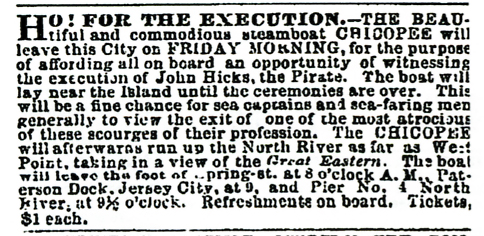
Convicted of the triple murder, Hicks was slated for execution on July 13, 1860, at a gallows constructed on Bedloe’s Island (also known as “Gibbet Isle”) out in the harbor, where the Statue of Liberty has stood since 1886. His procession from jail to gallows took on the aspect of a circus, and a general holiday atmosphere prevailed. Excursion boats had been lined up beforehand for the twelve thousand spectators (a New York Times estimate) to have a memorable outing: “HO! FOR THE EXECUTION” read the headline on one classified ad (1860). Peanut vendors and lemonade stands did a brisk business to the beat of the fife and drum. The thirsty “imbibed lager-beer,” reported the Times, and in rowboats there were “ladies, no, females of some sort, shielding their complexion from the sun with their parasols, while from beneath the fringe and the tassels they viewed the dying agonies of the choking murderer” (“Execution of H,” 1860).

Hicks the Pirate, Execution and Excursion, New York Times, July 12, 1860

Hicks the Pirate, Execution and Excursion, New York Times, July 12, 1860

Soon after Hicks was buried, grave robbers stole his body, spawning a long-standing rumor that he had somehow defeated the hangman and was running around wreaking havoc under an alias. In fact, his body had been sold to medical students. Within months of the hanging, P. T. Barnum’s American Museum featured a wax image of Hicks among its other notorious figures. The Great Showman’s newspaper ad described his sundry marvels (“Amusements,” 1861):

Not these alone attention draw; Figures in wax are found;
Classic and modern; Christian Sage and heathen of renown;
All characters whose names have a very familiar sound.
A Mummy here, a Judas there—a “Tommy” done up brown;
A John Brown or an Albert Hicks—a Lambert and his wife.
The Siamese Twins and Albert Guelph—all true to life.

“Hicks the Pirate,” the Saugerties Bard’s ballad published right after the hanging, marked the end of a tradition. Songs about solo murderers would soon pale before the slaughter of hundreds of thousands of our best in blue and gray. The young Henry Backus had not embraced the military as his father and brother had done; he would not do so now. Out of fashion and perhaps increasingly addlepated, he headed back north. “During the winter,” according to Brink, “he was hardly seen” (1902, 314).

On Monday, May 13, 1861, Backus slept in an old shed in Katsbaan outside a hotel maintained by James H. Gaddis, who found him the following morning, emaciated and unconscious. The Bard was taken to the village of Saugerties, where he was fed, charged with vagrancy, and taken to Kingston’s jail. There he lingered unattended until he died on May 20. His body was given a pine-coffin burial in Saugerties. Few members of his extensive family had stood by him in life; none now came in death. His remains were placed, in Pauline Hommell’s aptly chosen words, “into the six-foot cavity which is the common portion of all the sons of Adam” (1958, 37).

Songs of the Saugerties Bard

The Powder Mill Explosion at Saugerties, New York. 1847.

The Dying Californian. ca. 1850.

Uncle Sam’s Farm. Air—Walk in de Parlor and Hear de Banjo Play. ca. 1850.

Dunbar, the Murderer. 1851.

The Burning of the Henry Clay. 1852.

Explosion of Steamer Reindeer. On the Hudson at Malden, September 4, 1852.

The Burning of the Reindeer, September 10, 1852.

Whipoorwill, or American Night-bird: A Poem. 1852.

John Mitchel, Irish Patriot in Exile. Air—Hail to the Chief. ca. 1853–4.

The Murdered Pedlar, Catskill. Air—Burns’ Farewell. 1854.

The Baptist Preacher or the Drowned Woman and Child, Kingston, May. Air—The Rose Tree. 1854.

My Heart’s in Old ’Sopus Wherever I Go. Kingston. June 1855.

“Catskill Mountain House Ballad” [original title unknown]. June 30, 1856.

Dr. Burdell, or the Bond Street Murder. Which Took Place Jan. 30, 1857, in the City of New York. Air—Burns’ Farewell. 1857.

The Great Police Fight (Riot at City Hall), June 15, 1857. Air—Root Hog or Die. 1857.

Dead Rabbits’ Fight with the Bowery Boys. July 4, 1857. Air—Jordan. 1857.

The Murdered Policeman, Eugene Anderson, Who Was Shot by the Desperate Italian Burglar, Michael Cancemi, Cor. of Centre and Grand Streets, July 22, 1857. Air—Indian Hunter. 1857.

The Bellevue Baby Mrs. Cunningham’s Adopted. Air—Villikins [and His Dinah]. 1857.

Mrs. Cunningham and the Baby. Air—Villikins and His Dinah. 1857.

The Cunningham Baby. Or The Heir from Over Jordan. 1857.

That Baby on the Half Shell. 1857.

Bradley & Rankin’s Prize Fight for $1000 a Side. At Point Abino, Canada, August 1, 1857. Air—Old Virginia’s Shore. 1857.

The Queen’s Telegraphic Message, and President Buchanan’s Reply, Hudson. August 18, 1858.

The Thirtieth Street Murder. A Horrible Tragedy. Air—Burns’ Farewell. 1858.

Heart Rending Tragedy, or Song No. 2 on the 30th Street Murder. Air—Meeting of the Waters, or Indian Hunter. October 26, 1858.

Execution of Rodgers. 1858.

The Press Gang. Air—Tom Haliard. 1860.

Hicks the Pirate. Air—The Rose Tree. March 1860.

The American Flag. n.d.

Warren’s Address. To the American Soldiers Before the Battle of Bunker Hill. Air—Bruce’s Address. n.d.

Pocahontas. n.d.

Johnny Bull and Brother Jonathan. Air—Yankee Doodle. n.d.

Four Germans Drown’d in Rondout Creek. n.d.

References

“Amusements. Barnum’s American Museum. Advice Given Gratis.” February 28, 1861. Classified advertisement. New York Times:7.

Brink, Benjamin Myer. 1902. The Early History of the Saugerties, 1660–1825. Kingston, NY: privately published.

Evers, Alf. 1972. The Catskills. Garden City, NY: Doubleday.

Execution of Hicks, the Pirate. July 14, 1860. New York Times:1.

Execution of Warren Wood, from the Greene County Whig, Jan. 21. January 25, 1854. New York Times:8.

The Greene County Murder—The Peddler’s Affidavit—Wood’s Confession. September 3, 1853. New York Times:6.

“Ho! For the Execution.” July 12, 1860. Classified advertisement. New York Times:7

Hommell, Pauline. 1958. Teacup Tales. New York: Vantage Press.

Jones, Louis C. 1942. Henry Backus, the Saugerties Bard. New York History 23.2:139–48.

Katsbaan Church records. Reformed. Town of Saugerties, Ulster County, New York.

Lomax, John A. and Allan. 1934. American Ballads and Folk Songs. New York: Macmillan.

Poucher, J. Wilson, and Byron J. Terwilliger, ed. 1931. Old Gravestones of Ulster County, New York: Twenty-Two Thousand Inscriptions. Kingston. Rpt. 1998. Boston: New England Historic Genealogical Society.

Street Names Changed or Now Obsolete, Part 2

thorn_ourgameContinuing from Part 1, at https://gothamhistory.com/2015/06/08/street-names-changed-or-now-obsolete/. So many tales lurk herein, but let’s focus briefly on Tin Pan Alley, a neighborhood centered on  West 28th Street between Fifth and Sixth Avenues. Known for the large collection of songwriters and publishers who congregated in the area, as Don Jensen has written in “A Base Ball Krank’s Guide to Madison Square” (Base Ball: A Journal of the Early Game, 2014):

[Tin Pan Alley] dominated popular music in the United States from the 1890s to the 1920s. (The name may have derived from a reference by Harry Von Tilzer in the New York Herald to the sound made by the thin, tinny tone quality of the cheap pianos [offered] in music publishers’ offices.) …. George Gershwin, Jerome Kern, and Irving Berlin, along with many others, began their careers on the “Street of Songs.” But other kinds of businesses also practiced their trades there. In addition to Miss Flippeny’s, the building at 57 West 28th was a gambling den. For a time during the 1890s, Thomas Edison’s office for moving pictures was at No. 43, where he reportedly shot film on the roof. The New York Clipper, America’s first newspaper devoted to sports and entertainment, including baseball, had its offices at No. 47, not far from the William Morris Talent Agency (though the Clipper’s original offices were downtown).Clipper offices in heart of Tin Pan Alley

Tin Pan Alley will be found on no map of New York City streets, but Tin Pot Alley, whose existence clearly was invoked by the music folk. Running from 59 Greenwich to 91 Trinity Place, it was the former name of Exchange Alley and was also known as Oyster Pasty Alley. This name was commonly applied to a locality on the shore of the North river, opposite the present Exchange Place. A fortification at the end of this small lane, leading from Broadway west (now a part of Exchange Place) was known as the “Pasty Mount.” Charles Hemstreet wrote, in Nooks and Crannies of Old New York (1899):

There is a rift in the walls between the tall buildings at No. 55 Broadway,  near Rector Street, a cemented way that is neither alley nor street. It was a green lane before New Amsterdam became New York, and for a hundred years has been called Tin Pot Alley. With the growth of the city the little lane came near being crowded out, and the name, not being of proper dignity, would be forgotten but for a terra cotta tablet fixed in a building at its entrance. This was placed there by Rev. Morgan Dix, the pastor of Trinity Church.

Jensen observed that while Tin Pan Alley was always a place though never in one location, “a commemorative plaque is embedded on the sidewalk on East 29th Street just east of Broadway, where it is mostly unnoticed except perhaps for street vendors, pedestrians, and construction workers trying to restore the neighborhood to its former gritty charm.”

Jackson Avenue was the former name of University Place.

Jackson Place was an alley which ran north from No. 16 Downing St.; now called Downing Place.

Jauncey Lane was a country road which started between 93rd and 94th Sts., just west of West End Ave., and ran easterly crossing 8th Ave. at 94th St. and ending at the Eastern Post Road; about the present line of 96th St. between 5th and 6th Aves.

Jauncey Court was in the rear of Nos. 37, 39 and 41 Wall St. Jew’s Alley was the former name of South William St. Jew’s Alley was the former name of South William St. between Broad Street and Mill Lane.

Jew’s Alley formerly ran from Madison St. between Oliver and James Sts.

Jone’s Court was in the rear of Nos. 48. SO Wall St.

Jones Street was the former name of Great Jones St.

Judith Street was the former name of Grand St. between the Bowery and Center St.

King Street was the former name of Pine St. It was laid out about 1691 and was known as Queen St.; known in 1728 as King St.; name changed to Pine St. in 1793. King Street was the former name of William St. between Hanover Square and Wall St.

King George Street was the former name of William St. from Frankfort St. easterly to Pearl St.; known by this name in 1755.

Kingsbridge Road branched off from the Eastern Post Road a little north of McGowns Pass, about the present line of 108th St. between 5th and Lenox Aves., and ran northwesterly along the present St. Nicholas Ave. to 169th St., from there it followed along the present Broadway to the Harlem River, crossing the river on the old Kingsbridge.

Kingsbridge Road. There was a second road known by this name which started in the Village of Harlem; about the present Sylvian Place, between 3rd and Lexington Aves., 120th and 121st Sts., and ran northwesterly to 124th St. and Park Ave., then along 124th St. to the west line of Mount Morris Park, continuing northwesterly to 127th St. between Lenox and 7th Aves., then southwesterly to a point in the block bounded by Lenox and 7th Aves., 126th and 127th Sts.. then northwesterly to St. Nicholas Ave. between 131st and 132nd Sts., where it joined the other Kingsbridge Road. Kings Road was the former name of Pearl St. between Franklin Square and Park Row.

Kings Highway was one of the former names of Park Row and the Bowery.

Kip Street was the former name of Nassau St. between Maiden Lane and Spruce St.

KIPS BAY 1830Kips Bay Street was a country road which started at the Eastern Post Road, the present Madison Ave. and 35th St. and ran southeasterly, crossing 2nd Ave. at 34th St. and ended at the East River at the foot of 34th St.

Knapp Place was formerly in the rear of No. 412 East 10th St. between Avenue C and Dry Dock Street.

Koninck Street was a former name of Pine St.

Lafayette Place was the former name of Lafayette Street, between Great Jones St. and 8th St. It was opened July 4, 1826.

Lamartine Place was the former name of West 29th St. Lamartine Place was the former name of West 29th St. between 8th and 9th Aves.

Lambert Street was the former name of Church St. between Edgar and Liberty Sts.

Laurens Street was the former name of West Broadway, between Canal and 4th Sts.

Leandert’s Place was formerly in the rear of No. 147 Seventh St., between Avenues A and B.

Leary Street was a former name of Cortlandt St.

Leather Street was the former name of Jacob St.

Lenox Place was the former name of 22nd St. between 8th and 9th Aves.

Leroy Place was the former name of Bleecker St. between Mercer and Greene Sts.

Leyden Place was the former name of Fourth Ave. between 11th and 13th Sts.

Broadway, both sides, from Battery Place to Tin Pot Alley (now Exchange Alley), in 1848, Valentine's Manual

Broadway, both sides, from Battery Place to Tin Pot Alley (now Exchange Alley), in 1848, Valentine’s Manual

Liberty Court was formerly in the rear of Nos. 4 and 6 Liberty Place.

Little Street was the former name of Cedar St. between Broadway and the Hudson River.

Little Aim Street was the former name of Elm St. (now Lafayette St.) between Reade and Franklin Sts.

Little Chappel Street was the former name of College Place (now West Broadway) between Barclay and Warren Sts.

Little Division Street was the former name of Church St.

Little Division Street was the former name of Montgomery St.; known by this name in 1766-1767.

Little Dock Street was the former name of Water St. between Broad St. and Old Slip.

Little Dock Street was the former name of South St. between Whitehall St. and Old Slip.

Little George Street was the former name of Spruce St.; known by this name in 1725. 

Little Greene St. was the former name of Liberty Place.

Little Queen Street was the former name of Cedar St. It was laid out about 1690 and was known as Smith St.; known in 1728 as Little Queen St.; known since 1793 as Cedar St.

Little Stone Street was the former name of Thames St.; known by this name in 1766; known since 1791 as Thames St.

Little Water Street was the former name of Mission Place.

Broadway, both sides, from Battery Place to Tin Pot Alley (now Exchange Alley), in 1848, Valentine's Manual

Broadway, both sides, from Battery Place to Tin Pot Alley (now Exchange Alley), in 1848, Valentine’s Manual

Locust Street was the former name of Sullivan St.

Lombard Street, Lombardy Street, were the former names of Monroe St.; known in 1791 as Rutgers St.; name changed to Monroe St. Jan. 10, 1831.

London Terrace was the former name of the north side of 23rd St. between 9th and 10th Aves.

Lorillard Place was the former name of Washington St. between Charles and Perry Sts.

Louisa Street. Kips Bay Farm was a country road which ran from the Eastern Post Road about the present Lexington Ave. and 32nd St. southeasterly, crossing 2nd Ave. at 31st St. and ending at the East River at the foot of 30th St.

Love Lane, also called the Abingdon Road, was a country road which commenced at the Roy Road; about the present 8th Ave. and 21st St. and ran easterly on about the line of the Eastern Post Road at the present 3rd Ave. and 23rd St. Love Lane was a country road which ran from Chatham Square easterly to the Rutgers Farm, about the line of the present West Broadway.

Lowe’s Lane was a country road which commenced at the Eastern Post Road about the present 41st St., slightly east of Lexington Ave. and ran westerly crossing the Middle Road (5th Ave.) at 42nd St. and ending at the Bloomingdale Road (present Broadway), between 43rd and 44th Sts.

Low Water Street was the former name of Washington St. between Battery Place and West Houston St.

Low Water Street was the former name of Water St. between Broad and Wall Sts.

Ludlow Place was the former name of West Houston St. between Sullivan and Macdougal Sts.

Lumber Street was the former name of Trinity Place between Morris and Liberty Sts.

Lumber Street was the former name of Monroe St.

Maagde Paetge (Maidens Path) was the name of Maiden Lane during the time of the Dutch.

Madison Court was formerly in the rear of No. 219 Madison St.

Maiden Lane was a country lane in the block now bounded by Broadway, Amsterdam Ave., 160th and 161st St.

Plan of the City of New York, Maverick and Bridges, 1807.

Plan of the City of New-York, Maverick and Bridges, 1807.

Magazine Street was the former name of Pearl St. between Park Row and Broadway.

Manhattan Avenue was the former name of 5th Ave.

Manhattan Road was a country road which commenced at the Kingsbridge Road; about the present Lexington Ave. and 121st St. and ran southwesterly to a point in the block bounded by Park and Madison Aves., 118th and 119th Sts., then northwesterly, crossing 5th Ave. at 119th St., 6th Ave. between 120th and 121st Sts., 7th Ave. between 121st and 122nd Sts., to a point on the north side of 122nd St. about 200 ft. east of 8th Ave., then southwesterly to 8th Ave. about one-half way between 121st and 122nd Sts.

Mansfield Place was the former name of West 51st St. between 8th and 9th Aves.

Margaret Street was the former name of Cherry St. Margaret Street was the former name of Willett St.

Maria Street. Kips Bay Farm was the name of a country road which started from a point in the block bounded by 2nd and 3rd Aves., 29th and 30th Sts., and ran southeasterly to the East River between 28th and 29th Sts.

Marion Street was the former name of Cleveland Place and Lafayette St. between Broome and Prince Sts.

Market Street was the former name of South William St.

Marketfield Street was the former name of Battery Place between Broadway and Hudson River.

Martin Terrace was the former name of East 30th St. between 2nd and 3rd Aves.

Mary Street was the former name of Christopher St. between Greenwich Ave. and Waverly Pl.

Mary Street was the former name of Baxter St. between Leonard and Grand Sts.

Mary Street was the former name of Cleveland Pl. and Lafayette St. between Broome and Prince Sts.

Meadow Street was the former name of Grand St. between Broadway and Sullivan St.

Mechanics Alley formerly ran from No. 72 Monroe St. south to Cherry St. between Market and Pike Sts.; now the site of the Brooklyn Bridge approach.

Mechanics Place formerly ran from the east side of Avenue A, between 2nd and 3rd Sts.

Meek’s Court was formerly in the rear of 55 Broad St.

Merchants Court was in the rear of No. 48 Broad St.

Merchants Place formerly ran in the rear of No. 28 Avenue A, between 2nd and 3rd Sts.

Mechanics Place formerly ran in the rear of Rivington St. between Lewis and Goerck Sts.

Merchant Street was the former name of Beaver St.

Messier’s Alley was the former name of Cuyler’s Alley.

Montresor, 1767

Montresor, 1767

Middle Road was a country road which started at the Eastern Post Road, about the present 4th Ave., between 28th and 29th Sts., and ran northwesterly, crossing Madison Ave. at 35th St. At 5th Ave. and 42nd St. (Burr’s Corners) it turned northerly along the line of 5th Ave. to 90th St., where it terminated at the Eastern Post Road.

Middle Street was the former name of Monroe St. from Montgomery to Corlaer Sts.

Mill Street was the former name of Stone St.

Mill Street was the former name of South William St. between Broad St. and Mill Lane.

Miller Place was formerly in the rear of No. 4 Macdougal St.

Milligan Place was formerly in the rear of No. 139 Sixth Ave. between 10th and 11th Sts.

Millward Place was formerly the name of West 31st St.

Millward Place was formerly the name of West 31st St. between 8th and 9th Aves.

Mitchell Place was the former name of the north side of East 49th St. between 1st Ave. and Beekman Place.

Monroe Place was the former name of Monroe St. between Montgomery and Gouverneur Sts.

Moore’s Row was formerly between Catherine and Market Sts. and ran from Henry to Madison Sts.

Monument Lane was a country road leading to Greenwich Village. It started at the Bowery and Astor Place and ran easterly, then northeasterly, following the present Greenwich Ave.; which is a part of the old road; and ended at Gansevoort St.

Mortkile Street was the former name of Barclay St.

Morton Street was the former name of Clarkson St. between Varrick and Hudson Sts.

Mott’s Lane, see Hopper’s Lane.

Mustary Street was the former name of Mulberry St. between Park Row and Park St.

Neilson Place was the former name of Mercer St. between Waverly Place and 8th St.

New Street was the former name of Nassau St.

New Street was the former name of Staple St.

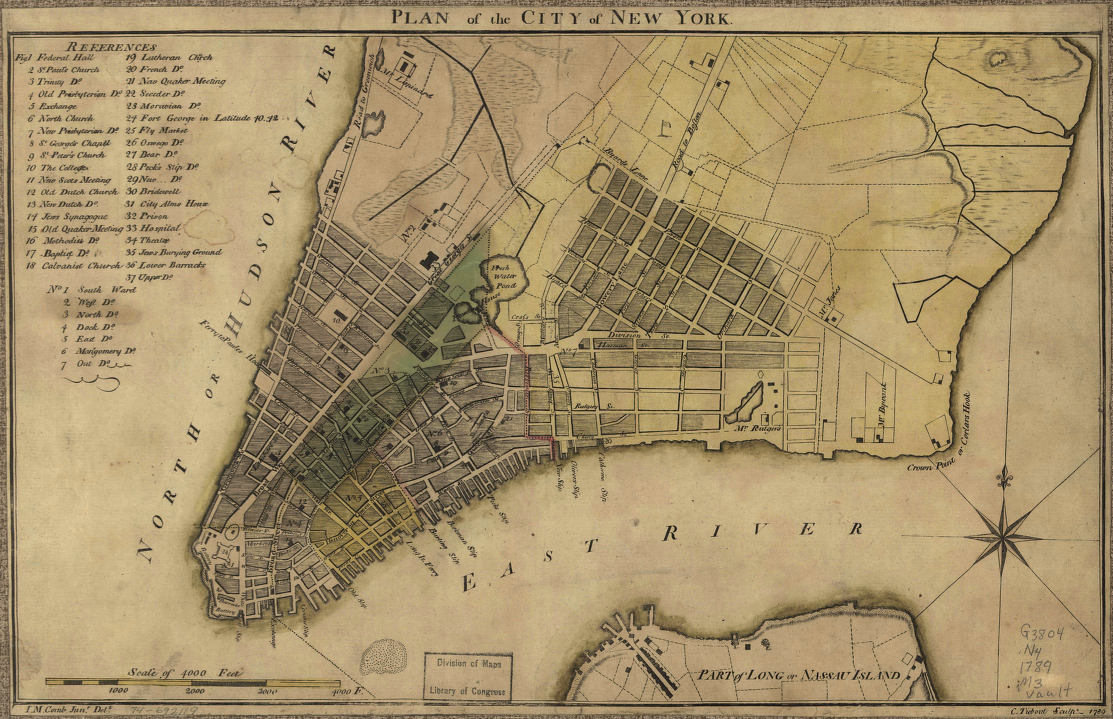
McComb, 1789

McComb, 1789

Nicholas Street was the former name of Walker St. between Canal St. and West Broadway.

Nicholas Street was the former name of Canal St. between Baxter and Division Sts.

Nieuw Straet was the Dutch name of New Street.

North Street was the former name of East Houston St. between the Bowery and the East River; name was changed in 1833.

Nyack Place was formerly in the rear of No. 31 Bethune St.

Ogden Street was the former name of Perry St.

Old Street was former name of Mott St. between Park Row and Park St.

Old Kiln Road, see Southampton Road.

Old Windmill Lane, see Windmill Lane.

Oliver Street was the former name of Spring St. between the Bowery and Broadway.

Orange Street was the former name of Baxter St. between Park Row and Grand St.

Orange Street was the former name of Cliff St.

Orchard Street was the former name of Broome St. west of Broadway.

Otters Alley formerly ran from Thompson to Sullivan Sts. between Broome and Grand Sts.

Oyster Pasty Alley was the former name of Exchange Alley, was also known as Tin Pot Alley.

Pacific Place was formerly in the rear of No. 133 West 39th St.

Park Street was the former name of Park Row between Ann and Beekman Sts.

Passage Place was the former name of Peck Slip.

Partition Street was the former name of Fulton St. between Broadway to the Hudson River; east of Broadway this street was called Fair St.

Patchin Place

Patchin Place

Patchin Place was an alley in the rear of No. 111 West 10th St.

Petticoat Lane was the former name of Marketfield St.; it was known by this name in 1791.

Penn Street was the former name of Pell St.

Petersfield Street was a country road on the Stuyvesant Farm; it started about the present 4th Ave. between 11th and 12th Sts., crossing 3rd Ave. between 12th and 13th Sts., 2nd Ave. between 13th and 14th Sts., 1st Ave. at 15th St., and ended in the center of the block bounded by 1st Ave., Ave. A, 15th and 16th Sts.

Pitt Street was the former name of Elm St. (now Lafayette St.) between Hester and Spring St.; known by this name in 1797.

Prince Street was the former name of Rose St.; known by this name in 1766.

Princess Street was the former name of Beaver St. between William and Wall Sts. During the time of the Dutch it was known as Prinsen Straet.

Prospect Street was the former name of Thompson St.

Provost Street was the former name of Franklin St.; known by this name in 1797; known as Sugar Loaf St. in 1807; name changed to Franklin St. in 1833.

Pump Street was the former name of Canal St. It was known by this name in 1797.

Pye Womans Lane, Pie Womans Lane, was the former name of Nassau St. between Wall St. and Maiden Lane.

Quay Street was the former name of Water St. between Whitehall St. and Coenties Slip.

Queen Street was the former name of Pearl St. between Wall St. and Park Row. This street was known by various names at different periods; known in 1657 as Pearl Street; and in part Hoogh Straet and the Waal; in 1691 as Dock St.; and Great Queen St.; in 1728 as Queen St., and since 1797 as Pearl St.

Queene Street was the former name of Cedar St. between William and West Sts.

Queene Street was the former name of Pine St.; was known by this name in 1691; known as King St. in 1728; name changed to Pine St. in 1794.

Quick Street was the former name of East Broadway.

Raison Street, see Reason St.

Randall Place was the former name of West 9th St. between Broadway and University Pl.

Reason Street was the former name of Barrow St. between Bleecker and Bedford Sts.; name changed in 1828.

Renwick Street was the former name of Baxter St. between Canal and Grand Sts.

Rhinelander Alley formerly ran from Greenwich to Washington Sts. between Beach and Hubert Sts.

Rhinelander Lane was a country road which ran from the Hell Gate Ferry Road at the present 2nd Ave. between 86th and 87th St. northeasterly to the south side of 90th St. between 1st Ave. and Ave. A.

Rider Street, Ridder Street, was the former name of Ryder’s Alley.

Riker Estate at 75th Street

Riker Estate at 75th Street

Riker’s Lane was a country road which ran from the Eastern Post Road, about the present 3rd Ave. and 76th St. and ran southeasterly, ending at the East River between 74th and 75th Sts.

Rivington Place was formerly in the rear of No. 316 Rivington St.

Roosevelt Lane was a country road which ran from the Old Harlem Road, about the present Lexington Ave. between 116th and 117th Sts., southeasterly, crossing 3rd Ave. at 115th St., 2nd Ave. at 112th St., then northwesterly to a point in the middle of the block bounded by 1st and 2nd Aves., 114th and 115th Sts., then southeasterly to the Harlem River between 110th and 111th Sts.

Rotten Row, Rough Street, Ruff Street, were the former names of Henry St.

Roy Road, FitzRoy Road, was a country road which ran north from Greenwich Village; it started at the Southampton Road about the present 14th St. between 7th and 8th Aves., and ran northwesterly, crossing 8th Ave. at 22nd St., then north, parallel with and a little west of 8th Ave. and ending at a cross road about the present 42nd St. midway between 8th and 9th Aves. 9th Ave. was closed from 23rd to 42nd Sts. on Oct. 26, 1832.

Robinson Street was the former name of Park Place.

Rosylyn Place was the former name of Greene St. between West 3rd and West 4th Sts.

Rudder Street was the former name of Ryder’s Alley.

Russell Place was the former name of Greenwich Avenue between Charles and Perry Sts.

Rutgers Mansion

Rutger’s Mansion

Rutger’s Hill was the former name of Gold St. between Maiden Lane and John St.

Rutger’s Place was the former name of Monroe St. between Clinton and Jefferson Sts.

Rutger’s Street was the former name of Oak St.; known by this name in 1755.

Ryndert Street, Rindert Street, was the former name of Center St. between Canal and Broome St.; known in 1797 as Potters Hill; known in 1807 as Collect St.; known in 1817 as Ryndert St.

Sackett Street was the former name of Cherry St.

St. Clamment’s Place was the former name of Macdougal St. between Houston and Bleecker Sts.

St. David Street was one of the former names of Bleecker St.

St. Hevins Street was the former name of Broome St. between Broadway and Hudson St.; was known in 1755 as St. Hevins St.; known in 1766 as Bullock St.; known in 1797 in part as Bullock St. and in part as William St., and in part as Orchard St.; known since 1807 as Broome St.

St. Johns Street was the former name of John St.

St. Marks Place was the former name of East 8th St.

St. Nicholas Street was the former name of Walker St. between Canal St. and West Broadway.

St. Nicholas Street was the former name of Canal St. between Walker St. and the Bowery.

St. Peters Place was the former name of Church St. between Vesey and Barclay St.

Schaape Waytie (The Sheep Pasture) was the Dutch name of Broad St. between Beaver and Wall Sts.

Scott Street was the former name of West 12th St. between Greenwich Ave. and Hudson St.: was also known as Troy St. and Abingdon Place.

Scott’s Alley formerly ran south from No. 71 Franklin St. to White St.

Second Street was the former name of Greene St.

Second Street was the former name of Forsythe St.

Seventh Street was the former name of Macdougal St.

Seventh Street Place was a short alley, seven houses long, in the rear of No. 185 Seventh St.

Shinbone Alley, Francis Hopkinon Smith

Shinbone Alley, Francis H. Smith

Shinbone Alley was the former name of Washington Mews: was also known as Washington Alley.

Sixth Street was the former name of Sullivan St.

Sixth Street was the former name of Waverly Place, between Broadway and Macdougal St.

Sixth Street was the former name of Ludlow St. It was known by this name in 1797.

Skinner Road was the former name of Christopher St.

Skinner Street was the former name of Cliff St. between Ferry and Hague Sts.; known by this name in 1755; known since 1791 as Cliff St.

Slaughter House Lane, Slaughter House Street, Sloat Lane, were the former names of Beaver St. between William and Pearl Sts.; name changed to Beaver St. Dec. 25, 1825.

Slyck Steegh (“Dirty Lane”) was the Dutch name of a lane which was afterwards widened and is now South William St. In 1657 known as Slyck Steegh; in 1674, Mill Street Lane; in 1691, Mill Lane.

Smell Street Lane was the former name of Broad St. between Exchange Place and Wall St.

Smith Court was a short alley which formerly ran from Congress St.

Smith Street, Smee Straet, Smeedes Straet, Smit Street, were the former names of William St. between Wall and Pearl Sts.

Smith Street was the former name of Cedar St. between William and West Sts.; known in 1691 as Smith St.; known in 1728 as Little Queen St.; known since 1794 as Cedar St.

Smith Street was the former name of East Broadway.

Smith Street Lane was the former name of Beaver St. between William and Broad Sts.

Smith Street Valley, Smith’s Vail, Smith’s Valley, Smith’s Vly, were the former names of Pearl St. between Wall St. and Peck Slip.

Southampton Road, Great Kiln Road, was the principal road leading north from Greenwich Village. It started at Gansevoort St., this street being part of the original road; from the present easterly end of Gansevoort St. it ran northeasterly, crossing 8th Ave. at 14th St., 7th Ave. between 15th and 16th Sts.. 6th Ave. at 17th St., then running northerly, just east of 6th Ave., and ending at Love Lane, about the present 21st St. a little east of 6th Ave.

South Fifth Avenue was the former name of West Broadway between Canal St. and Washington Sq.

Spencer Place was the former name of West 4th St. between Christopher and West 10th Sts.

Spingler Place was the former name of East 15th St. between Broadway and 5th Ave.

Stadt Huy Lane was the Dutch name of Coenties Alley.

Stanton Place was an alley formerly in the rear of No. 6 Stanton St.

Stewart Street formerly ran from Broadway between 30th and 31st Sts., southwesterly to a point in the block bounded by 6th Ave. and 7th Ave., 28th and 29th Sts.

Stillwell’s Lane was a country road which started at the Bloomingdale Road (the present Broadway) and 87th St. and ran easterly; about 150 feet east of Amsterdam Ave. it turned southerly, turning again easterly between 85th and 86th Sts., and ended in the present Central Park on a line with 7th Ave. and 86th St.

Stone Street was the former name of Pearl St.

Stone Street was the former name of Thames St.

Stone Bridge Street was one of the former names of Broadway.

The Residence of Jacob Leisler on the Strand, 1679

The Residence of Jacob Leisler on the Strand, 1679

Strand, The, was the name of the north side of Pearl St. between Broad St. and Old Slip; was known by this name when Pearl St. was fronting on the East River.

Striker’s Lane, see Hopper’s Lane.

Stueben Street formerly ran from the Eastern Post Road and 41st St. northwesterly to the Albany Road between 43rd and 44th Sts.

Stuyvesant Place was the former name of 2nd Ave. between 7th and 10th Sts.

Stuyvesant Street. The present street of this name, which now ends at 2nd Ave., formerly continued northeasterly, crossing 1st Ave. between 12th and 13th Sts., Ave. A at 14th St., and ended at the East River about the present 15th St. between Avenues A and B.

Sugar Loaf Street was the former name of Franklin St. between Broadway and Baxter St.; was known by this name in 1807.

Suice Straet was the Dutch name of William St. between Hanover Square and William Sts.

Susan Street was a country road in the Kip’s Bay Farm. It ran from the Eastern Post Road, the present Lexington Ave., between 38th and 39th Sts. southeasterly, crossing 38th St. between 2nd and 3rd Aves., and ending at the East River between 37th and 38th Sts.

Third Street was the former name of Wooster St.

Third Street was the former name of Eldridge St.

Thomas Street was the former name of Duane St. between Elm and Rose Sts.

Thomas Street was the former name of Pearl St. between Broadway and Park Row.

Thomas Street was the former name of William St. between Frankfort and Pearl Sts.

Thomas Street was the former name of Thames St.

Thompson’s Court was an alley which formerly ran from No. 363 Rivington St.

Tienhoven Street was the former name of Liberty St.; known in 1691 as Crown St.; name changed to Liberty St. in 1794.

Tienhoven Street was the former name of Pine St.

Tin Pot Alley was the former name of Exchange Alley; was also known as Oyster Pasty Alley.

Tompkins Place was the former name of East 10th St. between Greenwich Ave. and the Hudson River.

Torbet Street was a country road on the Rutger’s Farm; it ran from Henry to Madison Sts. between Catherine and Market Sts.

Troy Street was the former name of West 12th St. between Greenwich Ave. and the Hudson River.

Tulip Street was a country road on the Glass House Farm. It ran from 34th St. between 10th and 11th Aves, southerly to a point in the block bounded by 9th and 10th Aves., between 32nd and 33rd Sts.

Turin Lane was a country road which ran from the Bloomingdale Road (Broadway) between 93rd and 94th Sts. and ran easterly, ending at the Eastern Post Road, about the present 96th St.

Tuyn Straet was the name given to the present Exchange Place by the Dutch.

Tyron Row formerly ran from Center St. to Park Row on the ground now occupied by the south end of the Municipal Building.

Union Court was formerly on University Place between 12th and 13th Sts.

Union Place was the former name of the west side of 4th Ave. and the east side of Broadway between 14th and 17th Sts.

Union Road formerly ran from the Skinner Road, in the block bounded by 5th and 6th Aves., 11th and 12th Sts., northwesterly to the Southampton Road at 7th Ave. and 15th St.Union Street was the former name of Greene St.

Van Bruggen Street was the former name of Pine St.

Van Nest Place was the former name of Charles St. between 4th and Bleecker Sts.

Varrick Place was the former name of Sullivan St. between Houston and Bleecker Sts.

Verdant Lane; also called Feitners Lane; was a country road which started at the Bloomingdale Road (Broadway) between 45th and 46th Sts., and ran northwesterly crossing 8th Ave. between 46th and 47th Sts., 9th Ave. between 47th and 48th Sts., 10th Ave. between 48th and 49th Sts., 11th Ave. between 49th and 50th Sts., and ended at the Hudson River between 49th and 50th Sts.

Village Street was the former name of West Houston St. between Macdougal St. and the East River.

Walker Street was the former name of Canal St. between Baxter and Ludlow Sts.

Warren Place was the former name of Charles St. between Greenwich Ave. and Waverly Place.

Warren Road was a country road in Greenwich Village which ran from the Southampton Road to Love Lane, from the present 16th to 21st Sts. between 6th and 7th Aves.

Warren Street was the former name of Clinton St.

Walnut Street was the former name of Jackson St.

Washington Alley was the former name of Washington Mews.

Washington Street was the former name of Jefferson St.

Weaver Street was the former name of Vesey St.

Wendel Street was the former name of Oak St.

Wesley Place was the former name of Mulberry St. between Houston and Bleecker Sts.

West Court was formerly in the rear of No. 66 West 22nd St.

West Avenue, see Albany Road.

West Broadway Place was the former name of West Broadway between Canal and Grand Sts.

White Place was formerly in the rear of No. 134 West 18th St.

White Street was the former name of Ann St.

William Street was the former name of Broome St. between the Bowery and Sullivan St.; was known by this name in 1797.

William Street was the former name of West 4th St. between Christopher and West 13th Sts.; known by this name in 1807.

William Street was the former name of Madison St. between Catherine and Montgomery Sts.

Willow Street was the former name of Macdougal St.

Winckel Straet was a short street running north from Bridge St. just east of Whitehall St. It was closed in 1680.

Windmill Lane was a former name of Cortlandt St. Known by this name in 1728.

Winne (or Wynne) Street was the former name of Mott St. between Pell and Bleecker Sts. Known by this name in 1755.

Winthrop Place was the former name of Greene St. between Waverly Place and West 8th St.

Wooster Street was the former name of West Houston St., between Broadway and Macdougal St.

Wooster Street was the former name of University Pl. between Waverly Pl. and West 14th St.

Wynkoop Street was the former name of Bridge St.

Street Names Changed or Now Obsolete

thorn_ourgameEvery street name has a story. Let me tell you one, which may be my favorite–about Raisin Street–and maybe also another, regarding the original Murderers’ Row–no, it did not start with the 1927 Yankees. This will be a longish post, even after breaking it out into two segments, so as not make street search utterly maddening. Of course many streets have been renamed, usually in tandem with a prior name (52nd Street, or rather a portion of it, a.k.a. “Swing Street”) .
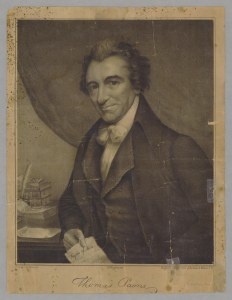
Thomas Paine, lith.by Bufford

Thomas Paine, lith. by Bufford ca. 1838

First, Raisin StreetOriginally dubbed Reason Street, after Thomas Paine’s The Age of Reason; between Bleecker and Bedford Sts.; name changed in 1828. New York’s accent is said to have transformed Reason Street into Raison Street–over time altered further and even written as Raisin Street.  It seems to me, though, that both names must have coexisted, as Paine left America for France to aid in the French Revolution, and raison is the French word for reason. Trinity Church, which owned land along the street, was unhappy about this commemoration of the free-thinking “atheistic” Paine–who certainly recognized a Supreme Being–and got the street renamed for Thomas Barrow, an artist whose 1776 drawing of Trinity’s great fire was very popular. Below is an 1861 lithograph by George Hayward, based on Barrow’s drawing made on the spot.

Barrow, Ruins of Trinity Church, 1776

Barrow, Ruins of Trinity Church, 1776

Second, Murderers’ Row:  The usual etymology for this term is plausible–that it derives from a row of cells in New York’s Tombs reserved for the most dastardly of criminals. This passage from Meyer Berger’s The Eight Million: Journal of a New York Correspondent (Columbia University Press, 1983), while not a contemporary description, does testify to a separate domicile for murderers. 

There were four tiers of cells. Convicted prisoners had the ground floor and those awaiting trial had the other three; murderers occupied the second, burglars and arsonists the third, and minor offenders the fourth. Homeless children seven and eight years old were thrown into cells with prostitutes, alcoholics, and cutpurses.

Yet this fact gleaned from Charles A. Hemstreet’s Nooks and Crannies of Old New York (Scribner, 1899) may give pause: Murderers’ Row was an actual alley long before the Civil War, starting where Watts Street ended at Sullivan Street, midway along the block between Grand and Broome Streets. Now part of the fashionable Soho district, Murderers’ Row was one of many mean streets in the neighborhood later known as Darktown–as the Chinese had Chinatown and the Jews had Jewtown (yes, that was what they called the Lower East Side in the years before 1900; and there was a “Jew’s Alley,” which ran from Madison St. between Oliver and James Streets).

The alley that Hemstreet called “Murderers’ Row” existed in 1827 and was called “Otter’s-alley” in James Hardie’s Description of the City of New York, which was printed and published in that year by Samuel Marks, 63 Vesey Street. From this book I was also able to confirm that all the streets mentioned in Hemstreet had indeed been cut through: Sullivan, Watts, Grand, and Broome. The alley/row ran east-west, connecting Sullivan and Thompson Streets.

The sticking point: precisely when someone called this thoroughfare Murderers’ Row, in print, for the first time. Let me quote from Paul Dickson’s estimable Dictionary of Baseball Quotations (Facts on File, 1989):

ETY/1ST 1858. According to Bill Bryson in his April 1948 Baseball Digest article entitled ‘Why We Say It,’ the writer who first called the Ruth-Gehrig-Meusel-Lazzeri combo Murderers’ Row, ‘… probably drew praise from his boss for a “fresh, vibrant phrase.” He then points out, ‘Well, it had been used in a New York newspaper’s account of a game a few years before that–about seventy years in fact. The 1858 writer got it from the name given the isolated rows of cells containing dangerous criminals in the Tombs prison in New York.’ Edward J. Nichols concurs, pointing out in his dissertation that there is a clipping in Henry Chadwick’s Scrapbook from 1858 in which it was applied to a lineup of power hitters.
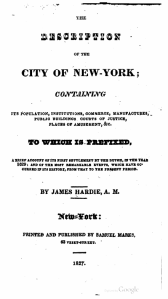
Hardie, 1827

Hardie, 1827

Boy, I’d love to see that clip, as Chadwick abhorred the slugging style of play and is himself unlikely to have coined the term Murderers’ Row as a colorful approbation. Moreover, the Tombs opened for business in 1838 and the alley almost surely predates that year. My belief is that the Tombs sense of the phrase Murderers’ Row cannot be earlier than 1840, and that the alley-way provides an earlier usage.

Checking an 1827 listing of street names, I found that Hemstreet’s location matched a street name: Otter’s Alley. As you will see in an entry below, “Otter’s Alley formerly ran from Thompson to Sullivan Sts. between Broome and Grand Sts.”–very nearly the same wording as in Hemstreet. 

Enough preamble; on with the show, from Valentine’s Manual of Old New York, 1923; No. 7, New Series; edited by Henry Collins Brown.

STREET NAMES WHICH HAVE BEEN CHANGED OR ARE NOW OBSOLETE IN THE BOROUGH OF MANHATTAN, NEW YORK CITY—1922.

By George Henry Stegmann

The following information regarding Old New York Streets was obtained from the following sources:

VALENTINE’S MANUAL — 1855; 1860; 1861; 1862; 1864; 1865; 1866.
Haswell — Reminiscences of an Octogenarian.
Hill — Story of a Street (Wall Street).
Historical Guide to the City of New York — .
Innes — New Amsterdam and its People.
Jenkins — The Greatest Street in the World.
Jenkins — The Old Boston Post Road.
Lossing — History of New York City.
Lamb — History of New York City.
Mott — New York City of Yesterday.
Pasko — New York Old and New.
Post — Old Streets, Roads, Lanes, etc., of New York.
Riker — History of Harlem.
Valentine — History of New York City.
Wilson — New York Old and New.
Plan of the City of New York—
1665, Duke’s Plan.
1695. Duke’s Plan.
1728, Jas. Lyne.
1742, D. Grim.
1764, S. Bellini.
1755, F. Maerschaick.
1766, B. Ratzer.
1775, John Montressor.
1797.
1803, Goerck & Mangin.
1807, Wm. Bridges.
1817, T. H. Poppelton.
1851.
1865.
1868.
Bromley’s Atlas of the Borough of Manhattan.

[Many street names have been entirely discontinued. Old Love Lane, formerly Twenty-first Street west of Fifth Avenue, is a case in point. And this list might easily be lengthened. We ought to celebrate great Americans when new names are needed, and get away from the tiresome numerical system heretofore slavishly followed.]

Abingdon Place was the former name of West 12th St. between Hudson and Greenwich Sts. It was laid out about 1807; known then as Cornelia St.; in 1817 known as Scott St.

Abingdon Road, see Love Lane.

Abattoir Place was the former name of West 12th St. between 11th Ave. and the Hudson River.

Achmuty Lane was in block bounded by Water, South, Pike and Rutgers Sts.

Adams Place was the former name of West Broadway between Spring and Prince Sts.

Albany Avenue formerly ran from 26th St. between 5th and Madison Ave. northwesterly, crossing 5th Ave. between 29th and 30th St. to the corner of 6th Ave. and 42nd St., then northerly on the present line of 6th Ave. to 93rd St.

Albion Place was the former name of East 4th St. between 2nd Ave. and the Bowery.
Amity Alley (or Amity Place) was formerly in the rear of No. 216 Wooster St.

Amity Lane was a country lane which commenced at Broadway, about fifty feet north of Bleecker St. and ran northwesterly to 6th Ave. just south of 4th St.

Amity Street was the former name of West 3rd St. between Broadway and 6th Ave.

Amos Street was the former name of West 10th St. between Greenwich Ave. and the Hudson River.

Ann Street was the former name of Grand St. between Broadway and the Bowery. It was laid out in 1797 and its name was changed to Grand St. in 1807.

Ann Street was [also] the former name of Elm St. between Reade and Franklin Sts. Name was changed in 1807.

View of a Section of Ann and Nassau Streets, Taken From Around the Corner, Anderson and Davis, Mirror, Sept 4, 1830

View of a Section of Ann and Nassau Streets, from Around the Corner, Anderson and Davis, Mirror, Sept 4, 1830

Anthony Street, Duane St. was called by this name at one time.

Anthony Street was the former name of Worth St. between Hudson and Baxter Sts. It was laid out in 1795; known in 1797 as Catherine St.; known in 1807 as Anthony St.

Arch Place was in the rear of No. 109 Canal St., between Church St. and West Broadway.
Arden Street was the former name of Morton St. between Varick and Bleecker St.; name was changed in 1829. It was also called Eden St.

Arundel Street was the former name of Clinton St. from Division to Houston Sts. It was laid out about 1760; name changed to Clinton St. in 1828.

Art Street was the former name of Astor Place. Originally it was a lane leading from the Bowery to a part of the Stuyvesant Farm. It was known as Art St. in 1807.

Ashland Place was the former name of Perry St. between Waverly Place and Greenwich Ave.

Asylum Street was the former name of West 4th St., between 6th Ave. and 13th St.

Augustus Street was the former name of City Hall Place. It was laid out about 1795; known as Augustus St. in 1797.

Bache Street, Beach St. was called by this name at one time.

Bailey Street was laid out through the New York Common Lands, it ran from Broadway to Albany Ave. between 25th and 26th Sts.

Bancker Street, Duane St. was at one time called by this name.

Bancker Street was the former name of Madison St. between Catherine and Pearl Sts. It was projected about 1750; known as Bancker St. in 1755; known as Madison St. since.

Bannon Street was the former name of Spring St.

Bar Street as laid out, ran from Grand St. to the East River between Scammel and Jackson Sts. It was also called Fir St.

Barley Street was the former name of Duane St. from Rose to Hudson Sts. It was laid out in 1791; name changed to Duane St. in 1807.

Barrack Street was the former name of Tyron Row (now obsolete); known by this name in 1766.

Barrick Street; Exchange Place was known by this name at one time.

Barrow Street; West Washington Place, between Macdougal and West 4th St., was known by this name at one time.

Batavia Lane was name of Batavia Street.

Battoe Street; Dey St. was so called at one time.

Bayard Place, now called Charles Lane; a narrow street running from Washington West St. between Charles and Perry Sts.

Bayard Street, Stone St. was so called at one time, Beaver Lane was the first name of Morris St.

Bedlow Street was the former name of Madison St. between Catherine and Montgomery Sts. It was known by this name in 1797; known as Bancker St. in 1817.

Belvedere Place was the former name of West 10th St.

Benson’s Lane was the former name of Elm St.

Bever Graft, Bever Straat, Bever Paatjie, were the Dutch names of Beaver St. from Broadway to Broad St.

Beurs Straat was the Dutch name of Whitehall St.

Bloomfield Street formerly ran from No. 7 10th Ave. to the Hudson River (now closed).

Clendening Mansion at Bloomingdale Road, Valentine's Manual, 1863

Clendening Mansion at Bloomingdale Road, Valentine’s Manual, 1863

Bloomingdale Road started at 23rd St., being the continuation of Broadway at that point. It followed the present Broadway as far as 86th St., where it veered easterly, running between Broadway and Amsterdam Ave. At 104th St. it again followed the line of Broadway until reaching 107th St., where it turned slightly westerly until it met the present easterly roadway of Riverside Drive, following it to 116th St., where it turned easterly, crossing Broadway at 126th St. and meeting Old Broadway at Manhattan St. (the present Old Broadway between Manhattan St. and 133rd St. is a part of the original road). From 133rd St. it ran slightly east of the present Broadway into Hamilton Place at 138th St., following Hamilton Pl. to its termination at Amsterdam Ave. and 144th St., from there running northeasterly and ending at the junction of Kingsbridge Road, just east of St. Nicholas Ave. and 147th St.

Bogart Street formerly ran from No. 539 West St. west to the Hudson River.

Boorman Terrace, West 32nd St. between 8th and 9th Ave.

Boston Post Road, see Eastern Post Road.

Bott Street was the former name of Elm St.

Boulevard, The, was the former name of Broadway from 59th to 155th St., it was opened in 1868 and name changed to Broadway on Jan. 1, 1899.

Boulevard Place was the former name of West 130th St. from 5th to Lenox Ave.

Bowery Lane. The Bowery was called by this name in 1760; since 1807 known as the Bowery.

Bowery Place was in the rear of No. 49 Christie St., between Canal and Hester Sts.

Bowling Green, Cherry St. was called by this name at one time.

Breedweg, Breedwegh. Broadway between Bowling Green and Park Row was known by these names during the Dutch occupancy of the City.

Brevoort Place was the former name of West 10th St. between Broadway and University Place.

Brewers Hill was the former name of Gold St.

Bride Street was the former name of Minetta St. from Bleecker St. to the bend in the street.

Bridge Street was one of the former names of Elm St.

Broad Wagon Way, The, was the name of Broadway in 1670.

Broadway Alley formerly ran from No. 153 East 26th St. north to 27th St.

Brook Street was the former name of Hancock St.

The Island of Manhados (with inset plan of) The Towne of New-York [The Nicolls Map or Survey], 1664-8.

The Island of Manhados (with inset plan of) The Towne of New-York [The Nicolls Map or Survey], 1664-8.

Brouwer Straat (Brewer’s St.) was the name of the Dutch first gave to the present Stone St. It was one of the earliest streets laid out by them and received this name on account of the Brewery of the West India Co. being located on it. Since 1797 has been known as Stone St., having been called High St. in 1674, and Duke St. in 1691.

Brugh Straet (Bridge Street) was one of the early Dutch Streets and received this name on account of it being the street which led to the bridge over the Canal in Broad St.; known as Bridge St. in 1674; as Hull St. in 1691; and as Bridge St. since 1728.

Brugh Steegh (Bridge Lane) was a narrow street, about twenty-two feet wide, which ran between Bridge and Stone Sts. It was closed about 1674.

Budd Street was the former name of Van Dam St.

Bullock Street was the former name of Broome St.; known by this name in 1766; since 1807 known as Broome St.

Burgers Path was the Dutch name of a part of William St.

Burling Lane was a country road which commenced at the present Broadway, between 17th and 18th Sts., and ran southwesterly, meeting the Southampton Road at about the present 6th Ave. and 16th St.

Burnet Street was the former name of Water St. between Wall St. and Maiden Lane.

Burr Street was the former name of Charlton St.

Burrows Street was the former name of Grove St. In 1807 was known as Columbia St. and since 1817 as Burrows St.

Burton Street was the former name of LeRoy St. from Varrick to Bleecker Sts.

Bushwick Street was the former name of Tompkins St.

Camden Place was the former name of East 11th St. between Avenue B and C.
Caroline Street was at the head of Duane St. Slip.

Carroll Place was the former name of Bleecker St. between West Broadway and Thompson St.

Cartmans Arcade was an Alley which ran south at No. 171 Delancey St., now closed.

Catherine Place was the former name of Catherine Lane.

Catherine Street was the former name of Worth St.; known in 1797 as Catherine St.; in 1807 as Anthony St.

Catherine Street was the former name of Waverly Pl. between Christopher and West 12th St.; known by this name in 1807.

Catherine Street was the former name of Mulberry St. between Bayard and Bleecker St.; known by this name in 1797.

Catherine Street was the former name of Pearl St. between Broadway and Elm St.; was also called Magazine St.

Cato’s Lane started at the Eastern Post Road, about the present 2nd Ave. between 52nd and 53rd St., and ran southeasterly to the East River at Ave. A between 50th and 51st Sts.

Chapel Street was the former name of West Broadway from Murray to Canal St.; known by this name in 1797; name changed to College Place in 1830. Chappel Street was the former name of Beekman St. Charles Chappel Street was the former name of Beekman St.

Charles Alley was the former name of Charles Lane.

Charlotte Street was the former name of Pike St. between Cherry and Division Sts.; was known by this name in 1791.

Pearl and Chatham, Valentine's Manual, 1861

Pearl and Chatham, Valentine’s Manual, 1861

Chatham Street was the former name of Park Row. This street was originally part of the Bowery; called Chatham St. in 1774, changed to Park Row in 1886.

Cheapside was the former name of Hamilton St. between Catherine and Market Sts.; was known by this name in 1797; name changed to Hamilton St. on Aug. 27, 1827.

Chestnut Street was the former name of Howard St. between Broadway and Mercer Sts.; known in 1807 as Hester St.

Chester Street was the former name of West 4th St. between Bank and Christopher Sts.

Chrystie Street was the former name of Cherry St.

Church Lane was one of the first streets laid out in the village of Harlem, it ran from 117th St. between 3rd and 4th Aves, northerly to 120th St., then northeasterly, crossing 3rd Ave. at 121st St., 2nd Ave. at 123rd St. and ending at the Harlem River between 125th and 126th Sts.

Church Street was the former name of Exchange Place between Broadway and William St.

Clendenning’s Lane was a country road which started in Central Park about on line with 6th Ave. and 105th St. and ran westerly along the southerly side of 105th St. to the middle of the block between Columbus and Amsterdam Ave., then southwesterly to the Bloomingdale Road, at about a point fifty feet south of 103rd St.

Clermont Street was the former name of Mercer St.; known in 1797 as First St. and since 1807 as Mercer St.

Clermont Street was the former name of Hester St. between Center St. and Broadway and of Howard St. between Broadway and Mercer St.

Clinton Place was the former name of West 8th St., from Broadway to 6th Ave.

Colden Street was the former name of Duane St., from Lafayette to Rose St.; known by this name in 1803.

College Place was the former name of West Broadway from Barclay to Warren Sts.; known in 1755 as Chapel St.; name changed to College Pl. in 1830.

Collet Street was the former name of Center St. from Hester to Pearl Sts.; known by this name in 1807 to 1817.

Columbia Place was the former name of a part of 8th St.

Columbia Street was the former name of Grove St.; was also called Burrows and Cozine Sts.

Columbia Street was the former name of Jersey St.

Commerce Street was the former name of Barrow St.

Commons Street. Park Row was so called at one time.

Concord Street was the former name of West Broadway from Canal to 4th Sts.

Congress Place was the former name of an Alley in the rear of No. 4 Congress St.

Coopers Street was the former name of Fletcher St.

Cop Street was the former name of State St.

Cornelia Street was the former name of West 12th St. between Greenwich Ave. and Hudson St.

Cottage Place was the former name of East 3rd St. between Avenue B and C.

Cottage Row was the former name of 4th Ave. between 18th and 19th Sts.

Crabapple Street was the former name of Pike St.

Cropsie Street was the former name of State St.

Cozine Street was the former name of Grove St.

Cross Street was the former name of Park St.

Crown Point Street was the former name of Grand St. from the Bowery to the East River.

Crown Point Street was the former name of Corlears St.

Crown Point Street was the former name of Water St. between Montgomery St. and the East River.

Crown Street was the former name of Park St.; known in 1797 as Cross St.

Crown Street was the former name of Liberty St.; it was laid out about 1690; at one time called Tienhoven St.; name changed to Liberty St. in 1783.

Custom House St. was the former name of Pearl St., between Whitehall St. and Hanover Square.

David Street was the former name of Bleecker St., between Broadway and Hancock St.; name changed in 1829.

David Street was the former name of Clarkson St. between Varick and Hudson Sts.

Decatur Place was the former name of 7th St. between 1st Ave. and Avenue A.

Depau Row was the former name of Bleecker St. between Thompson and Sullivan Sts.

Desbrosses Street was the former name of Grand St. between Broadway and Varick St.
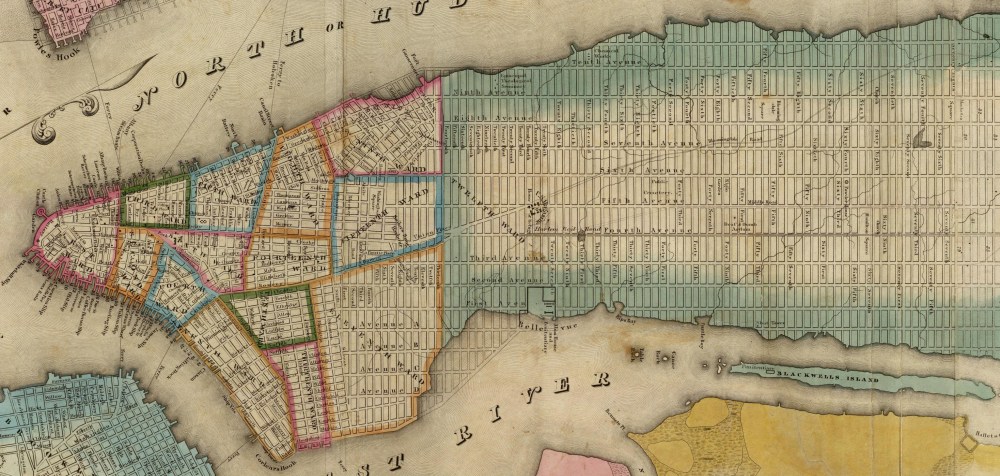
Extract from David Burr Atlas, NYC Ward Map, 1832.

Extract from David Burr Atlas, NYC Ward Map, 1832.

Dirty Lane was the former name of South William St. This street was opened about 1656 and was called by the Dutch Slyck Steegh, meaning Dirty Lane. In 1674 it was called Mill Street Lane; name changed to South William St. about 1832.

Division Street was the former name of Fulton St. between Broadway and West St.

Dixson’s Row was the name given to a part of 110th St. between 8th and Columbus Ave.

Dock Street was the former name of Pearl St. between Whitehall St. and Hanover Square.

Dock Street was the former name of Water St. between Coenties Slip and Beekman St.

Dommic Street was the former name of Dowling St.

Donovan’s Lane was near No. 474 Pearl St.

Duggan Street was the former name of Canal St. between Center and West Sts.

Duke Street was the former name of Stone St. During the Dutch times a part was known as Brouwers Straet, and another part as Hoogh Straet; in 1674 was known as High St. and a part as Stone St. In 1691 it was called Duke St. and since 1797 has been known as Stone St. This street was the first to be paved with stone in the City.

Duke Street was the former name of Vanderwater St.; it was known by this name in 1755.

Duncomb Place was the former name of East 128th St. between 2nd and 3rd Aves.

Dunscombe Place was the former name of East 50th St. between 1st Ave. and Beekman Place.

Dunham Place was the former name of an Alley running south from 142 West 33rd St., now closed.

Dwar’s Street was the former name of Exchange Place between Broadway and Broad St.

Dyes Street. Dey Street was so called in 1767.

Eagle Street was the former name of Hester St.; it was laid out about 1750; known in 1755 as Hester St.; in 1766 as Eagle St., and since 1807 as Eagle St.

East Bank Street was an old road in Greenwich Village; it ran from 7th and Greenwich Ave. northeasterly to the Union Road in the block now bounded by 6th and 7th Aves., 13th and 14th Sts.

East Court was in West 22nd St. near 6th Ave.; now closed.

East George Street was the former name of Market St.

Eastern Post Road started at the present Broadway and 23rd St. and ran northeasterly across Madison Square to about 30th St. just west of Lexington Ave.; it then ran northerly, parallel to Lexington Ave. to 36th St., there veering easterly, crossing 3rd Ave. at 45th St. and then running northerly, midway between 2nd and 3rd Ave. to 50th St., where it turned northeasterly. Crossing 2nd Ave. at 52nd St., from there it ran northerly, midway between 1st and 2nd Aves. At 57th St. it turned slightly westerly, crossing 2nd Ave. at 62nd St., 3rd Ave. at 72nd, and Lexington Ave. at 76th St. It then ran northerly and northeasterly, recrossing Lexington Ave. at 77th St., then northeasterly, northerly and northwesterly, crossing 5th Ave. at 90th St., then northerly through Central Park, recrossing 5th Ave. at 109th St., Central Park, recrossing 5th Ave. at 109th St., 4th Ave. at 115th St., then northeasterly between 3rd and 4th Ave. to the Harlem River at 130th St. and 3rd Ave. This road was also called the Boston Post Road. It was closed in 1839.

East Place formerly ran in the rear of Nos. 184-186 East 3rd St., between Avenue B and C.

East Road was the former name of 4th Ave. between 37th and 90th Sts.

East Street was the former name of Mangin St.

East Tompkins Place was the former name of East 11th St. between Ave. A and B.

Ratzer Map, 1769

Ratzer Map, 1769

Eden Street was the former name of Morton St. between Bedford and Bleecker Sts. It was also called Arden St.

Eden’s Alley; see Ryder’s Alley.

Edgar Street was the former name of Morris St.

Edgars Alley was the former name of Exchange Alley.

Eighth Street was the former name of Hancock St.

Elbow Street was the former name of Cliff St.

Eliza Street was the former name of Waverly Place.

Eliza Street was a country road on the Kips Bay Farm. It started in the block bounded by 2nd and 3rd Aves., 28th and 29th Sts., and ran northeasterly, crossing 2nd Ave. at 35th St. and ended at 39th St., between 1st and 2nd Aves. It ran at right angle to two other old roads; Kips Bay St. and Maria St.

Ellet’s or Elliotts Alley was the name by which Mill Lane was known in about 1664. Elm Street was the former name of Lafayette St. between Worth and Spring Sts.

Erie Place was the former name of Duane St. between Washington and West Sts.

Exchange Court was in the rear of No. 74 Exchange Place.

Exchange Street was the former name of Beaver St. between William and Pearl Sts.

Exchange Street was the former name of Whitehall St.

Exchange Street was the former name of Marketfield St. In 1791 it was called Petticoat Lane.

Extra Place was an alley which ran north from 1st St. between the Bowery and 2nd Ave.

Factory Street was the former name of Waverly Place between Christopher and Bank Sts. It was also called Catherine St.

Fair Street was the former name of Fulton St. from Broadway to the Hudson River, east of Broadway it was called Partition St. It was laid out about 1720.

Farlow’s Court was formerly in the rear of Nos. 153, 155, 157, 159 and 161 Worth St.

Fayette Street was the former name of Oliver St. It was known as Oliver St. since 1825. From Park Row to Madison Sts.

Feitner’s Lane, see Verdant Lane.

Ferry Street was the former name of Bayard St.

Ferry Street was the former name of Peck Slip.

Ferry Street was the former name of Jackson St. between Division and Cherry Sts.; was known by this name in 1807; was also called Ferry Place.

Ferry Street was the former name of Scammel St.

Field Street, Fieldmarket Street were the former names of Marketfield St.

Fir Street ran from Grand St. to the East River between Scammel and Jackson Sts., now closed, it was also called Bar St.

Fifth Street was the former name of Orchard St.

Fifth Street was the former name of Thompson St.

Fifth Street was the former name of Washington St.

First Street was the former name of Christie St. from Division to Houston St. was known by this name in 1766.

First Street was the former name of Merces St.; was called Clermont St. in 1797; since 1807 known as Mercer St.

First Street was a former name of Greenwich St.

Fisher’s Court was in the rear of Nos. 22, 24 and 26 Oak Street, between Roosevelt and James Sts.

Fisher Street was the former name of Bayard St., from the Bowery to Division St., known by this name in 1755; since 1807 known as Bayard St.

Fitzroy Place was the former name of West 28th St. between 8th and 9th Aves.

Fitzroy Road, see Roy Road.

Flattenbarrack Street was one of the former names of Exchange Place, between Broadway and Broad St., it was known by this name in 1728.

Fourth Street was the former name of Allen St. between Division and Houston Sts.

Fourth Street was the former name of West Broadway between Canal and West 4th Streets.

Franklin Terrace was in the rear of No. 364 West 36th St.

French Church Street was the former name of Pine Street between Broadway and William St.
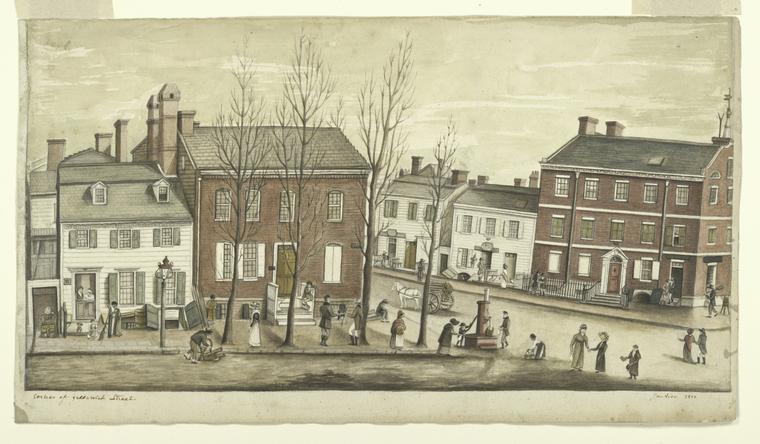
Greenwich Street 1810

Greenwich Street 1810

Front Street was the former name of Greenwich St.

Fulton Street was a former name of Nassau St.

Garden Lane was the former name of Exchange Alley; was also known as Tin Pot Alley.

Garden Row was the former name of Nos. 140 to 158 West 11th St.

Garden Street was one of the former names of Exchange Place. This Street was laid out during the Dutch rule and was called by them Tuyn (Garden) Straet; in 1691 it was known as Church St., in 1728 as Garden St. and a part as Flattenbarrack; in 1797 it was all called Garden St. Garden Street was the former name of Cherry St. from Montgomery to Corlaers Sts.

Gardiner Street was the former name of Tompkins St.

Gen. Greene Street was the former name of Governeur St. George Street was the former name of Beekman St.

George Street was the former name of Bleecker St. between Hancock and Bank Sts.

George Street was the former name of Hudson St.

George Street was the former name of Market St. between Division and Cherry Sts. It was known by this name in 1791.

George Street was the former name of Park St.

George Street was the former name of Rose St.

George Street was the former name of Spruce St. It was laid out about 1725 as George St.; in 1817 it was known as Little George St.

Germain Street was the former name of Carmine St.

Gibb Alley ran from Madison St., between Oliver and James Sts., northwesterly about one-half a block.

Gilbert Street was the former name of Barrow St. between Bleecker and West 4th Sts.

Gilford Place was the former name of East 44th St. between 3rd and Lexington Ave.

Glassmakers Street, Glazier Street, was a former name of William St. between Pearl and Wall Sts.

Glover Place was one of the former names of Thompson St. between Spring and Prince Sts.

Golden Hill was the former name of John St. between William and Pearl Sts.

Grand Avenue was the former name of 125th St.

Great Dock Street was one of the former names of Pearl St. This street was known in 1657 as Pearl St.; in the same year was also known as Hoogh St. and the Waal; in 1691 as Great Dock and Great Queen Sts.; in 1728 as Queen St.; in 1728 as Queen St. in 1797 it was known as Pearl St. as far north as Park Row, the rest being called Magazine St. Since 1807 the entire street has been known as Pearl St.

Great George Street was the name Broadway, north of the City Hall Park, was known by in 1791.

Great Kiln Road see Southampton Road.

Green Alley or Lane was the former name of Liberty Place.

Greenwich Lane was the former name of Gansevoort and Greenwich Ave.

Greenwich Street, Washington St. was called by this name at one time.

Green Street was a former name of Liberty St.

Garry Place was the former name of West 35th St. between 7th and 8th Aves. Hamilton Place was the former name of West 5lst St.

Hamilton Place was the former name of West 51st St. between Broadway and 8th Ave.

Hammersly Street was the former name of West Houston Street between Macdougal St. and the Hudson River.

Hammond Street was the former name of West 11th St. between Greenwich Ave. and the Hudson River.

Hanson Place was the former name of 2nd Ave. between 124th and 125th Sts.
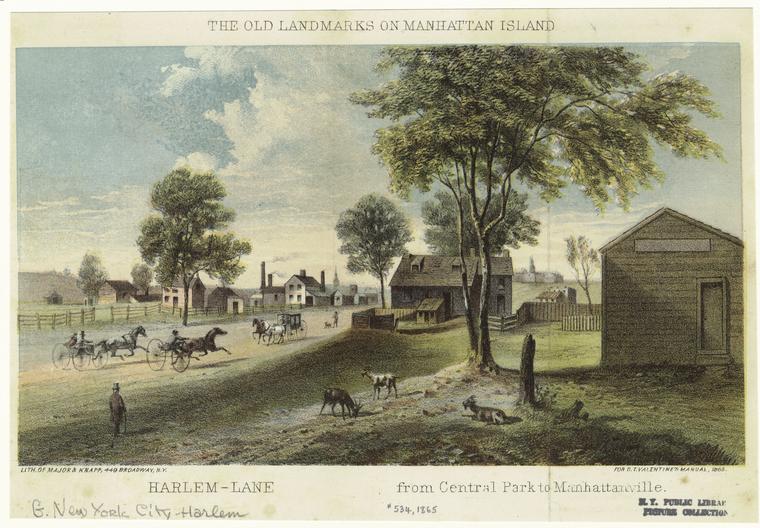
Harlem Lane, Sarony and Major, Valentine's Manual, 1865

Harlem Lane, Sarony and Major, Valentine’s Manual, 1865

Harlem Lane. The present St. Nicholas Ave. from 110th to 123rd Sts. was called by this name; it was part of the Kingsbridge Road.

Harlem Road (The Old) was a country road leading to the Village of Harlem; it started at the junction of the Eastern Post Road in the Central Park about on a line of 108th St. and between 5th and Lenox Ave. running northeasterly; crossing Madison Ave. at between 113th and 114th Sts., Park Ave. between 115th and 116th Sts., Lexington Ave. between 117th and 118th Sts.; 2nd Ave. at 123rd St.; 1st Ave. at 125th St., and ending at the Harlem River at the foot of 126th St.

Harlem Road started at the Eastern Post Road, about the present 95th St. between Madison and 5th Ave.. and ran northeasterly, crossing Madison Ave. at 99th St.; Park Ave. at 108th St., Lexington Ave. at 116th St. and ending at the Harlem River at 129th St.

Harmon Street was the former name of East Broadway; it was originally a lane, known as Love Lane that led to the Rutgers Farm.

Harsen’s Lane was a country road which connected the Village of Harsenville (70th St. & Broadway) with the eastern part of the Island; it commenced at the Bloomingdale Road (the present Broadway) between 71st and 72nd Sts. and ran easterly about on line of the present 71st and ended at the Middle Road; the present 5th Ave. and 71st St.

Hazard Street was the former name of King St.

The Graft or Canal (Heer Graft ), 1659

The Graft or Canal (Heer Graft ), 1659

Heer Graft (High Ditch) was the name given by the Dutch to the present Broad St. between Beaver and Pearl Sts. in 1657; it was one of the earliest streets laid out in the City, and received its name on account of the narrow Canal which ran through the center. This canal was filled in about 1676 and the street was called Broad St.; it was sometimes spelled Heeren Gracht.

Heere Straet, Heere Wegh, Heere Waage Wegh, were the Dutch names for the present Broadway between Bowling Green and the City Hall Park.

Hell Gate Ferry Road was a country road which ran from the East River at the foot of 90th St. southwesterly, joining the Eastern Post Road at Madison Ave. and 82nd St.

Hereweg. The Dutch name of the present Park Row from Broadway to Chambers St.

Herman Place was in the rear of Nos. 194, 1%, 198 Fourth St. between Avenues A and B.

Henry Street was the former name of Perry St.

Herring Street was the former name of Bleecker St. between Carmine and Banks Sts.; known by this name in 1817; name changed to Bleecker St. in 1829.

Herring Street was the former name of Mercer St.

Hester Court was formerly in the rear of No. 101 Hester St.

Hester Street was the former name of Howard St.

Hett Street, Hetty Street, were the former names of Charlton St.

Hevins Street was the former name of Broome St. between Broadway and Hudson Sts.; was also known as St. Hevins St.

High Street was the former name of Madison St. from Montgomery to Grand Sts.

High Street was the former name of Stone St.; known by this name in 1674.

Hohoken Street formerly ran from No. 474 Washington St. west to West St., now a part of Canal St.

Hoogh Straet (High Street) was the name of Stone St. east of Broad St. prior to 1664.

Hoppers Lane was a country road which ran from the Bloomingdale Road (the present Broadway), just south of 5lst St. westerly to the Hudson River at the foot of 53rd St.

Horse and Cart Lane was the name of part of William St.

Houston Street was the former name of Prince St. between Broadway and Hancock St.

Hubert Street was the former name of York St.

Hudson Place was the former name of West 24th St. between 8th and 9th Aves.

Hudson Street was the former name of West Houston Street between Broadway and Hancock St.

Hull Street was the former name of Bridge St. between Whitehall and Broad Sts.; known as Bridge St. in 1676; Hull St. in 1681; and Bridge St. since 1728.

Part two at https://gothamhistory.com/2015/06/09/street-names-changed-or-now-obsolete-part-2/.
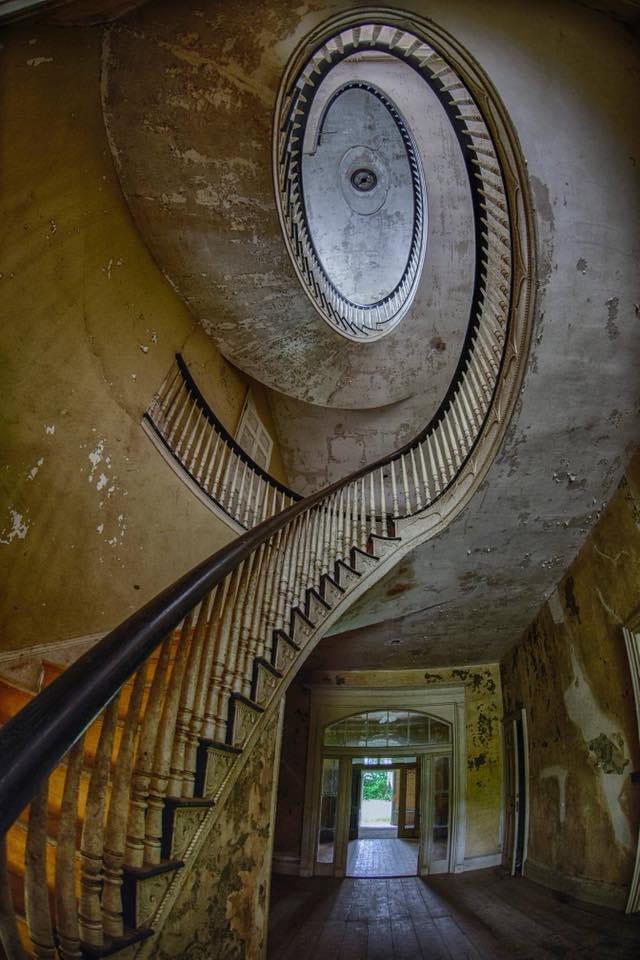
Wart’s in a Name?

BenjaminHere is another guest spot from Vernon Benjamin. Not exactly about Gotham, but at less than twenty miles away, Dobbs Ferry is in the city’s orbit. (Heck, so is everything south of Albany, I figure.) And besides, the renaming of streets and institutions in the wake of the Revolutionary War was a commonplace in New York City–King’s College becoming Columbia; Queen Street becoming Pearl Street; Duke Street becoming Stone Street; and so on. (Indeed, the very next post in this space will be a list of all the old street names, going back to Dutch times, and what later became of them.) This year Mr. Benjamin published a work two decades in the making, the indispensable The History of the Hudson River Valley: From Wilderness to the Civil War. The story below will appear in that book’s sequel, The History of the Hudson River Valley: 1865-2015, forthcoming from Overlook Press.

Dobbs Ferry lost its name for forty years after 1830. Van Brugh Livingston (1792-1868), who had a mansion on the river, filed deeds naming the dockside “Livingston’s Landing,” to the great dissatisfaction of the locals. Westchester already had too many identity changes with the incredible period of growth that was occurring in the birthing of America, and was exploding in uncomfortable ways in the industrial and urban expansion of the times. True, a similar proliferation of country seats, recreational resources, and waterfront accessories along the Hudson and Long Island Sound ameliorated some of these distasteful changes, but where would it stop?

Livingston's Landing

Livingston’s Landing

New York City’s need for the county’s rich water resources was preventing significant growth in the central and northeastern areas of the county, a mixed blessing for all but the city. Livingston’s new dockside was part of the commercial growth, and the change in identity brought with it new frustrations for the locals to endure. Some of the river towns, to be sure, were benefiting from their identification with the Ichabod Crane land of Washington Irving, but now this. Would the whole of the American Revolution be thrown out with the names?

The dugout canoe ferry that Jeremiah Dobbs began using at Willow Point in the eighteenth century had continued in successively reinvented forms until, by 1915, a light motorboat came into use. The boat was summoned by a wooden signal with a rope that, when pulled, displayed a black square on white wood clearly visible from across the river. So why change the name of the place so long associated with this ferry? The notion annoyed the old-timers like a bad tooth, even though there were uncomfortable associations with the original name. Dobbs was a Loyalist on the British side during the Revolution.

Capture of André 1780, by Currier 1845

Capture of Andre 1780, by Currier, 1845

After Livingston’s death, in 1870 a meeting was convened to come up with a better choice of names for this historic place. Resuming the old Dobbs Ferry name was frowned upon because of Dobbs’ association with the British. Yet the fame of the town, as with the region, had grown as a result of the Benedict Arnold scandal over the treason of West Point and the capture of his British co-conspirator, John André (1750-80). André’s ship, the Vulture, retreated to the waters off Dobbs Ferry after being chased off from Verplanck’s Point by patriots with cannon, a distance too great for André to have traversed by rowboat from Haverstraw Bay, where he had met with Arnold; he had to take an overland route, and that let to his capture. In contrast to the taint of loyalism in the ferryman’s family, the obvious choice for the new Dobbs Ferry seemed to be the patriotic one.

Capture of Andre 1780; Currier and Ives, 1876

The Capture of Andre, by Currier and Ives, 1876

But which one? Three men out on patrol on militia duty—or, as André and the American colonel Benjamin Talmadge (1754-1835) claimed, brigands looking for some booty to steal—had captured the British spy. The crowd discussed the idea of renaming the location “Paulding-on-Hudson” in honor of one of the captors, but an old man rose and made a speech against it, perhaps remembering that John Paulding (1758-1818) was born in Peekskill. He said he had known Paulding personally “and could not brook him.” No one was interested in another Williamstown—after David Williams (1754-1831), another of the captors—so the man suggested that the third member of the threesome that caught André might make a good choice. He was Isaac Van Wart (1762-1828), and if the Van were dropped, the old fellow suggested, the town could comfortably be called “Wart-on-Hudson.”

The amusement that the suggestion provoked may have been tempered by the changing nature of the county itself, but it also showed that the community could appreciate the humor in a historic name. The meeting, and the idea, broke up in guffaws. The town dropped the Livingston manorial name and resumed using the old moniker of the Tory ferryman. Bygones were going to be bygones after all.

They Who Knock at Our Gates

This stirring piece is extracted from Mary Antin’s “Judges in the Gate, from They Who Knock At Our Gates,” first published in American Magazine in 1914. It was also issued in book form that year by Houghton Mifflin, with illustrations by the Futurist painter Joseph Stella. [http://goo.gl/n67zAK]. The national and ethnic origins of the immigrants were different but the story is, a century later, the same.thorn_ourgame

Stella_The Sinew and Bone of All NationsNeither does the immigrant’s civic reputation depend entirely on negative evidence. New York City has the largest foreign population in the United States, and precisely in that city the politicians have learned that they cannot count on the foreign vote, because it is not for sale. A student of New York politics speaks of the “uncontrollable and unapproachable vote of the Ghetto.” Repeated analyses of the election returns of the Eighth District, which has the largest foreign population of all, show that “politically it is one of the most uncertain sections” in the city. Many generations of campaign managers have discovered to their sorrow that the usual party blandishments are wasted on the East Side masses. Hester Street follows leaders and causes rather than party emblems. Nowhere is the art of splitting a ticket better understood. The only time you can predict the East Side vote is when there is a sharp alignment of the better citizens against the boss-ridden. Then you will find the naturalized citizens in the same camp with men like Jacob Riis and women like Lillian Wald. And the experience of New York is duplicated in Chicago and in Philadelphia and in every center of immigration. Ask the reformers.

How often we demand more civic virtue of the stranger than we ourselves possess! A little more time spent in weeding our own garden will relieve us of the necessity of counting the tin cans in the immigrant’s back yard.

As to tin cans, the immigrants are not the only ones who scatter them broadcast. How can we talk about the foreigners defacing public property, when our own bill-boards disfigure every open space that God tries to make beautiful for us? It is true that the East Side crowds litter the parks with papers and fruit-skins and peanut shells, but they would not be able to do so if the park regulations were persistently enforced. And in the mean time the East Side children, in their pageants and dance festivals, make the most beautiful use of the parks that a poet could desire.Stella_Rough Work and Low Wages for the Immigrant

There exists a society in the United States the object of which is to protect the natural beauties and historical landmarks of our country. Who are the marauders who have called such a society into being? Who is it that threatens to demolish the Palisades and drain off Niagara? Who are the vulgar folk who scrawl their initials on trees and monuments, who chip off bits from historic tombstones, who profane the holy echoes of the mountains by calling foolish phrases through a megaphone? The officers of the Scenic and Historic Preservation Society are not watching Ellis Island. On the contrary, it was the son of an immigrant whose expert testimony, given before a legislative committee at Albany, helped the Society to save the Falls of the Genesee from devastation by a power company. This same immigrant’s son, on another occasion, spent two mortal hours tearing off visiting-cards from a poet’s grave — cards bearing the names of American vacationists.

Some of the things we say against the immigrants sound very strange from American lips. We speak of the corruption of our children’s manners through contact with immigrant children in the public schools, when all the world is scolding us for our children’s rude deportment. Finer manners are grown on a tiny farm in Italy than in the roaring subways of New York; and contrast our lunch-counter manners with the table-manners of the Polish ghetto, where bread must not be touched with unwashed hands, where a pause for prayer begins and ends each meal, and on festival occasions parents and children join in folk-songs between courses!

If there is a corruption of manners, it may be that it works in the opposite direction from what we suppose. At any rate, we ourselves admit that the children of foreigners, before they are Americanized, have a greater respect than our children for the Fifth Commandment.

We say that immigrants nowadays come only to exploit our country, because some of them go back after a few years, taking their savings with them. The real exploiters of our country’s wealth are not the foreign laborers, but the capitalists who pay them wages. The laborer who returns home with his savings leaves us an equivalent in the products of labor; a day’s service rendered for every day’s wages. The capitalists take away our forests and water-courses and mineral treasures and give us watered stock in return.

Stella_The Ungroomed Mother of the East SideOf the class of aliens who do not come to make their homes here, but only to earn a few hundred dollars to invest in a farm or a cottage in their native village, a greater number than we imagine are brought over by industrial agents in violation of the contract labor law. Put an end to the stimulation of immigration, and we shall see very few of the class who do not come to stay. And even as it is, not all of those who return to Europe do so in order to spend their American fortune. Some go back to recover from ruin encountered at the hands of American land swindlers. Some go back to be buried beside their fathers, having lost their health in unsanitary American factories. And some are helped aboard on crutches, having lost a limb in a mine explosion that could have been prevented. When we watch the procession of cripples hobbling back to their native villages, it looks more as if America is exploiting Europe.

O that the American people would learn where their enemies lurk! Not the immigrant is ruining our country, but the venal politicians who try to make the immigrant the scapegoat for all the sins of untrammeled capitalism — these and their masters. Find me the agent who obstructs the movement for the abolition of child labor, and I will show you who it is that condemns able-bodied men to eat their hearts out in idleness; who brutalizes our mothers and tortures tender babies; who fills the morgues with the emaciated bodies of young girls, and the infirmaries with little white cots; who fastens the shame of illiteracy on our enlightened land, and causes American boys to grow up too ignorant to mark a ballot; who sucks the blood of the nation, fattens on its brains, and throws its heart to the wolves of the money market.

The stench of the slums is nothing to the stench of the child-labor iniquity. If the foreigners are taking the bread out of the mouth of the American workingman, it is by the maimed fingers of their fainting little ones.

And if we want to know whether the immigrant parents are the promoters or the victims of the child labor system, we turn to the cotton mills, where forty thousand native American children between seven and sixteen years of age toil between ten and twelve hours a day, while the fathers rot in the degradation of idleness.Stella_A Fresh Infusion of Pioneer Blood

From all this does it follow that we should let down the bars and dispense with the guard at Ellis Island? Only in so far as the policy of restriction is based on the theory that the present immigration is derived from the scum of humanity. But the immigrants may be desirable and immigration undesirable. We sometimes have to deny ourselves to the most congenial friends who knock at our door. At this point, however, we are not trying to answer the question whether immigration is good for us. We are concerned only with the reputation of the immigrant — and incidentally with the reputation of those who have sought to degrade him in our eyes. If statecraft bids us lock the gate, and our national code of ethics ratifies the order, lock it we must, but we need not call names through the keyhole.

Mount guard in the name of the Republic if the health of the Republic requires it, but let no such order be issued until her statesmen and philosophers and patriots have consulted together. Above all, let the voice of prejudice be stilled, let not self-interest chew the cud of envy in full sight of the nation, and let no syllable of willful defamation mar the oracles of state. For those who are excluded when our bars are down are exiles from Egypt, whose feet stumble in the desert of political and social slavery, whose hearts hunger for the bread of freedom. The ghost of the Mayflower pilots every immigrant ship, and Ellis Island is another name for Plymouth Rock.

Bathing at Coney Island

Richard K. Fox, 1883

Richard K. Fox, 1883

Richard K. Fox is best known as the editor of The National Police Gazette, which he purchased in 1877, its 33rd year of publication. Fox was what was known then as a sport, and he had added sporting coverage to the venerable scandal sheet’s specialties of murder and mayhem. The weekly’s pink-sheeted parade of buxom beauties in imminent danger of the unthinkable fueled the ascent of many boys into manhood, by way of the local tonsorial parlor. Not for nothing was The Police Gazette termed the “Bible of the Barbershop.” As it surpassed the circulation of  The New York Clipper in the 1880s, an editor of that publication opined: “Now the circulation of the Gazette is 140,000 per week. Fox publishes several other equally vile publications, and it is said that he prints without charge two religious papers, and doubtless draws his own conclusions on the smallness of their circulation as compared to his wicked sheets. He is a natty, round-shouldered young fellow of quick manners, shrewd and plucky. He caters to the rougher sporting element and is naturally the ‘boss’ of that class. Here is a sweet bit from one of the aforementioned “vile publications,”  Coney Island Frolics: How New York’s Gay Girls and Jolly Boys Enjoy Themselves by the Sea! (1883).thorn_ourgame

There are various ways of bathing at Coney Island. You can go in at the West End, where they give you a tumble-down closet like a sentry box stuck up in the sand, or at the great hotels where more or less approach to genuine comfort is afforded. The pier, too, is fitted up with extensive bathing houses, and altogether no one who wants a dip in the briny and has a quarter to pay for it need to go without it. Bathers, robed.If a man is troubled with illusions concerning the female form divine and wishes to be rid of those illusions he should go to Coney Island and closely watch the thousands of women who bathe there every Sunday. A woman, or at least most women, in bathing undergoes a transformation that is really wonderful. They waltz into the bathing-rooms clad in all the paraphernalia that most gladdens the feminine heart. The hair is gracefully dressed, and appears most abundant; the face is decorated with all that elaborate detail which defies description by one uninitiated in the mysteries of the boudoir; the form is molded by the milliner to distracting elegance of proportion, and the feet appear aristocratically slender and are arched in French boots. 1416Thus they appear as they sail past the gaping crowds of men, who make Coney Island a loafing place on Sundays. They seek out their individual dressing-rooms and disappear. Somewhere inside of an hour, they make their appearance ready for the briny surf. If it were not for the men who accompany them it would be impossible to recognize them as the same persons who but a little while ago entered those diminutive rooms. . . . The broad amphitheater at Manhattan Beach built at the water’s edge is often filled with spectators. Many pay admission fees to witness the feats of swimmers, the clumsiness of beginners and the ludicrous mishaps of the never-absent stout persons. Under the bathing house is a sixty horse-power engine. It rinses and washes the suits for the bathers, and its steady puffing is an odd accompaniment to the merry shouts of the bathers and the noise of the shifting crowd ashore. . . . 115A person who intends to bathe at Manhattan or Brighton Beach first buys a ticket and deposits it in a box such as is placed in every elevated railroad station. If he carries valuables he may have them deposited without extra charge in a safe that weighs seven tons and has one thousand compartments. He encloses them in an envelope and seals it. Then he writes his name partly on the flap of the envelope and partly on the envelope itself. For this envelope he receives a metal check attached to an elastic string, in order that he may wear it about his neck while bathing. This check has been taken from one of the compartments of the safe which bears the same number as the check. Into the same compartment the sealed envelope is put. When the bather returns from the surf he must return the check and must write his name on a piece of paper. This signature is compared with the one on the envelope. Should the bather report that his check has been lost or stolen his signature is deemed a sufficient warrant for the return of the valuables. The safe has double doors in front and behind. Each drawer may be drawn out from either side. When the throng presses six men may be employed at this safe.

Modern Times

This is the first guest column at Gotham History, and I can think of no one I could be happier to welcome than my friend of some 35 years, Vernon Benjamin. This year he published a work two decades in the making, the indispensable The History of the Hudson River Valley: From Wilderness to the Civil War. The story below is excerpted from its sequel, The History of the Hudson River Valley: 1865-2015, forthcoming from Overlook Press in 2016.

In politics, in religion, in economics, in sociology, everything seems to be out of date, and is being re-examined! . . . Nothing is safe—nothing is sacred from the clamor of the reformers, from the outcry of the radicals, from the intrusion of the iconoclasts. . . . 

–Seymour Van Santvoord, Troy, February 2, 1924

Modern times in the Hudson River Valley officially began on May 29, 1910, when Glenn Curtiss (1878-1930) took off from a makeshift airport on Westerlo (Castle) Island at Albany and flew for two hours and 51 minutes to Manhattan, demonstrating the viability of long-distance air travel to the world.

Glenn Curtiss, c. 1910

Glenn Curtiss, c. 1910

Curtiss, 32, came to collect a $10,000 prize offered by the New York World for the 152-mile flight. He built his “monster violin” at his home in Hammondsport on Keuka Lake, called it the Albany Flyer, and shipped the plane by barge to Albany for the occasion. It was a curious contraption, a double set of wings covered in rubberized silk with a balloon cloth attached containing five inflatable bags and metal drums on the underside of each wing, all for flotation in case he crashed into the river.

“It was the world’s first seaplane,” historian Reed Sparling wrote, although the flotation devices were not put to the test.

Curtiss reconnoitered the river by boat to determine wind currents and find potential landing sites. His principal fear concerned the Hudson Highlands and its notorious winds. The World allowed for two stops on the route, but he thought he could make the flight with just one stop for fuel. He chose a field just south of Poughkeepsie. Bad weather delayed the takeoff for three days, enough to sour the interest of thousands of onlookers who had come to see the plane. Fewer than a hundred spectators were on hand on the fated day, although downriver the audience of shoreline watchers grew sizeable with anticipation.

The Albany Flyer

The Albany Flyer

The Poughkeepsie Daily Eagle likened the takeoff to a partridge “running to get its wings,” the noise of the aircraft even mimicking the beating of the bird’s wings. Curtiss averaged 52 miles per hour, “going like H—!” as a telegraph operator related when the plane flew over Catskill. He toyed with the idea of flying under the Poughkeepsie railroad bridge, but flew over instead and landed at his designated site. His fuel supplier failed to appear, however, so Curtiss topped off his ten-gallon fuel tank with eight gallons provided by two New Jersey motorists who were on hand for the occasion.

He had been flying at 700 feet, but rose to 2,000 for the Highlands and still experienced jolting gusts of wind that forced the craft into a 200-foot fall at one point, “the worst plunge I ever got in an aeroplane,” Curtiss later said. As cadets on the plains at West Point saluted the airman as he flew by, Curtiss mused at the ease with which he might drop bombs on them from the air.

May 29, 1910: Curtiss over West Point

May 29, 1910: Curtiss over West Point

An oil leak forced him to land in Manhattan just south of the Spuyten Duyvil kill, where a startled homeowner was enjoying his Sunday papers on the porch. The brief stopover turned the man’s back lawn into a “fairgrounds” as people came rushing to watch Curtiss take off for the last three miles of his journey. All Manhattan was out on the rooftops, the tugs and larger boats hooting in the bay as Curtiss flew around the Statue of Liberty and landed on Governor’s Island. Scientific American gave him a trophy for his deed.

Later that year, Molly Ahearn reported, the big event at the Dutchess County Fair in Washington Hollow was a race involving a small Curtiss biplane, piloted by Eugene Ely, and Ralph DePalma’s 45-horsepower red Fiat. The local paper called Ely “man bird” and “birdman,” but he was not that on this day. He lost all the heats to the Fiat, and on the last one crashed in a nearby field, breaking a rudder and some of his pride.

Twenty years after the Curtiss flight, four major airlines were in business (including the predecessor of American Airlines, founded by W. A. Harriman in 1929), and aviators with licenses were giving passenger rides and performing parachute jumps at ball fields and cow fields all along Curtiss’s route. LeRow Field in Westchester County (1929-38) featured parachute jumps as well as charter flights; a German chutist named Paul Wintermeyer was killed there in 1929. Eddie DeAlmo contracted with Harry Beers to run his Waco 10 plane next to the Driving Park in Saugerties in 1929. Twenty-year-old Alice Voerg (1909-90) got two rides that day, one with each of her younger brothers—her father Will refused to ride in such a contraption but did not want them to ride alone.

Quentin Roosevelt Field

Quentin Roosevelt Field

Castle Island hosted the first important long-distance air field in America, thanks to Curtiss. The field that he used was named the Quentin Roosevelt Memorial Field after 1918 and operated until 1928. After returning from France, Colonel Charles A. Lindbergh landed the Spirit of St. Louis here on July 27, 1927, while undertaking a 22,000-mile hop-scotch across America, a feat considered even more astonishing than his Paris flight because he was never more than ten minutes late for any stop along the way.

Mayor John Boyd Thatcher II showed Lindbergh a Shaker farm on the Albany-Shaker Road where Thatcher was planning a much larger airport. The remains of Mother Ann Lee and her brother William were removed to a nearby Shaker cemetery when the construction began in the following year. The Albany Municipal Airport opened as a mail run on June 1, 1928, and by October passengers were flying to Montreal and Newark. Greater Albany soon expanded its water-borne footprint into the oceans of the world when the dredging of the Hudson River with a 27-foot channel as far south as Hudson allowed for the creation of the Port of Albany (1931) on 200 acres along the river in Albany and 35 in Rensselaer County.

Copyright © 2015, Vernon Benjamin.