A Peter Stuyvesant Miscellany

thorn_ourgamePetrus Stuyvesant, a native of Friesland, had formerly been director of the Company’s colony at Curapoa, whence, having lost a leg in an attack on the Portuguese settlement at Saint Martin’s, he had been obliged to return to Europe for surgical aid…. [He] replaced his leg by a wooden one with silver bands, which gave rise to [the nickname “Old Silver Nails” and] the tradition that he wore a silver leg….”
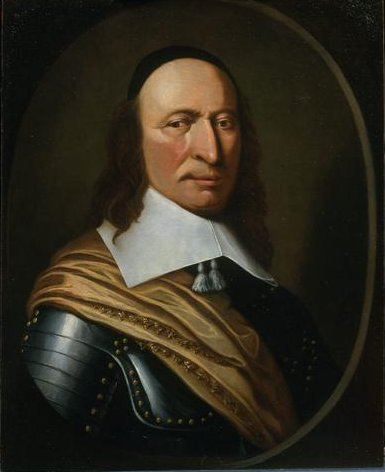
Peter Stuyvesant

Peter Stuyvesant

The portrait (owned by the New-York Historical Society) … is half-length and therefore does not record which of Pieter’s legs was the “silver leg.” [Long thought to be a Rembrandt, it is now attributed to Hendrick Couturier.] This was a mystery, even to his remote descendants, for some two centuries, until, in 1926, Victor H. Paltsits, historian and linguist, read a group of Dutch versified manuscript letters, written to Stuyvesant by his English friend Johan Farret. Therein is a playful allusion to the amputation and burial in Curacao of Pieter’s right leg.

“Old Silver Nails,” from History of the City of New York, by Mary L. Booth, 1867.

***

PETER STUYVESANT Letter to the Dutch Towns on Long Island.

Honorable, Dear, Faithful:

You as well as we can sufficiently infer from the arrival of the English frigates at the Narrows, of some ships with ammunition and provisions at Hellgate, as well as from the arming of the English both on the Mainland and on Long Island and other places, that this Capital is the object aimed at, which if lost, all is lost, there being no other place capable of offering any resistance. It is, therefore, requisite and in the highest degree necessary, that it should be protected and defended with all possible might and main; for the better effecting and accomplishing of this purpose, you are hereby earnestly required and requested to act in this most critical conjuncture as faithful subjects of the High and Mighty the Lords States General and the Honorable the Directors of the Incorporated West India Company are bound and ought to do, and to reinforce us with every third man from your town.

Relying thereupon, we, after cordial salutation, &c.
Fort Amsterdam in New Netherland,
28th August, 1664.

Their answer:

Honorable, Most Wise, Right Honorable, the Director-General and Council of New Netherland:

Having received your Honors’ letter, and the same, with the request made in great friendship, being read to us by the Schout and Schepens, we unanimously answer, that it is impossible for us to comply with it, as we ourselves are living here on the Flatland without any protection and must leave wives and children seated here in fear and trembling, which our hearts would fail to do. And, moreover, the English are themselves hourly expected; ignorant of what we have to expect from them ; not sure either of life or property, we yet heartily wish it were in our power to assist your Honors.

Herewith ending, we wish your Honors the gracious protection of the Most High and a favorable peace and prosperous government unto salvation. Furthermore, commending ourselves to your Honors’ good favor, we shall be and remain,

Right Honorable,
Your subjects and servants,
The Court and Commonalty of the town of Midwout

***

Asher Durand's "Dance on the Battery in the Presence of Peter Stuyvesant."

Asher Durand’s “Dance on the Battery in the Presence of Peter Stuyvesant.”

RESOLUTION TO EXEMPT THE JEWS FROM MILITARY SERVICE, the Burgher Council (1655)

August 28, 1655.

The Captains and officers of the trainbands of this City baring asked the Director General and Council, whether the Jewish people, who reside In this City, should also train and mount guard with the Citizens’ bands, this was taken in consideration and deliberated upon: first the disgust and unwillingness of these trainbands to be fellow-soldiers with the aforesaid nation and to be on guard with them in the same guard house and on the other side, that the said nation was not admitted or counted among the citizens, as regards trainbands or common citizens’ guards neither in the Illustrious City of Amsterdam nor (to our knowledge) in any city in Netherland; but in order that the said nation may honestly be taxed for their freedom in that respect. It is directed by the Director General and Council, to prevent further discontent, that the aforesaid nation shall, according to the usages of the renowned City of Amsterdam, remain exempt from the general training and guard duty, on condition that each male person over sixteen and under sixty years contribute for the aforesaid freedom towards the relief of the general municipal taxes sixty five stivers* every month and the military council of the citizens is hereby authorized and charged to carry this into effect until our further orders and to collect pursuant to the above the aforesaid contribution once in every month and in case of refusal to collect it by legal process. Thus done in Council at Fort Amsterdam, on the day as above. [It was signed:]

P. Stuyvesant, Nicasius de Sille, Cornelius Van Tienhoven

Col. Docs, N.Y., xii. 96.

FROM: Ecclesiastical Records, State of New York, 1901.

***

HENRICUS SELYNS, First Dominie of Breuckelen

EPITAPH ON GOVERNOR STUYVESANT. —The last volume of the Bradford Club has, among the poems of Domine Henricus Selyns, this epitaph on Stuyvesant:

Graafschrift Voor Petrus Stuyvesant, Gewesen Generael van Niew Nederlandt

Stuyft niet te seer en’t sandt, want daer legt Stuyvesant

Die eerst was ‘t opperhooft van gantsch Niew Nederlandt

En gaf met wil of geen het landt den vyandt over

So naween en berouw treft ¡emans hert syn hert

Stierf duysentmaal, en droog onlydelycke smert,

In’ t eerste al to ryck, op ‘t laaste al te pover.

Petrus Stuyvesant vault cover, St. Mark's Church in-the-Bowery

Petrus Stuyvesant vault cover, St. Mark’s Church in-the-Bowery

Thus translated by the accomplished Mr. Murphy, to whom the old poets of the colony are indebted for the laurels now so tardily placed on their brows [Stuyvesant translates as “shifting sand”]:

Stir not the sand too much, for there lies Stuyvesant,
Who erst commander was of all New Netherland;
Freely or no, unto the foe, the land did he give over.
If grief and sorrow any hearts do smite, his heart
Did die a thousand deaths, and undergo a smart
Insuff’rable. At first, too rich; at last, too pauvre.

FROM: The Historical Magazine and Notes and Queries Concerning the Antiquities, History and Biography of America. January 1865.

A 1611 Account of Henry Hudson’s Second Voyage (1608)

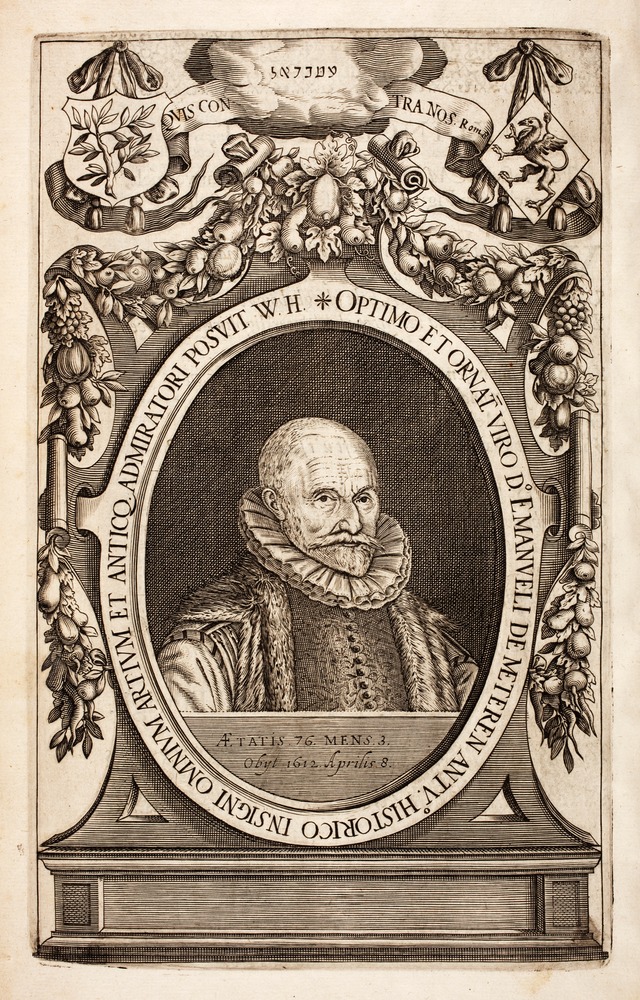
thorn_ourgameBelow is an account of Henry Hudson’s second voyage in search of a Northwest Passage, of 1608, written by Emanuel Van Meteren in 1611 and published in The Hague three years later. Van Meteren (1535-1612) was a Flemish historian and Consul for “the Traders of the Low Countries” in London. When Hudson returned from his second voyage on behalf of the Muscovy Company of England he related to van Meteren that there had been a mutiny in 1608, originating in quarrels between Dutch and English sailors. Van Meteren had access to Hudson’s journals, charts and logbooks for his Historien der Nederlanden, en haar naburen oorlogen tot het iaar 1612 (published in 1614). It was, during the 1609 third voyage, in the Halve Maene, that once again foiled by summer ice, Hudson detoured toward Manhattan. A fourth voyage, in 1610-11, proved disastrous. Following a mutiny, Hudson, his teenage son, and seven crew members were set adrift in an open boat and were never heard from again.

We have said in the preceding book that the Directors of the East India Company in Holland had sent, in the month of March last past, in order to seek a passage to China by Northwest or Northeast, a brave English pilot named Henry Hudson, with a Vlie-boat, and about eighteen or twenty men, part English and part Dutch, well provided. This Henry Hudson sailed from Texel on the 6th of April, 1609, and doubled the Cape of Norway on the 5th of May; he laid his course toward Nova Zembia, along the northern coast, but found the sea as full of ice there as he had found it the preceding year, so that he was compelled to abandon all hope for that year; whereupon, owing to the cold which some who had been in the East Indies could not support, the English and Dutch fell into disputes among themselves.

Last Voyage of Henry Hudson, by John Collier

Last Voyage of Henry Hudson, by John Collier

Whereupon the Master, Hudson, gave them their choice between two things, the first was, to go the coast of America in the fortieth degree of latitude, mostly incited to this by letters and maps which a certain Captain Smith had sent him from Virginia, and on which he showed him a sea wherein he might circumnavigate their Southern Colony from the North, and from thence pass into a Western sea. If this had been true (which experience up to the present time has shown to the contrary), it would have been very advantageous, and a short route to sail to the Indies.

The other proposition was, to search for the passage by Davis’ Straits, to which at last they generally agreed; and on the fourteenth they set sail, and, with favorable winds, arrived the last of May at the isle of Faro, where they stopped only twenty-four hours to take in fresh water. Leaving there, they reached, on the eighteenth of July, the coast of New-France in latitude forty-four, where they were obliged to make a stay to replace their foremast which they had lost, and where they obtained and rigged one. They found this a good place for catching codfish, and also for carrying on a traffic for good skins and furs, which they could obtain for mere trifles; but the sailors behaved very badly toward the people of the country, taking things by force, which was the cause of a strife between them.

The English, thinking they would be overpowered and worsted, were afraid to enter further into the country; so they sailed from there on the twenty-sixth of July, and continued at sea until the third of August, when they approached the land in latitude forty-two. From thence they sailed again until the twelfth of August, when they again approached the land at latitude thirty-seven and three-quarters, and kept their course thence along it until they reached the latitude of forty degrees and three-quarters, where they found a good entrance between two headlands. Here they entered on the twelfth of September, and discovered as beautiful a river as could be found, very large and deep, with good anchorage on both shores. They ascended it with their large vessel as high as latitude forty-two degrees and forty minutes, and went still higher up with the ship’s boat.

At the entrance of the river they had found the natives brave and warlike; but inside, and up to the highest point of the river, they found them friendly and civil, having an abundance of skins and furs, such as martens and foxes, and many other commodities, birds, fruits and even white and blue grapes. They treated these people very civilly, and brought away a little of whatever they found among them. After they had gone about fifty leagues up the river, they returned on the fourth of October, and again put to sea. More could have been accomplished there if there had been a good feeling among the sailors, and had not the want of provisions prevented them.

Title page, Emanuel van Meteren, Historien der Nederlanden, 1614

Title page, Emanuel van Meteren, Historien der Nederlanden, 1614

At sea there was a consultation held at which there was a diversity of opinion. The mate, who was a Dutchman, thought that they ought to go and winter in Newfoundland, and seek for the Northwest passage through Davis’ Straits. The master, Hudson, was opposed to this; he feared his crew would mutiny, because at times they had boldly menaced him, and also because they would be entirely overcome by the cold of winter, and be, after all, obliged to return with many of the crew weak and sickly. No one, however, spoke of returning home to Holland, which gave cause of further suspicion to the master. Consequently, he proposed that they should go and winter in Ireland, to which they all agreed, and at length arrived, November 7th, at Dartmouth in England. From this place they sent an account of their voyage to their masters in Holland, proposing to go in search of a passage to the Northwest if they were furnished with fifteen hundred guilders in money to buy provisions, in addition to their wages and what they had in the ship. He wished to have some six or seven of his crew changed, making the number up to twenty men, etc., and to sail from Dartmouth about the first of March, in order to be at the Northwest by the end of that month, and there pass the month of April and half of May in killing whales and other animals in the neighborhood of the isle of Panar; from there to go toward the Northwest….


Hudson’s Arrival: As The Indians Told It

thorn_ourgameJohn Heckwelder wrote this reconstruction of how things might have looked to Native Americans back in 1609. It was published in New-York Historical Society Collections, 2nd series (1841), vol. 1: 71–74. That it is in some measure fanciful is not to be doubted; but folklore competes with history in America’s earliest days. It is said in folklore circles that when a custom or practice is too old for its origins to be remembered, a story is often devised to rationalize what would otherwise be baffling.

That the Dutch did not build New Amsterdam ex nihilo, but rather grafted their culture onto the one they found, is evident from the Castello Plan of 1660. Depicted below is the print drafted in 1916 by John Wolcott Adams from the nineteenth-century watercolor copy of the lost original. Note the clearly delineated path of modern-day Broadway; it had long been a major Native American trail north from the tip of the island.

Afbeeldinge van de stadt Amsterdam in Nieuw Neederlandt  [The Castello Plan] 1660

Afbeeldinge van de Stadt Amsterdam in Nieuw Neederlandt [The Castello Plan] 1660

The Dutch Arrive on Manhattan Island: An Indian Perspective

Henry Hudson, employed by the Dutch India Company, anchored off Manhattan in 1609 and traded with local Indians. Hudson then headed up the river (later named the Hudson River) seeking Northwest Passage to Asia. Other Dutch settlers soon followed. Delawares and Mahicans, who had been living along the coast of New Jersey and up the Hudson River when the Dutch arrived, were driven westward by expanding European settlements. The Reverend John Heckwelder, a Moravian missionary in the Ohio Valley, took down this particular narrative in the 1760s “as it was related to me by aged and respected” Delawares and Mahicans. Indian stories of the first encounters between Indians and Europeans often depicted the Europeans as “the great Mannito” or Supreme Being. This account went on to describe the trading and hospitality that followed the first encounter and the Europeans’ eventual desire for land above all else.

A long time ago, when there was no such thing known to the Indians as people with a white skin (their expression), some Indians who had been out a-fishing, and where the sea widens, espied at a great distance something remarkably large swimming, or floating on the water, and such as they had never seen before. They immediately returning to the shore apprised their countrymen of what they had seen, and pressed them to go out with them and discover what it might be. These together hurried out, and saw to their great surprise the phenomenon, but could not agree what it might be; some concluding it either to be an uncommon large fish, or other animal, while others were of opinion it must be some very large house.

It was at length agreed among those who were spectators, that as this phenomenon moved towards the land, whether or not it was an animal, or anything that had life in it, it would be well to inform all the Indians on the inhabited islands of what they had seen, and put them on their guard. Accordingly, they sent runners and watermen off to carry the news to their scattered chiefs, that these might send off in every direction for the warriors to come in. These arriving in numbers, and themselves viewing the strange appearance, and that it was actually moving towards them (the entrance of the river or bay) concluded it to be a large canoe or house, in which the great Mannitto (great or Supreme Being) himself was, and that he probably was coming to visit them.

Hudson entering New York Bay, conjectural view

Hudson entering New York Bay, conjectural view

By this time the chiefs of the different tribes were assembled on York Island, and were counselling (or deliberating) on the manner they should receive their Mannitto on his arrival. Every step had been taken to be well provided with plenty of meat for a sacrifice; the women were required to prepare the best of victuals; idols or images were examined and put in order; and a grand dance was supposed not only to be an agreeable entertainment for the Mannitto, but might, with the addition of a sacrifice, contribute towards appeasing him, in case he was angry with them. The conjurors were also set to work, to determine what the meaning of this phenomenon was, and what the result would be. Both to these, and to the chiefs and wise men of the nation, men, women, and children were looking up for advice and protection.

Between hope and fear, and in confusion, a dance commenced. While in this situation fresh runners arrive declaring it a house of various colours, and crowded with living creatures. It now appears to be certain that it is the great Mannitto bringing them some kind of game, such as they had not before; but other runners soon after arriving, declare it a large house of various colours, full of people, yet of quite a different colour than they (the Indians) are of; that they were also dressed in a different manner from them, and that one in particular appeared altogether red, which must be the Mannitto himself. They are soon hailed from the vessel, though in a language they do not understand; yet they shout (or yell) in their way. Many are for running off to the woods, but are pressed by others to stay, in order not to give offence to their visitors, who could find them out, and might destroy them. The house (or large canoe, as some will have it) stops, and a smaller canoe comes ashore with the red man and some others in it; some stay by this canoe to guard it. The chiefs and wise men (or councillors) had composed a large circle, unto which the red-clothed man with two others approach. He salutes them with friendly countenance, and they return the salute after their manner.

Indian village of the Manhattans, prior to the occupation of the Dutch; George Heyward, Valentine's Manual 1858

Indian village of the Manhattans, prior to the occupation of the Dutch; George Heyward, Valentine’s Manual 1858

They are lost in admiration, both as to the colour of the skin (of these whites) as also to their manner of dress, yet most as to the habit of him who wore the red clothes, which shone with something they could not account for. He must be the great Mannitto (Supreme Being) they think, but why should he have a white skin? A large hockhack is brought forward by one of the (supposed) Mannitto’s servants, and from this a substance is poured out into a small cup (or glass) and handed to the Mannitto. The (expected) Mannitto drinks; has the glass filled again, and hands it to the chief next to him to drink. The chief receives the glass, but only smelleth at it, and passes it on to the next, chief, who does the same.

The glass thus passes through the circle without the contents being tasted by any one; and is upon the point of being returned again to the red-clothed man, when one of their number, a spirited man and great warrior, jumps up, harangues the assembly on the impropriety of returning the glass with the contents in it; that the same was handed them by the Mannitto in order that they should drink it, as he himself had done before them; that this would please him; but to return what he had given to them might provoke him, and be the cause of their being destroyed by him. And that, since he believed it for the good of the nation that the contents offered them should be drank, and as no one was willing to drink it he would, let the consequence be what it would; and that it was better for one man to die, than a whole nation to be destroyed. He then took the glass and bidding the assembly a farewell, drank it off.

Every eye was fixed on their resolute companion to see what an effect this would have upon him, and he soon beginning to stagger about, and at last dropping to the ground, they bemoan him. He falls into a sleep, and they view him as expiring. He awakes again, jumps up, and declares that he never felt himself before so happy as after he had drank the cup. Wishes for more. His wish is granted; and the whole assembly soon join him, and become intoxicated.

After this general intoxication had ceased (during which time the whites had confined themselves to their vessel) the man with the red clothes returned again to them, and distributed presents among them, to wit, beads, axes, hoes, stockings, &c. They say that they had become familiar to each other, and were made to understand by signs; that they now would return home, but would visit them next year again, when they would bring them more presents, and stay with them awhile; but that, as they could not live without eating, they should then want a little land of them to sow some seeds in order to raise herbs to put in their broth.

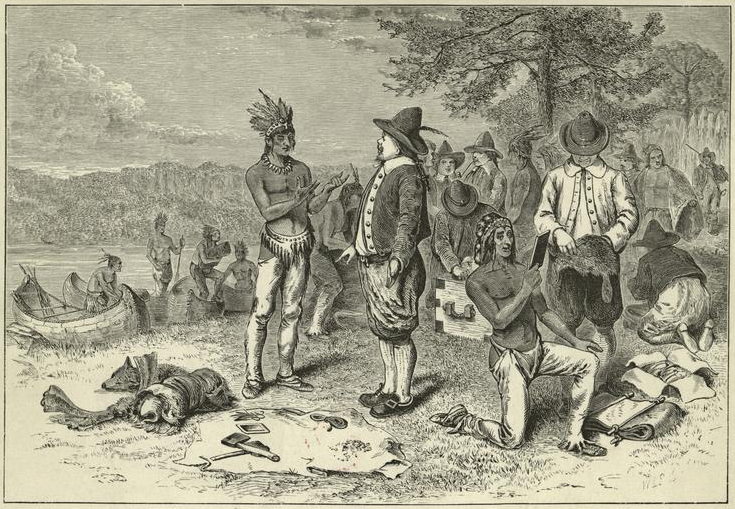
That the vessel arrived the season following, and they were much rejoiced at seeing each other; but that the whites laughed at them (the Indians,) seeing they knew not the use of the axes, hoes, &c., they had given them, they having had these hanging to their breasts as ornaments; and the stockings they had made use of as tobacco pouches. The whites now put handles (or helves) in the former, and cut trees down before their eyes, and dug the ground, and showed them the use of the stockings. Here (say they) a general laughter ensued among them (the Indians), that they had remained for so long a tribe ignorant of the use of so valuable implements; and had borne with the weight of such heavy metal hanging to their necks for such a length of time. They took every white man they saw for a Mannitto, yet inferior and attendant to the supreme Mannitto, to wit, to the one which wore the red and laced clothes.

Dutch traders at Manhattan, a conjectural scene

Dutch traders at Manhattan, a conjectural scene

Familiarity daily increasing between them and the whites, the latter now proposed to stay with them, asking them only for so much land as the hide of a bullock would cover (or encompass,) which hide was brought forward and spread on the ground before them. That they readily granted this request; whereupon the whites took a knife, and beginning at one place on this hide, cut it up into a rope not thicker than the finger of a little child, so that by the time this hide was cut up there was a great heap. That this rope was drawn out to a great distance, and then brought round again, so that both ends might meet. That they carefully avoided its breaking, and that upon the whole it encompassed a large piece of ground. That they (the Indians) were surprised at the superior wit of the whites, but did not wish to contend with them about a little land, as they had enough. That they and the whites lived for a long time contentedly together, although these asked from time to time more land of them; and proceeding higher up the Mahicanittuk (Hudson river), they believed they would soon want all their country, and which at this time was already the case.

Henry Hudson and the Half Moon, 1609

thorn_ourgameAlthough we may commence the history of New York with the arrival of the first Europeans in 1609–or the men accompanying Verrazzano in 1524–the Munsee branch of the Lenape (later named by Europeans the Delaware Indians) could argue for a date far earlier. Manhattan is a phonetic interpretation of a word in the Munsee dialect meaning (among other offered etymologies) “hilly island.” Some of the Lenape trails would survive as urban thoroughfares, while others would be obliterated by the grid plan. But from the Dutch and English perspective, Henry Hudson and the crew of the Half Moon “discovered” New York.

Henry Hudson, a fanciful portrait

Henry Hudson, a fanciful portrait

Presented below is an extract from the journal of Robert Juet. The next post will offer an early (1614) account of the voyage; the post after that will detail Hudson’s arrival from the Native American point of view. Juet, by the way also sailed with Hudson on his next–the fourth and final–journey to the New World; he was one of the mutinneers who sent his captain off in an open boat to meet his fate.

Journal aboard the Half Moon, 1609

Sept. 4: In the morning as soon as the day was light, we saw that it was good riding farther up. So we sent our boat to sound, and found that it was a very good harbour; and four and five fathoms, two cables length from the shore. Then we weighed and went in with our ship. Then our boat went on land with our net to fish, and caught ten great mullets, of a foot and a half long a piece and a ray as great as four men could haul into the ship. So we trimmed our boat and rode still all day. At night the wind blew hard at the north-west, and our anchor came home, and we drove on shore, but took no hurt, thanked be God, for the ground is soft sand and ooze. This day the people of the country came aboard of us, seeming very glad of our coming, and brought green tobacco, and gave us of it for knives and beads. They go in deer skins loose, well dressed. They have yellow copper. They desire clothes, and are very civil. They have great store of maize or Indian wheat, whereof they made good bread. The country is full of great and tall oaks.

Sept. 5: In the morning as soon as the day was light, the wind ceased and the flood came. So we heaved off our ship again into five fathoms water, and sent our boat to sound the bay, and we found that there was three fathoms hard by the southern shore. Our men went on land there, and saw great store of men, women and children, who gave them tobacco at their coming on land. So they went up into the woods, and saw great store of very goodly oaks, and some currants. For one of them came aboard and brought some dried, and gave me some, which were sweet and good. This day many of the people came aboard, some in mantles of feathers, and some in skins of divers sorts of good furs. Some women also came to us with hemp. They had red copper tobacco pipes, and other things of copper they did wear about their necks. At night they went on land again, so we rode very quiet, but durst not trust them.

The Half Moon, Sept. 4th, 1609, Samuel Hollyer

The Half Moon, Sept. 4th, 1609, Samuel Hollyer

Sunday, Sept. 6: In the morning was fair weather, and our master sent John Colman, with four other men in our boat over to the north side to sound the other river, being four leagues from us. They found by the way shoal water two fathoms; but at the north of the river eighteen, and twenty fathoms, and and very good riding for ships; and a narrow river to the westward between two islands. The land they told us were as pleasant with grass and flowers, and goodly trees, as ever they had seen, and very sweet smells came from them. So they went in two leagues and saw an open sea, and returned; and as they came back, they were set upon by two canoes, the one have twelve, the other fourteen men. The night came on and it began to rain so that their match went out; and they had one man slain in the fight which was an Englishman, named John Colman, with an arrow shot into his throat, and two more hurt. It grew so dark that they could not find the ship that night, but laboured to and fro on their oars. They had so great a stream that their grapnel would not hold them.

Sept 7: Was fair, and by ten o’clock they returned aboard the ship, and brought our dead man with them, whom we carried on land and buried, and named the point after his name. Colman’s Point. Then we hoisted in our boat and raised her side with waste boards for defence of our men. So we rode still all night, having good regard to our watch.

Sept. 8: Was very fair weather, we rode still very quietly. The people came aboard us, and brought tobacco and Indian wheat, to exchange for knives and beads, and offered us no violence. So we fitting up our boat did mark them, to see if they would make any show of death of our man; which they did not.

Landing of Hendrick Hudson, after a painting by Robert Weir

Landing of Hendrick Hudson, after a painting by Robert Weir

Sept. 9: Fair weather. In the morning, two great canoes came aboard full of men; the one with their bows and arrows, and the other in show of buying of knives to betray us; but we perceived their intent. We took two of them to have kept them and put red coats on them and would not suffer the other to come near us. So they went on land, and two others came abord in a canoe; we took the one and let the other go; but he which we had taken, got up and leaped over-board. Then we weighed and went off into the channel of the river, and anchored there all night.

Sept. 10: Fair weather, we rode till twelve o’clock. Then we weighed and went over, and found it shoal all the middle of the river, for we could find but two fathoms and a half, and three fathoms for the space of a league; then we came to three fathoms, and anchored, and rode all night in soft oozy ground. The bank is sand.

Sept.11: Was fair and very hot weather. At one o’clock in the afternoon, we weighed and went into the river, the wind at south-south-west, little wind. Our soundings were seven, six, five, six, seven, eight, nine, ten, twelve, thirteen and fourteen fathoms. Then it shoaled again, and came to five fathoms. Then we anchored and saw that it was a very good harbour for all winds, and rode all night. The people of the country came aboard of us, making show of love, and gave us tobacco and Indian wheat, and departed for that night; but we durst not trust them.

Sept. 12: Very fair and hot. In the afternoon at two o’clock we weighed, the wind being variable, between the north and the north-west; so we turned into the river two leagues and anchored. This morning at our first rode in the river, there came eight and twenty canoes full of men, women and children to betray us; but we saw their intent, and suffered none of them to come aboard us. At twelve o’clock they departed. They brought with them oysters and beans, whereof we bought some. They have great tobacco pipes of yellow copper, and pots of earth to dress their meat in. It floweth south-east by south within.

Discovery of the Hudson River, 1609

Discovery of the Hudson River, 1609

Sunday, Sept. 13: Fair weather; the wind northerly; at seven o’clock in the morning, as the flood came we weighed and turned four miles into the river; the tide being done we anchored. Then there came four canoes aboard, but we suffered none of them to come into our ship; they brought very great store of very good oysters aboard, which we bought for trifles. In the night I set the variation of the compass, and found it to be 13 degrees. In the afternoon we weighed and turned in with the flood two leagues and a half further and anchored all night, and had five fathoms soft oozy ground, and had a high point of land, which shewed out to us, bearing north by east five leagues of us.

Sept. 14: In the morning being very fair weather, the wind south-east, we sailed up the river twelve leagues, and had five fathoms and five fathoms and a quarter less, and came to a strait between two points, and had eight, nine and ten fathoms; and it trended north-east by north one league, and we had twelve, thirteen and fourteen fathoms; the river is a mile board; there is very high land on both sides. Then we went up north-west, a league and a half deep water; then north-east by north five miles; then north-west by north two leagues and anchored. The land grew very high and mountainous; the river is full of fish.

Sept. 15: The morning was misty until the sun arose, then it cleared; so we weighed with the wind at south, and ran up into the river twenty leagues, passing by high mountains. We had a very good depth, as six, seven, eight, nine, ten, twelve, and thirteen fathoms, and great store of salmon in the river. This morning our two savages got out of a port and swam away. After we were under sail they called to us in scorn. At night we came to other mountains, which lie from the river’s side; there we found very loving people, and very old men, where we were well used. Our boat went to fish, and caught great store of very good fish.


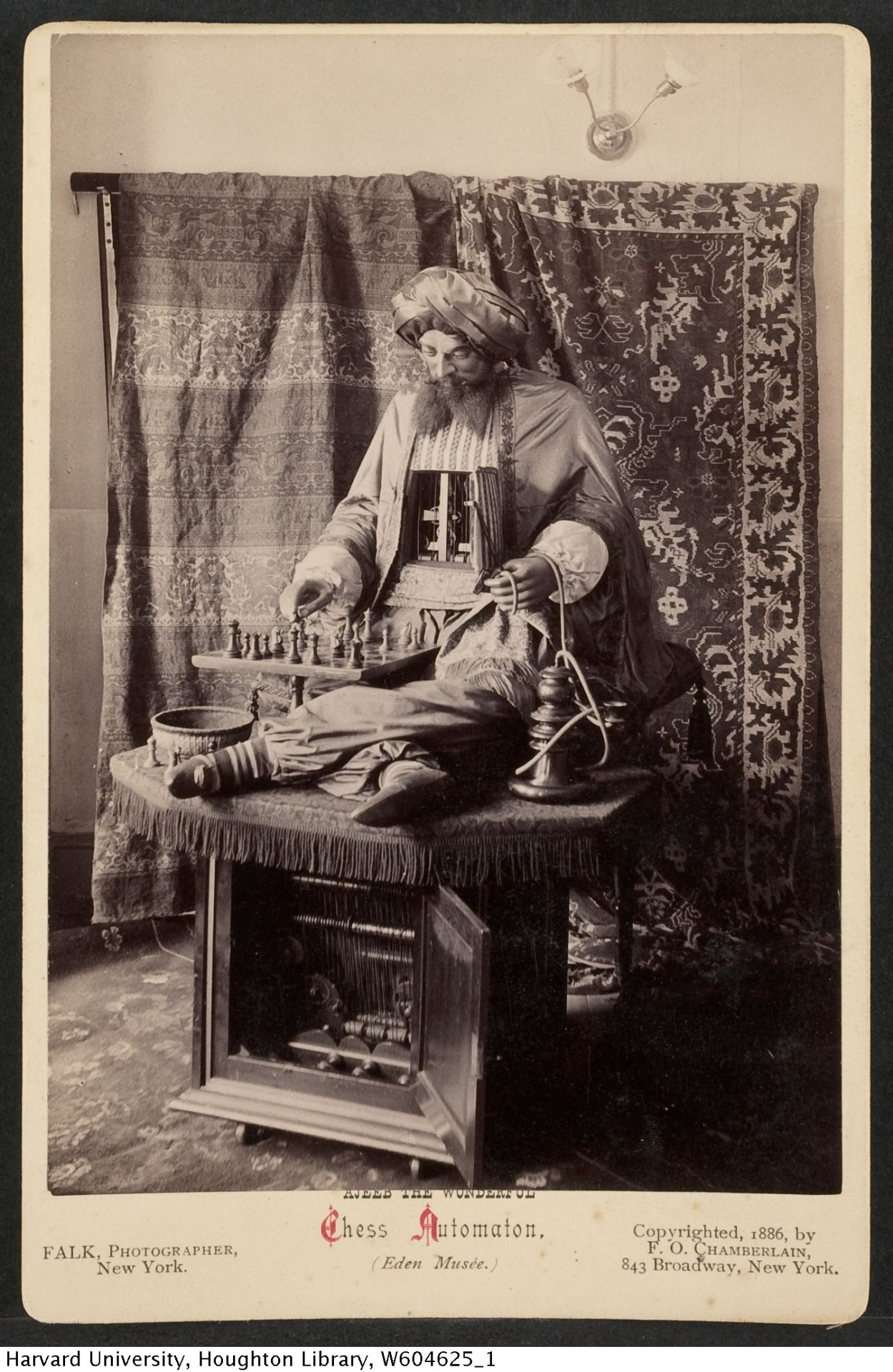
Ajeeb, the Eden Musée Chessman

thorn_ourgameAjeeb first appeared at the gloriously seedy Eden Musée  at 55 West 23rd Street in 1886, mystifying generations with his uncanny chess skill. O. Henry frequently dropped in to challenge Ajeeb to a game; so did Sara Bernhardt each time she came to this country. Christy Mathewson, the baseball player, liked to puzzle with him, as did Harry Houdini and Teddy Roosevelt. What they did not know was that Henry Pillsbury, a skilled chess player, was hiding in the massive Arabian clockwork sheik. The Sun asserted upon the death of Peter J. Hill in 1929 that he had been the man in the machine. In truth several others had preceded Hill and Pillsbury.

Ajeeb the Chess Automaton, trade card. New York, 1886

Ajeeb the Chess Automaton, trade card. New York, 1886

At Gotham History we will bounce around from the arts to popular culture; from first-person narratives of visitors to accounts of great events and tumultuous times. Chronology has been tossed overboard. Let’s have some fun here.

Bernard of Chartres wrote some 900 years ago, “We are like dwarfs on the shoulders of giants, so that we can see more than they, and things at a greater distance, not by virtue of any sharpness of sight on our part, or any physical distinction, but because we are carried high and raised up by their giant size.” One such man was Henry Collins Brown, the founder of the Museum of the City of New York and a lifelong NYC antiquarian; his many books will serve as a touchstone for Gotham History. Here he recalls the old Eden Musee and its principal attraction.

Ajeeb the Wonderful, by Falk, 1886

Ajeeb the Wonderful, by Falk

“Perhaps the greatest single attraction among the many novelties displayed within was Ajeeb the chess-playing Automaton.  This was a genuine sensation for many years.  It was supposed to be a machine which worked automatically.  As a matter of fact Henry Pillsbury, one of the most skillful chess players of the day, was concealed inside the multitudinous clockwork.  The figure was huge and was made to represent an arab sheik.  At all events he produced an uncanny effect with his ponderous iron arms and hand when it came to his move.  Some of the most brilliant players in the world essayed to beat Ajeeb, but all were defeated and retired in disgust.  One of them in particular, a champion at the time, was so completely upset by the swiftness and regularity with which an apparent machine checkmated his moves that he fled in dismay long before the match was finished.

“It was a funny old institution, the Eden Musée, and it ought never to have gone out of business.  It was originally built by a group of titled Frenchmen, with the idea of duplicating Mme. Tussaud’s Wax Works in London, and for many years they were successful.  The change in the shopping district caused their demise.

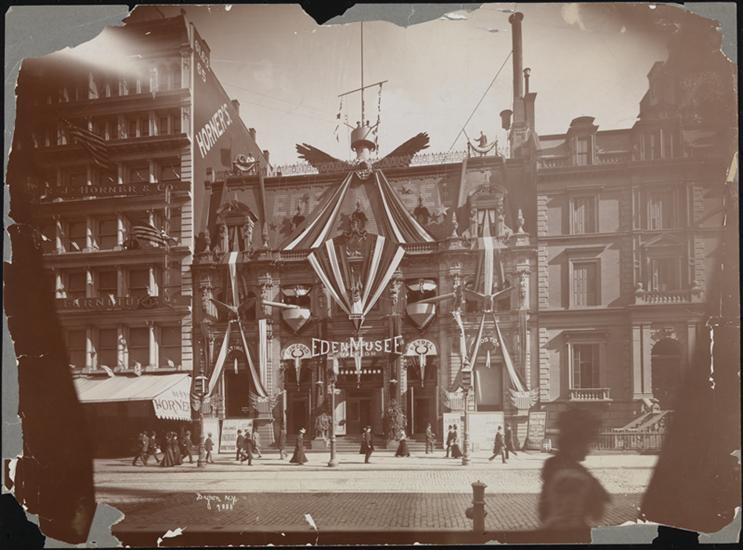
Eden Musee 1899

Eden Musée 1899, made out like a battleship, perhaps in honor of Admiral Dewey’s return

“The plague of Little Lord Fauntleroys at this time was something of stupendous proportions and besides Wallace Eddinger, many another boy inwardly swore at his doting mama who rigged him up in the now well known costume immortalized by Reginald Birch in his famous illustrations of Mrs. Frances Hodgson Burnett’s story then running serially in St. Nicholas.  While it would not be true to say that Mrs. Burnett’s story could not have scored the success it did without them, here was one case at least where the illustrations really helped and Birch’s interpretation of the Little Lord became second in popularity only to the story itself.  A whole generation of boys would have been glad to see Birch hung, drawn and quartered.  The “Little Lord Fauntleroy” suit with its insipid sash and wide ‘sissy’ collar peered from every shop window in the land and the streets were filled with quandom Fauntleroys.”

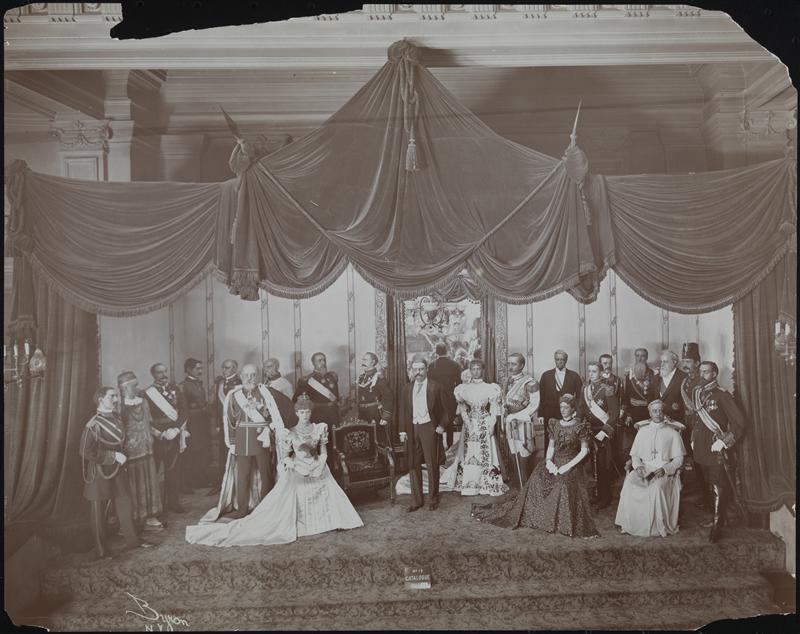
Eden Musée wax tableau: “Rulers of the World”

These wretched children and their mamas habituated the Eden Musée for its promoted “high-class” entertainments, while their charges drifted off to the more seedy attractions in the house: freaks, fire eaters, sword swallowers, waxworks, a Chamber of Horrors … and Ajeeb.

In the 1899 Eden Musée Catalogue, Ajeeb the Chess Player is described thus:

Visitors while on the gallery should not fail to see AJEEB, the mysterious chess and checker playing automaton. It represents a Moorish figure seated on a cushion, beneath which is a perfectly open table; in front is a small cabinet with doors, which are all open, as well as the back and chest of the figure. Any stranger is at liberty to play a game with the automaton; the movements of the figure are free and easy, and it shifts the pieces with as much accuracy as its living opponents and with much greater success, generally coming off the conqueror. In giving check to the king the automaton makes a sign by raising his head twice, and for checkmate three times.

The Eden Musée closed its doors in 1915 after 21 years in business. Ajeeb was sent to Coney Island. As of 1943, he is “stored in Queens, dissected into eight parts. Seven-eighths of him, done up in packing cases, rests in the back of a Cadillac touring car which is itself stored on blocks in an open-air parking lot in Astoria; the other eighth — his head — lies swathed in silk in a trunk in the Jackson Heights apartment of one of Ajeeb’s two present owners….”


Saint Rip

thorn_ourgameIn our last post we unmasked Washington Irving as a plagiarist, Rip Van Winkle as a Teutonic shepherd named Peter Klaus, and the Catskills as a hornets’ nest of folkloric sleeper cells from Scandinavia, Japan, Ireland, Greece, and Turkey. In this last mentioned locale, during the persecutions of the Roman emperor Decius ca. 250 CE, seven Ephesian Christians were given a chance to recant their faith. They instead gave their possessions to the poor and retired to a mountain cave to pray and there, as they slept the night, Rome’s soldiers walled the mouth of the cave with stones. More than a century later, during the reign of Christian emperor Theodosius I (379-395) or II (408-421)—one ought not press too hard for the factual base of this tale, especially as Aristotle had written of the “Sleepers of Sardes” some seven centuries earlier—the cave was unsealed and therein the masons found seven Ephesians awakening from what they believed to be a single night’s slumber.

One of these seven sleepers, Malchus, walked into town and was startled by the crosses atop several buildings. Like Rip, he had slept through a revolution.

Seven Sleepers site at Ephesus

Seven Sleepers site at Ephesus

Attempting to buy bread with his ancient coin, Malchus was interrogated by the townfolk, who suspected that he had come across an ancient treasure and was holding out on them. A bishop intervened to save Malchus from mayhem and returned with him to the cave, where he was amazed to see the other six with “theyr visages lyke unto roses flouryng,” as the story was recorded in The Golden Legend of Jacobus de Voragine, a popular medieval celebration of the lives of the saints, written ca. 1260 (though the story had been recorded in Syriac as early as the year 500). The seven tell their tale to the bishop and then die, praising God.

These Seven Sleepers of Ephesus—Maximian, Martinian, Dionysius, John, Serapion, and Constantine, in addition to Malchus—were honored as saints for centuries thereafter. During the Crusades their remains were removed to the Church of Saint Victoire in Marseilles, where pilgrims flocked. In 1927-28 an excavation at Ephesus, underneath the ruins of a church, revealed several hundred graves from the fifth and sixth centuries, some with inscriptions referring to the Seven Sleepers. This grotto remains a tourist destination today, even though the sleepers’ feast day of July 27 was suppressed as mythical (i.e., of pagan origin) with the reform of the Roman Catholic liturgy in 1969.
***
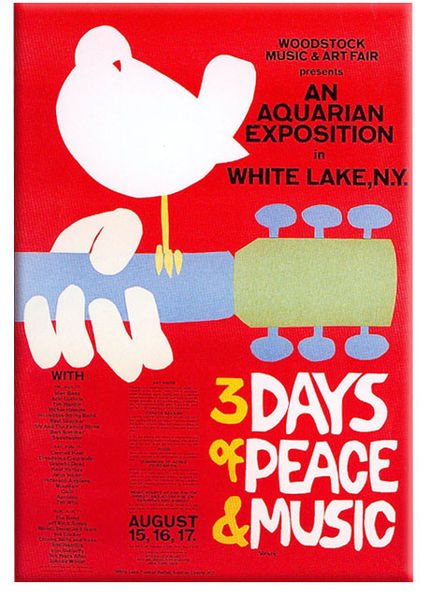
Luckily, that was the year of the Woodstock Music Festival, the height (or should we say Haight) of all hippiedom. And our beset and bedraggled Catskillian hero was ready to become its patron saint, even if this ripeness is evident only in retrospect. Rip was the quintessential hippie, the one who made a success of failure by tuning in, turning on, and dropping out.
Woodstock 1969

Woodstock 1969


Irving’s genius had lain not in his stealthy adoption of the nondescript Peter Klaus as his archetype, but in creating Rip with a twist, as an anti-hero, a henpecked laggard, at the very moment in history when America was most insufferably vainglorious. Irving had left native soil in 1815, created Rip in 1819, and did not return until 1832. An Addisonian stylist with no hatred of Mother England—like Rip, Irving was apolitical—he had struck a popular chord with American readers with his evocations of a Knickerbocker tradition that had nearly vanished. And by making ethnic jokes of the Dutch—as a dwindling minority, they were popularly portrayed as dumb, cowardly, and gluttonish—he indirectly flattered those of English stock.

By making Rip literally a good-for-nothing, Irving created a role model not only for a distant counterculture but also for art—which, like play, must have no purpose but itself or it becomes no longer itself. In the years after Irving’s death, America became ever more practical, pragmatic, and utilitarian, reinventing itself with every generation, relentlessly conflating change with progress. The seeming idler—the writer, the painter, the philosopher, prized in past times for performing his work far from the madding crowd—increasingly was termed the useless man. For the artist—the man outside—Rip provided the perfect symbol.

Mind you, Irving did not intend his hero this way. It was for the next generation of writers like Whitman, Hawthorne, and Melville to see in their own commercial struggles, their own ineffectuality, the specter of Rip.

***

For Melville in particular, Rip possessed untapped allegorical, even spiritual possibilities. His star had fallen from the firmament of American authors after Typee (16,320 copies sold in his lifetime, on both sides of the Atlantic) and Omoo (13,335). His masterwork, Moby-Dick,published in 1851, sold only 3,715 copies. His last attempt at fiction, The Confidence Man, sold even more poorly. His 1866 volume of poetry, Battle-Pieces and Aspects of the War, sold a pathetic 471 copies, compelling the author to reimburse the publisher for its production costs. In that same year he gave over all hope of making a living from his writing and accepted a job as an outdoor customs inspector in New York City, a post he held for 19 years.

Herman Melville, in 1885, by Rockwood

Herman Melville, in 1885, cabinet photo by Rockwood, New York

Melville’s death in 1891 passed almost unnoticed. But in 1919 it emerged that he had never stopped writing, and had left behind work that future generations would cherish: the novella Billy Budd, today perhaps his most widely read book, and a volume of poems titled Weeds and Wildings, Chiefly, With a Rose or Two. One of the sections in this astounding book of poems is called “Rip Van Winkle’s Lilac,” an experimental combination of prose and poetry that transforms and elevates Rip to nothing short of sainthood.

Melville introduces a new character, a “certain meditative vagabondo” who comes upon Rip’s vacant but picturesque abode some years before the hero’s awakening. “And the gray weather-stain not only gave the house the aspect of age,” Melville wrote, “but worse; for in association with palpable evidences of its recentness as an erection, it imparted a look forlornly human, even the look of one grown old before his time.” Yet the vagabondo is drawn to the ramshackle ruin of fallen willow, roof-shingle mosses and Lilac (Melville always capitalizes it) gaily sprouting from Rip’s planting on the day he last saw home. Exhorted by a passing stranger—“gaunt, hatchet-faced, stony-eyed”—to paint a trim white church in the distance rather than the shambles before him, he demurs, only to have the stranger press on:

“You will stick to this wretched old ruin, then, will you?”

“Yes, and the Lilac.”

“The Lilac? And black what-do-ye-call-it—lichen, on the trunk, so old is it. It is half-rotten, and its flowers spring from the rottenness under it, just as the moss on those eaves does from the rotting shingles.”

“Yes, decay is often a gardener.”

Rip Van Winkle House c. 1880

Rip Van Winkle House c. 1880

When Rip returns to his broken-down home some years afterward he recalls having set a Lilac on the day of his departure for the hills:

That Lilac was a little slip,

And yonder Lilac is a tree!

The poet here intrudes:

But why rehearse in every section

The wildered good-fellow’s resurrection,

Happily told by happiest Irving

Never from genial verity swerving;

And more to make the story rife,

By Jefferson acted true to life.

Me here it but behooves to tell

Of things that posthumously fell.

Rip Van Winkle gameMany years after Rip was “remanded into night,” the Lilac continued to bloom:

Each June the owner joyance found

In one prized tree that held its ground,

One tenant old where all was new,—

Rip’s Lilac to its youth still true.

To the end of his life, Melville had kept on his desk this motto: “Keep true to the dreams of thy youth.”

And the poem concludes:

See, where man finds in man no use,

Boon Nature finds one—Heaven be blest!

R.I.P., Rip.

BONUS CONTENT: Joseph Jefferson plays Rip in the first motion-picture version of the tale (filmed 1896, copyrighted 1902):

http://archive.org/download/rip_van_winkle_1896/rip_van_winkle_1896_512kb.mp4

Washington Irving and the Real Rip Van Winkle

thorn_ourgameYesterday I launched GothamHistory.com with a post about how Gotham got its name. Washington Irving had something to do with it, in his Salmagundi Letters of 1807. But his enduring contributions to American arts and letters are two individuals , Diedrich Knickerbocker and Rip Van Winkle. The first was very nearly made from whole cloth, the latter not nearly. Of Knickerbocker, Irving wrote in 1849 “…I find, after a lapse of nearly forty years, this haphazard production of my youth … become a ‘household word,’ and used to give the home stamp to everything recommended for popular acceptance, such as Knickerbocker societies, Knickerbocker insurance companies, Knickerbocker steamboats, Knickerbocker omnibuses, Knickerbocker bread, and Knickerbocker ice….” But Rip Van Winkle is his great legacy to the national imagination.

Rip has belonged to all America from the moment he was born, by passage through Irving’s pen, in 1819. Only six years later Thomas Cole was sketching him; in the year after that there was a Rip Van Winkle House along the road from Palenville to the nation’s first resort hotel, the Catskill Mountain House; in 1850 there was another Rip Van Winkle House on the corner of Pacific Wharf and Battery Street in San Francisco. Rip’s real-life presence was attested by nonagenarians who claimed to have known him and his nagging Dame. Other Hudson Valley denizens claimed to have heard as children, whenever thunder rumbled in the mountains, the tale of Henrik Hudson and his gnomish bowlers, as if it were a folktale eons old rather than Irving’s invention. Today Rip is more prevalent—perhaps more real—than ever, the figure for whom every writer grasps when trying to convey our era’s dizzying rate of change.

Thomas Cole, Rip Van Winkle, Albany Institute, c. 1825.

Thomas Cole, Rip Van Winkle, Albany Institute, c. 1825

In 1872 William Cullen Bryant wrote, in Picturesque America: “As you climb up this steep road [to the Catskill Mountain House] … here, by the side of a little stream, which trickles down the broad, flat surface of a large rock, is the shanty called “Rip Van Winkle’s House….” In a June 1906 issue of 4 Track News, an overwrought Charles B. Wells wrote: “Rip’s ‘Village of Falling Water,’ Palenville, lies at the base and from the summit, looking far out over a field of fleecy cloud-tipped peaks, the gilded dome of the capitol at Albany tosses back the sparkling sunlight which glistens in the silvery Hudson below as though seeking to detain it in its mad onward rush to the pathless sea.” In 1947 Rufus Rockwell Wilson, wrote, in New York in Literature, “Most of the dwellers in present-day Leeds are prompt in their denials that such a man as Rip Van Winkle ever lived in the town, but there is one wrinkled veteran, far spent in years who, if discreetly questioned, will tell you in confidence that were he again a lad he would lead you to the rock, a little way this side of Palenville, where Rip used to camp and sleep on his hunting trips.”

Rip Van Winkle House, 1820s.

Rip Van Winkle House, 1820s

The real Rip is more interesting. Let’s hurtle back to the eighteenth century.

Washington Irving

Washington Irving

Washington Irving was born in New York in 1783, the year in which the American Revolution was won. In 1800 he made his first voyage up the Hudson. Writing of it long after, he said: “The Kaaterskill Mountains had the most witching effect on my boyish imagination. As we slowly floated along I lay on deck and watched them, through a long summer day, undergoing a thousand mutations under the magical effects of atmosphere.” Presumably he gathered up stories on his travels in the Valley, as he did on subsequent journeys to Canada and, in 1804-6, Europe. Upon his return he elected not to go into the law, even though he had been admitted to the bar. Instead he published, with his literary cohorts, the Salmagundi papers and, in 1809 as Diedrich Knickerbocker, a History of New-York that is fresh and funny today.

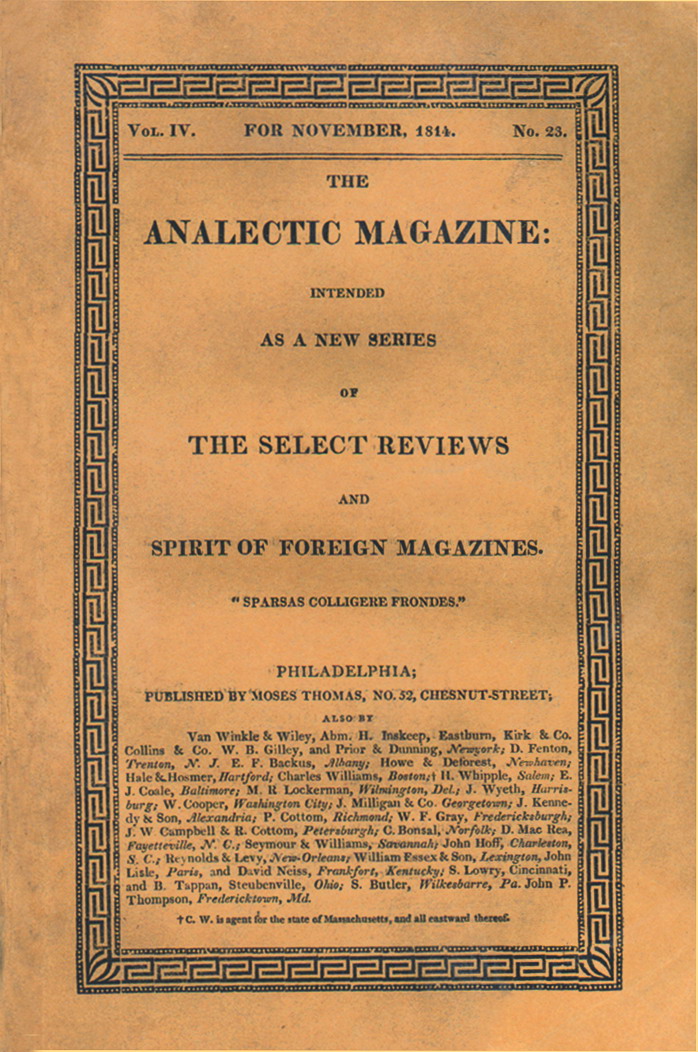
Flush from success on both sides of the Atlantic, he suffered a blow with the death of his fiancée, Matilda Hoffman; he was never to marry. A morose Irving entered the literary business, where his celebrity could not keep his Analectic Magazine from failing. In May 1815 he went to Europe and took charge of the family business in Liverpool, but in 1818 it failed too. He now had nothing on which he might capitalize but his fame: he had to write for a living.

Analectic Magazine, 1814.

Analectic Magazine, 1814

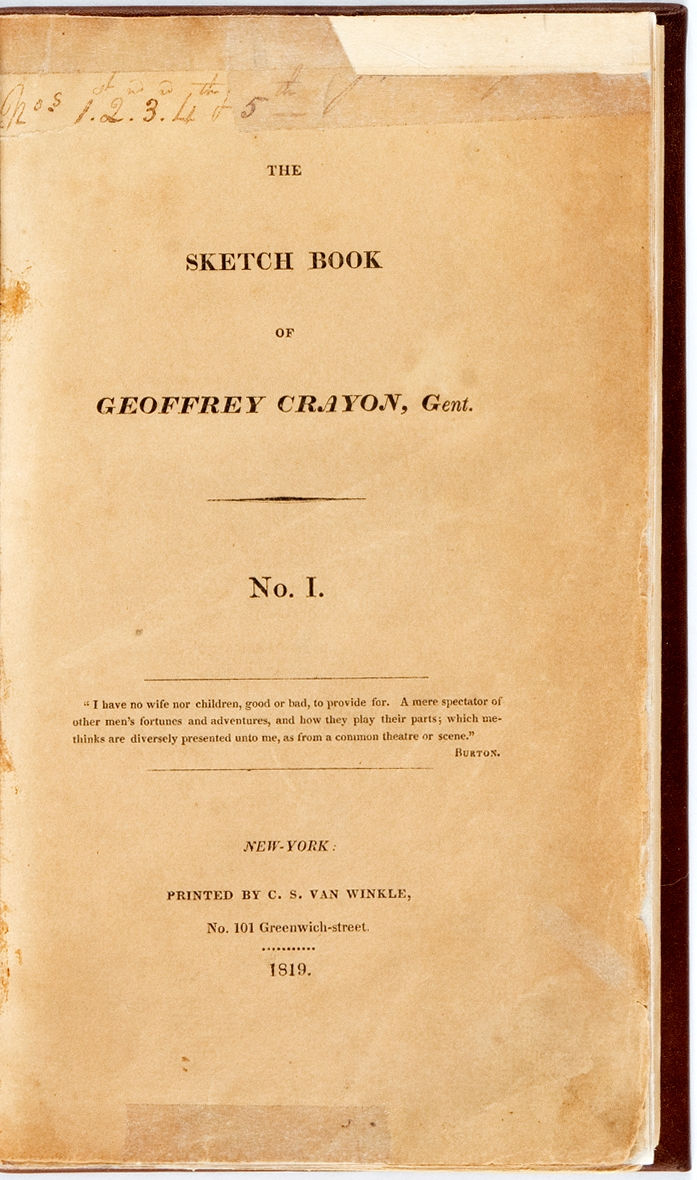
Irving visited his admirer Walter Scott at Abbotsford and learned from him of the wealth of unused literary material in Scottish and especially German folk tales. Irving feverishly taught himself rudimentary German so that he might read (and borrow from) these tales. “Rip” met the light of day in May 1819 as the last sketch in the first installment of The Sketch Book of Geoffrey Crayon, Gent., No. 1, published in New York by, oddly, C.S. Van Winkle. Six installments followed until in 1820 the publisher issued them all in one volume.

Today we might say that with The Sketch Book, which also included “The Legend of Sleepy Hollow,” Irving invented not only the American short story but the Catskills themselves as a source of legend and enchantment. Yet even in his own day, Irving’s critics pointed out that some passages in “Rip Van Winkle” were not mere borrowings but in fact direct translations from the German of Otmar’s Volksagen, published in Bremen in 1800.

In a note appended to the legend, Diedrich Knickerbocker (among whose posthumous writings the tale was supposedly located by editor Geoffrey Crayon) informs us that he himself has talked with Rip Van Winkle, and that “the story, therefore, is beyond the possibility of doubt.” Crayon introduces this note by saying that without it one would suspect that the tale had been “suggested by a little German superstition about the Emperor Frederick der Rothbart and the Kyffhauser Mountain.” This clue led a generation of scholars off onto a Barbarossan snipe-hunt, as “Rip Van Winkle” is certainly not based on the legend of the Mountain King who would rise with his entombed army to defend his nation. Irving’s location was indeed the Kyffhauser Mountain, but his model was plainly Otmar’s Peter Klaus, described thus by Bayard Taylor in By-ways of Europe, 1869:

Rip Van Winkle, portrayed on stage by Joseph Jefferson, 1869.

Rip Van Winkle, portrayed on stage by Joseph Jefferson, 1869

Peter Klaus, a shepherd of Sittendorf, pastured his herd on the Kyffhauser, and was in the habit of collecting the animals at the foot of an old ruined wall. He noticed that one of his goats regularly disappeared for some hours every day; and, finding that she went into an opening between two of the stones, he followed her. She led him into a vault, where she began eating grains of oats which fell from the ceiling. Over his head he heard the stamping and neighing of horses. Presently a squire in ancient armor appeared, and beckoned to him without speaking. He was led up stairs, across a court-yard, and into an open space in the mountain, sunken deep between rocky walls, where a company of knights, stern and silent were playing at bowls. Peter Klaus was directed by gestures to set up the pins, which he did in mortal fear, until the quality of a can of wine, placed at his elbow, stimulated his courage. Finally, after long service and many deep potations, he slept. When he awoke, he found himself lying among tall weeds, at the foot of the ruined wall. Herd and dog had disappeared; his clothes were in tatters, and a long beard hung upon his breast. He wandered back to the village, seeking his goats, and marveling thathe saw none but strange faces. The people gathered around him, and answered his questions, but each name he named was that upon a stone in the church-yard. Finally, a woman who seemed to be his wife pressed through the crowd, leading a wild-looking boy, and with a baby in her arms.

“What is your name?” he asked.

“Maria.”

“And your father?”

“He was Peter Klaus, God rest his soul! who went up the Kyffhauser with his herd, twenty years ago, and has never been seen since.”

***

Sound familiar? I won’t burden you with side-by-side German and English, but trust me, the congruency is shocking. When confronted by his critics, Irving seemed confused, responding that legends were for all to use, as writers of the past had done. Eventually he issued a sort of apology:

In a note which follows that tale [‘Rip Van Winkle’], I alluded to the superstition on which it is founded, and I thought a mere allusion was sufficient, as the tradition was so notorious as to be inserted in almost every collection of German legends. I had seen it myself in three. I could hardly have hoped, therefore, in the present age, when every ghost and goblin story is ransacked, that the origin of the tale would escape discovery. In fact I had considered popular traditions of the kind as fair foundations for authors of fiction to build upon, and made use of the one in question accordingly.

The Sketchbook of Geoffrey Crayon, Gent. New York, C.S. Van Winkle, 1819,

The Sketchbook of Geoffrey Crayon, Gent. New York, C.S. Van Winkle, 1819

Irving lived long enough to see his own invented and adapted legends become in turn the legends which others used for their tales and stories. And to be fair, sleeper tales went back far earlier and wider than that of Peter Klaus, to Scandinavia’s “Girl at the Troll Dance,” to Ireland’s Clough na Cuddy, to Japan’s “Urashima Taro,” and more. In an ancient Greek tale Epimenides, a shepherd, went to the mountains in search of stray sheep, fell asleep in a cave, and woke up 57 years later to find himself unrecognized by all until his youngest brother, by then an old man, finally recognized him. And then there is Ulysses, who returned home after 20 years to be recognized only by his faithful dog Argus. And Woody Allen’s Sleeper. All, no matter how dimly, echo the greatest Resurrection story we know, which itself is the product of legend and fable from prior millennia.

But the motherlode for the Christian Era appears to be The Seven Sleepers of Ephesus, saints whose feast day is July 27. Maximian, Malchus, Martinian, Dionysius, John, Serapion, and Constantine … these are the men who, in our next post, will wake to restore Irving to his pedestal. And Herman Melville, in a posthumous and little-known work, will arise once more to canonize, truly, our beloved Rip.

So Why Is It Called Gotham, Anyway?

thorn_ourgameHello, folks. I am John Thorn, and some of you will know me for my work in baseball; I am Major League Baseball’s official historian, and I have written many books on baseball and other sports over the past four decades. But with a profession that may seem like a hobby, I have always felt that I ought to have serious interests outside the realm of sport. One of these has been, since prowling used-book stores on Fourth Avenue ca. 1960, New York City history. Occasionally I get to write on the subject, too, notably New York 400, which I created for the Museum of the City of New York for Gotham’s 400th birthday bash in 2009.

Would a city by any other name be as sweet? Many evidently have thought so, for New York has been called the Big Apple, Fun City, and the Melting Pot. It has been the City of Golden Dreams, the Capital of the World, and the City So Nice, They Named It Twice (though it might have to share that last one with Walla Walla). As early as 1784 George Washington dubbed New York the Seat of Empire, which soon became the enduring Empire City–and, by extension, State. But the most richly evocative of all the city’s nicknames may be one that, like Yankee Doodle, was originally intended by its English coiners as an insult: Gotham.

Let’s start with why our fair burg is called Gotham in the first place. For this I am going to focus on a unique artifact of baseball, long before anyone dreamed of forming a professional league.

Gotham Base Ball Club pin.

Gotham Base Ball Club pin.

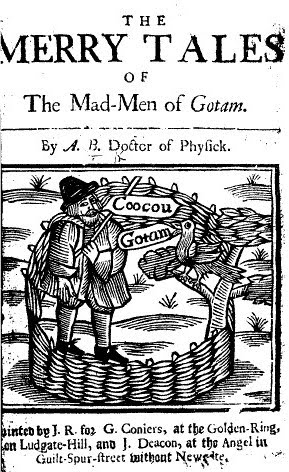
To give an idea of how large a story a trinket may tell, and how rich in association it may prove, allow me to present a baseball pin no larger than a dime, along with a common nursery tale: “Three wise men of Gotham went to sea in a bowl,” went the Mother Goose rhyme; “if the bowl had been stronger, then my rhyme had been longer.” Mother Goose, orSongs for the Nursery, was first published in London in 1760, based upon English and French sources, including Charles Perrault’s Contes de ma mère l’oye(1697). Not a propitious beginning for a baseball story, is it? But look at the accompanying photograph, of a pin worn by members of the Gotham Base Ball Club of New York in the 1850s. Let’s track the story back even further, to 1460, when the “Foles of Gotham” were first mentioned in print, and a century later, when the absurd doings of the people of that village (seven miles from Nottingham, in England) were collected in a book, Merrie Tales of the Mad Men of Gotham.

At that time the simplicity of the inhabitants was legendary. One absurdity attributed to them was the building of a thornbush round the cuckoo to secure eternal spring; another was an attempt to rid themselves of an eel by drowning it. But the archetypal tale of Gothamite behavior was when King John intended to establish a hunting lodge nearby. The villagers, fearful of the cost of supporting the court, feigned imbecility when the royal messengers arrived. Wherever the king’s men went, they saw the fools of Gotham engaged in some lunatic endeavor. When King John selected another spot for his lodge elsewhere, the “wise men” boasted, “We ween there are more fools pass through Gotham than remain in it.”

Merrie Tales.

Merrie Tales.

How did this tale come to resonate with the members of the Washington Base Ball Club, formed in 1850 as the second club after the Knickerbockers–or, as its members claimed, formed before the Knicks, in the 1830s–and two years later renamed after the proverbial wise fools? Gotham is understood today as Batman’s hometown, but it is also a common synonym for New York and has been so since our English cousins began to refer to those “fools” who sailed from the mother country (three men in a tub) to make their fortunes in New York as residents of the “New Gotham.” Washington Irving also applied the name of Gotham to New York in 1807, in some of his Salmagundi letters from Mustapha-Rub-a-Dub Keli Khan. (“Rub-a-dub-dub, three men in a tub…”)

Proper businessmen scorned the young men who played baseball in the New York area around 1850 for acting like fools, trying to extend their youth beyond the time when men should give over childish things. So the Washington Base Ball Club, in a defiant stance against the British, cricket, and their elders’ puritanical attitudes toward play, renamed themselves the Gotham Base Ball Club and made up this little badge of honor for its members. This example, the only one known to survive, was issued to charter member Henry Mortimer Platt and was donated to the Hall in 1939 by his daughter.

Daniel Denton had written in A Brief Description of New York (1670): “Here those which Fortune hath frowned upon in England, to deny the man inheritance amongst their brethren, or such as by their utmost labors can scarcely procure a living—I say such may procure here inheritances of lands and possessions, stock themselves with all sorts of cattle, enjoy the benefit of them whilst they live, and leave them to the benefit of their children when they die.”

So New Yorkers adopted Gotham as their model, the city of “wise fools” who knew more than their English lords. Visitors might note that New York was not only crass but also dirty and crowded and mongrelized; residents would nod in agreement and set about their business. They liked their city just the way it was.