Alexander Jackson Davis, Picturesque American
An old story, reawakened by social media posts
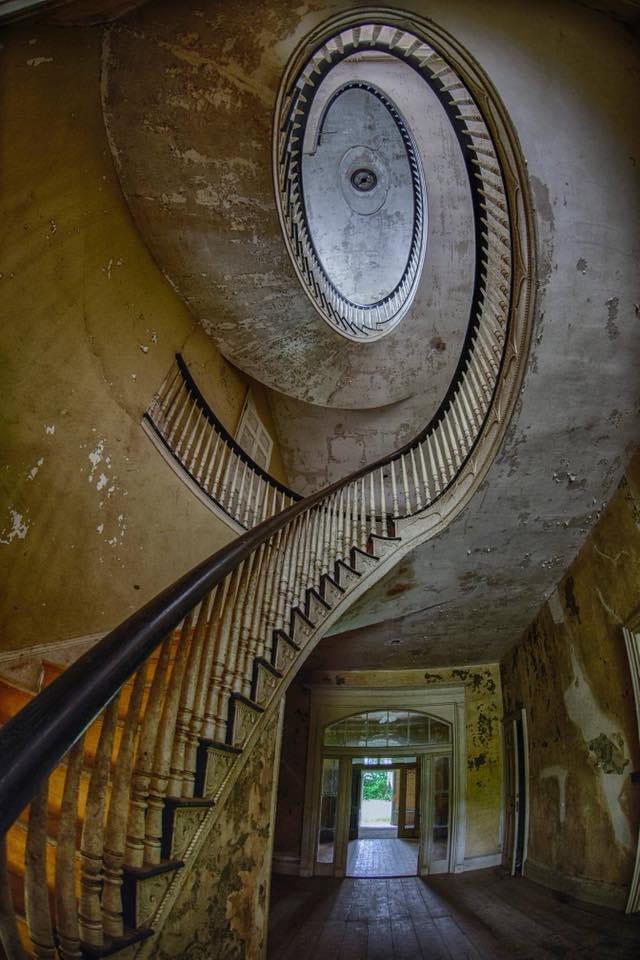
Oliver Bronson House in Hudson, NY (2016); photo, Adam Tarsia
I collect buildings, the way some people collect baseball cards or lovers: the more seemingly unattainable the object of my desire, the more ardent is my longing. While buildings that escape the wrecker’s ball have tangible charms, those that have been lost, or survive in ruin and whose loss is imminent, are to me most romantic, most alluring. Reconstruction, however responsible (think Williamsburg, Virginia), is to me a bore, a classroom diorama for credulous grownups. Renovation is a term that gives me the willies, too; well-intentioned but ghastly examples may be found around the corner. Restoration and preservation, however, are decidedly on the side of the angels — and there is a spectacular work in progress in the architectural museum that is Newburgh, New York, about which there is more to be said.

Villa for artist James Smillie in former village of Rondout, NY; A.J. Davis design; courtesy Metropolitan Museum
Galvanically attractive to me are the buildings that never were — the ones that were planned but never built, those that failed to prevail in civic competitions, or the flights of fancy that architects sketched knowing they would never be built. That is why I like reading about buildings almost as much as I do visiting them, or prowling around their former sites, sensing the presence of ghosts in a most agreeable manner.
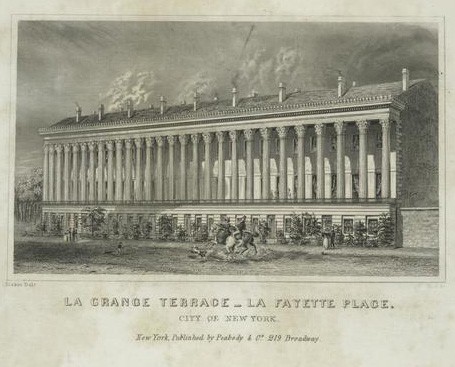
La Grange Terrace, from the New York Mirror
For more than a decade my regular companion on such literary or actual perambulations has been Alexander Jackson Davis (1803–1892), an architect who worked in a dazzling variety of styles: Greek Revival, Italianate or Tuscan, Gothic Revival, Tudor, Egyptian, Swiss. He invented the style we know as “Hudson River Bracketed,” which Edith Wharton referenced in her 1929 novel of the same name. He co-designed the first apartment building in America in 1833 (La Grange Terrace or Colonnade Row in New York), and beginning twenty years later he designed Llewellyn Park, in East Orange, New Jersey, America’s first great picturesque suburban community — a continuous landscape of winding streets, shaded sidewalks, and undulating lawns.
But if there is one word to describe the vast terrain over which Davis was master, it would be Picturesque. His buildings have survived to an astonishing extent (although many splendid examples were razed in the name of progress) and his own copiously detailed record of his life and art has been preserved in four major collections, all in New York City: the Avery Library at Columbia University, the New York Public Library, the New-York Historical Society, and the Metropolitan Museum of Art.It is from the collections of the Met that I obtained Davis’s serene plan for “A Villa in the Italian Style,” for which construction commenced in 1836 at Rondout on the Hudson (since 1870 a part of Kingston) on behalf of New York city engraver James Smillie. The precise site of this villa has continued to elude me, despite research among Ulster County deeds of the period, but it is likely that the land was owned by Smillie’s father-in-law, Lambert Van Valkenburg. Alas, the avant-garde residence was abandoned halfway when the expense began to overwhelm the client, Smillie, who like Davis had won fame with his delineations for the New-York Mirror.

Federal Hall, formerly the Custom House, elevation.
Davis was an artist whose renderings of New York buildings in the 1820s had been so widely admired that painters John Trumbull and Rembrandt Peale advised him to turn his hand to architecture. Joining Ithiel Town and Martin Euclid Thompson as an “architectural composer,” Davis designed public buildings and even residences in the Greek Revival style that was the firm’s hallmark. Among his many notable commissions in this style were the home of poet James Hillhouse in New Haven, Connecticut (demolished in 1943), the Custom House in New York (which survives on Wall Street as the Federal Hall Memorial), and the Dutch Reformed Church in Newburgh (deconsecrated in 1967 but still holy to those who revere fine buildings).
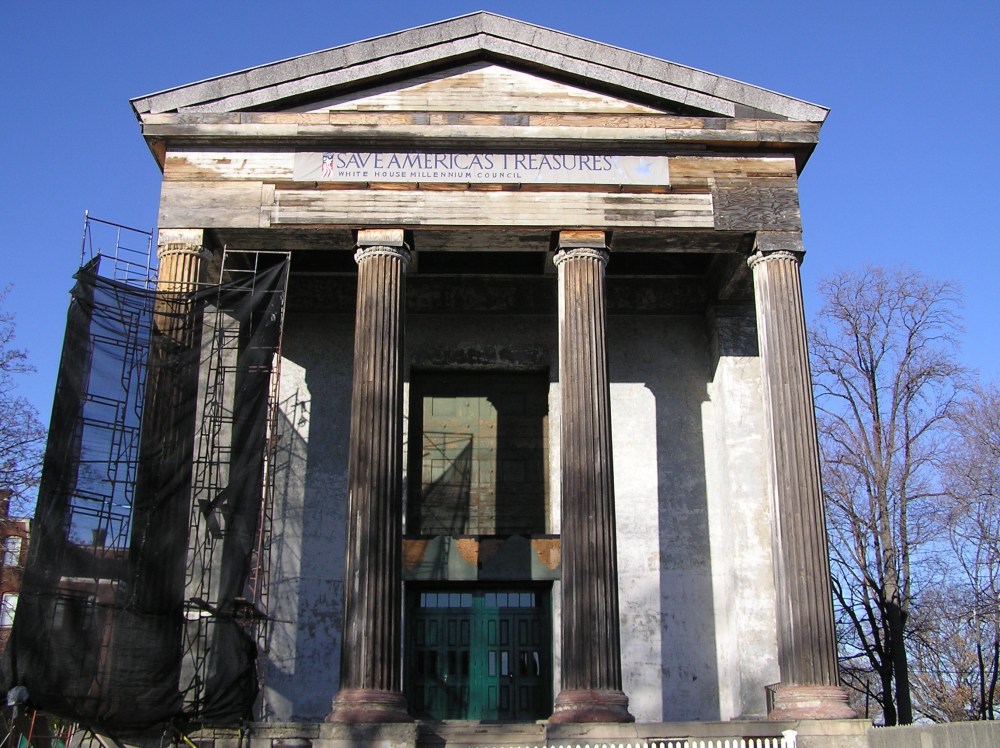
Dutch Reformed Church, Newburgh, NY,1835. Photo by Mark Thorn.
By 1836 Davis had parted ways with Town (and with James Dakin, who had joined the practice after Thompson left it; it was Dakin with whom Davis had designed La Grange Terrace). His work at Blithewood for patron Robert Donaldson had convinced him that Grecian temples in rustic settings constituted a wretched excrescence. Donaldson (1800–72) was a Carolinian who not only commissioned Davis to design Blithewood but also a key addition to Edgewater, Donaldson’s later residence at Barrytown that may be seen from the west bank of the Hudson (it remains a private residence to this day). Donaldson was also one of the sponsors of Davis’s only book, Rural Residences, in 1837.
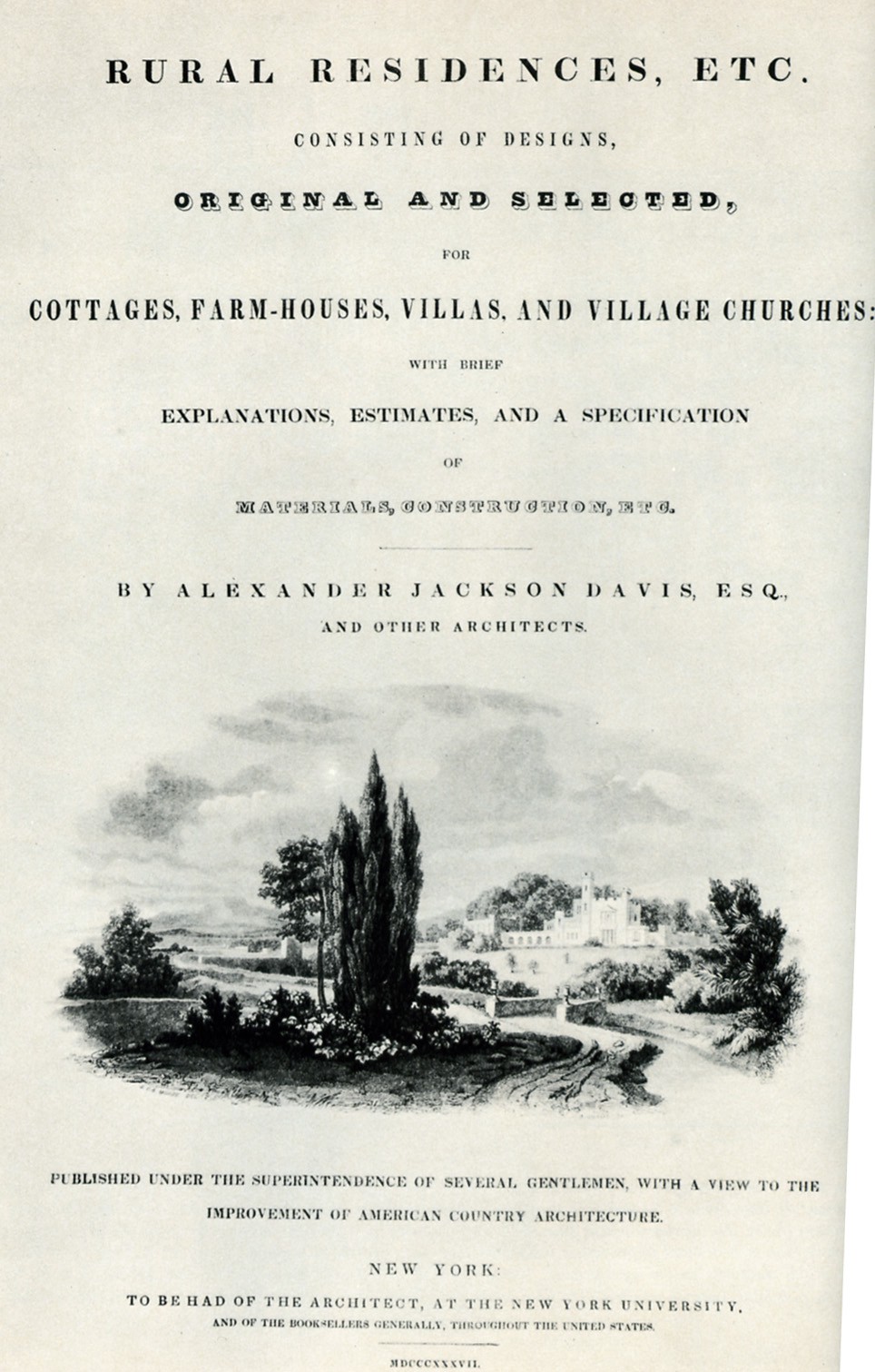
Rural Residences, title page; 1837
By 1841 Davis would supply designs for the first of many books by Andrew Jackson Downing, for whom, like Davis, Donaldson was a most sympathetic patron. The two AJDs collaborated throughout the ensuing decade to cure Americans of the “Greek temple disease,” as Downing put it, and to embrace a picturesque style that became known as Hudson River Gothic, and ultimately American Gothic. Their most harmonious hands-on collaboration of landscape and architecture is permanently on view at Montgomery Place, just a bit further north.
The first Gothic Revival cottage in America was the now demolished structure erected for Donaldson at Blithewood and depicted in Rural Residences:
This building has been erected in Dutchess County, near Barrytown, on the Hudson River, as a gate-house to Blithewood, the seat of R. DONALDSON, Esq. Its prominent features are the rustic porch, bay and mullioned windows, high gables, with ornamented carved vergeboards, and the chimney-shafts. The form and size of the mullion is of considerable importance in giving the cottage window its peculiar character. The bay, or projecting window, and picturesque chimney-tops, are also distinguishing features in this style of building. If this design should be adopted for a summer retreat, it may be much improved by enlarging the porch and windows.

Gatehouse to Blithewood for Robert Donaldson, from Rural Residences.
In 2001 Bard College students began excavating around the former structure, in preparation for the siting of the new Richard B. Fisher Center for the Performing Arts, a Frank Gehry design. Due to the historic significance of the Blithewood site, and the discovery of significant artifacts, the college decided to relocate the new facility a mile north. In absentia, Davis’s rustic cottage at Blithewood forms a ghostly tandem with Smillie’s white elephant across the Hudson, each the progenitor of a style. However, still standing is Davis’s bracketed gatehouse for Donaldson, which functions as a part of Bard College and may be seen along the Annandale Road. And a fine example of Davis’s pointed Gothic style may be enjoyed — even as an overnight guest — at the house Davis designed in 1844 for Henry Delameter at 44 Montgomery Street in Rhinebeck; today it serves as a guest house of the venerable Beekman Arms.
Driving south on Route 9 from Montgomery Place, Bard College and Rhinebeck, we come to another significant Davis monument: the additions commissioned by painter and inventor Samuel F.B. Morse to Locust Grove, the home he purchased in 1847. (I cannot think of that lovely mansion without envying its billiard room).
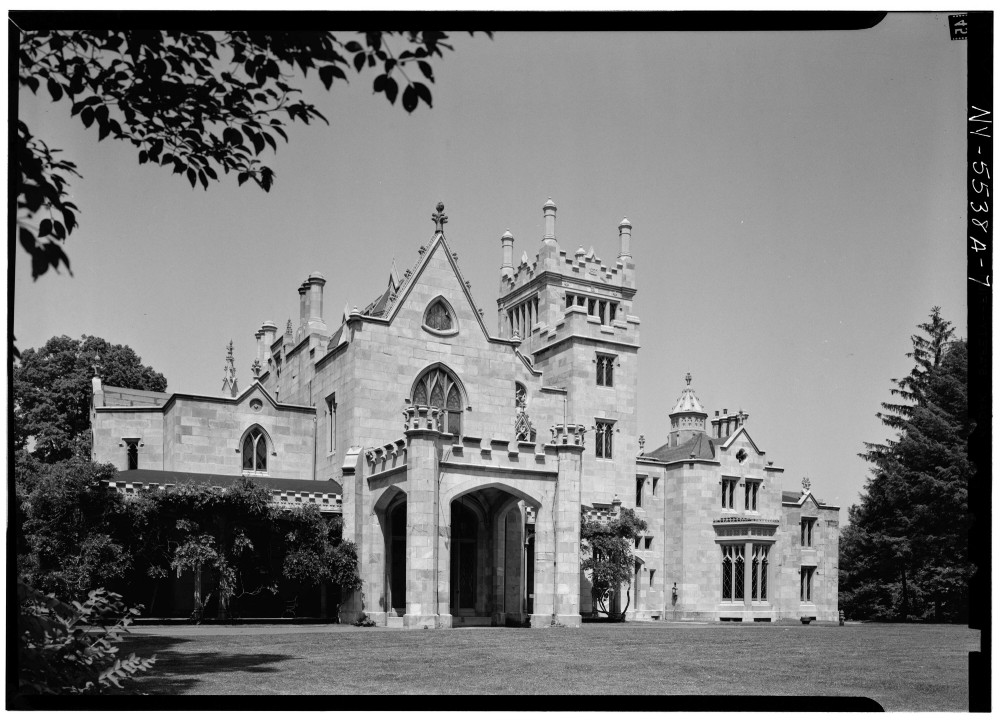
Lyndhurst
Further south, in Tarrytown, one comes upon what many regard as Davis’s greatest Gothic Revival work, Lyndhurst. Designed in 1838 for William and Philip Paulding (when it was called The Knoll) and greatly enlarged in 1867 for George Merritt, Lyndhurst may be the most complete Davis tour de force; he even designed the Gothic furniture. Yet fantastic as it is, my sentiments are not much different from those of Philip Hone, who wrote in his celebrated diary of a visit to The Knoll in July 1841:In the course of our drive, we went to see Mr. William Paulding’s magnificent house, yet unfinished, on the bank below Tarrytown. It is an immense edifice of white or gray marble, resembling a baronial castle, or rather a Gothic monastery, with towers, turrets, and trellises; minarets, mosaics, and mouse-holes; archways, armories, and air-holes; peaked windows and pinnacled roofs, and many other fantastics too tedious to enumerate, the whole constituting an edifice of gigantic size, with no room in it; great cost and little comfort, which, if I mistake not, will one of these days be designated as “Paulding’s Folly.”

A.J. Davis
Jumping back across the Hudson at last to Newburgh, I must report that the Dutch Reformed Church is my favorite extant Davis building. Stately, vast, monolithic, and noble, its exterior belies a delicate jewel of an interior that has been unseen for generations except on special open-house days. (See sidebar below for details about visiting this and other Davis sites in the region). Improbably extant despite decades of neglect, the DRC has at last been designated a National Historic Landmark and its preservation and restoration now seem assured.

Interior, Dutch Reformed Church, Newburgh, NY, 1940s (?); Library of Congress, HABS NY-6221
While my private pleasure will continue to be the buildings that aren’t there or never were, my public delight is in the survivors, the buildings that bear testament to other times, other views of the nation and the cosmos. As citizens of both, we cannot leave the fate of our heritage to the academics and the experts any more than we can trust that public officials will act as guardians of history. Preservation may sometimes appear to be public policy but it is always personal duty; how we regard our past says much about our future.
Davis Buildings in the Hudson Valley
Plumb-Bronson House. Worth Ave (Route 9), Hudson.
Perhaps the earliest “Hudson River Bracketed” residence. For generations the best way to see this building has been to commit a felony, as it is located on the grounds of a state prison. I drove up to it a few years ago and was told in no uncertain terms to turn around, by an officer who thought I was there to facilitate a jailbreak. Recently listed as a National Historic Landmark, this Davis gem is now, on rare occasion, open to the public. See: https://www.brownstoner.com/upstate/ruin-restoration-saving-picturesque-legacy-hudsons-dr-oliver-bronson-house/
Montgomery Place, River Road (Route 103), Annandale-on-Hudson
Expanded over time by the Livingston family. Davis renovated the structure in 1842 and again in the 1860s. Andrew Jackson Downing’s horticultural and landscaping genius are evident.
Locust Grove
2683 South Road (Route 9), Poughkeepsie.
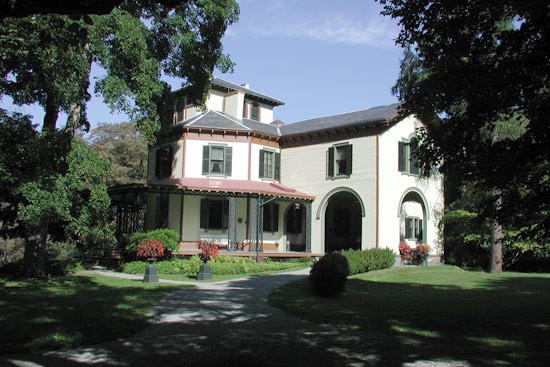
Locust Grove, residence of S.F.B. Morse
Davis added two wings to the north and south, creating the octagon, porte-cochère and billiards room to the east, plus a four-story tower.
Dutch Reformed Church, 120 Grand St, Newburgh.
According to J. Winthrop Aldrich, former New York Deputy Commissioner of Historic Preservation, the DRC is “the greatest surviving ecclesiastical commission of America’s greatest architect of the era.”
Lyndhurst, 635 S. Broadway, Tarrytown.
A National Historic Landmark, the house is owned and operated by the National Trust for Historic Preservation.
 gothamhistory