 Ajeeb first appeared at the gloriously seedy Eden Musée at 55 West 23rd Street in 1886, mystifying generations with his uncanny chess skill. O. Henry frequently dropped in to challenge Ajeeb to a game; so did Sara Bernhardt each time she came to this country. Christy Mathewson, the baseball player, liked to puzzle with him, as did Harry Houdini and Teddy Roosevelt. What they did not know was that Henry Pillsbury, a skilled chess player, was hiding in the massive Arabian clockwork sheik. The Sun asserted upon the death of Peter J. Hill in 1929 that he had been the man in the machine. In truth several others had preceded Hill and Pillsbury.

Ajeeb the Chess Automaton, trade card. New York, 1886
At Gotham History we will bounce around from the arts to popular culture; from first-person narratives of visitors to accounts of great events and tumultuous times. Chronology has been tossed overboard. Let’s have some fun here.
Bernard of Chartres wrote some 900 years ago, “We are like dwarfs on the shoulders of giants, so that we can see more than they, and things at a greater distance, not by virtue of any sharpness of sight on our part, or any physical distinction, but because we are carried high and raised up by their giant size.” One such man was Henry Collins Brown, the founder of the Museum of the City of New York and a lifelong NYC antiquarian; his many books will serve as a touchstone for Gotham History. Here he recalls the old Eden Musee and its principal attraction.
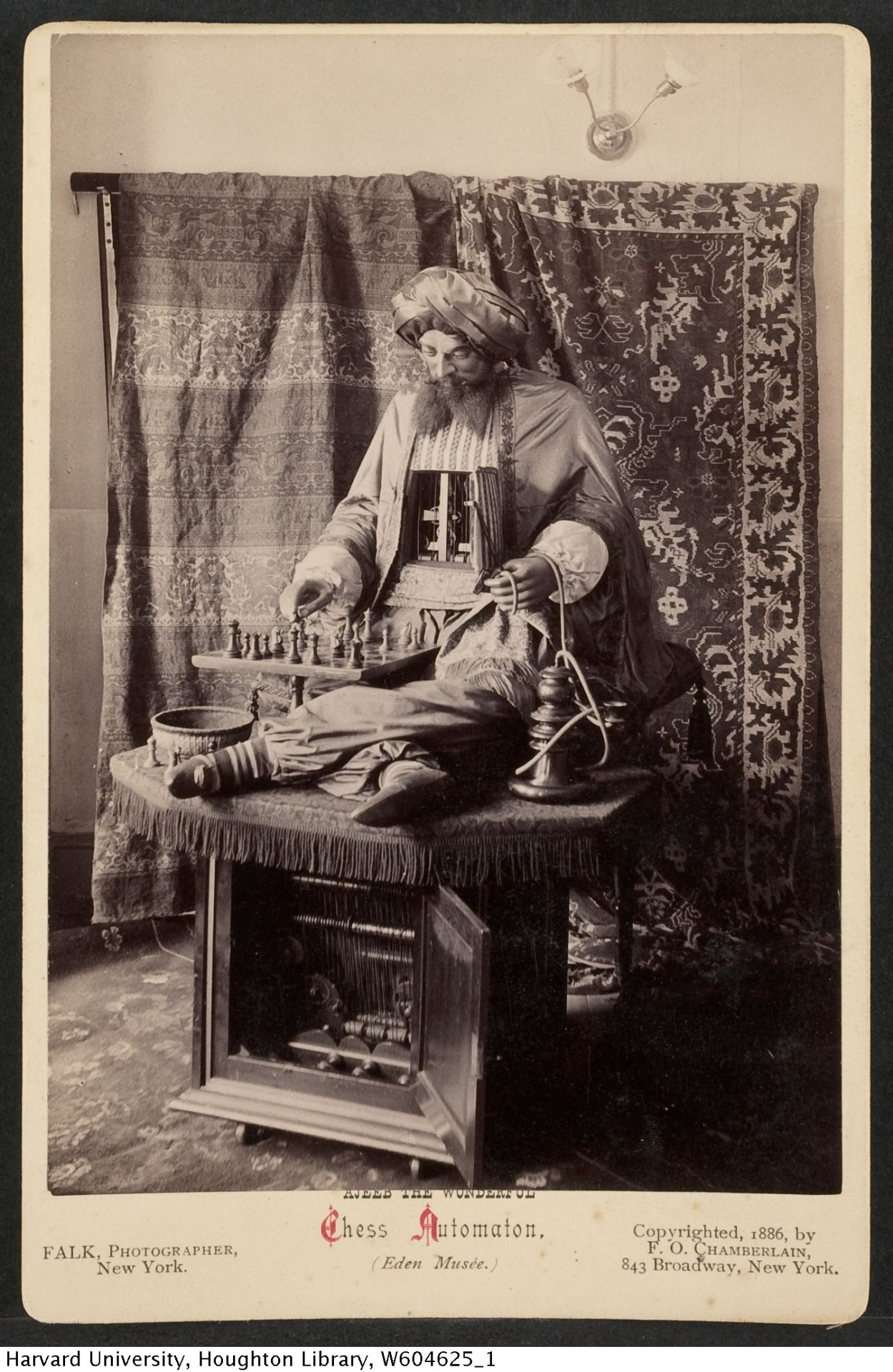
Ajeeb the Wonderful, by Falk
“Perhaps the greatest single attraction among the many novelties displayed within was Ajeeb the chess-playing Automaton. This was a genuine sensation for many years. It was supposed to be a machine which worked automatically. As a matter of fact Henry Pillsbury, one of the most skillful chess players of the day, was concealed inside the multitudinous clockwork. The figure was huge and was made to represent an arab sheik. At all events he produced an uncanny effect with his ponderous iron arms and hand when it came to his move. Some of the most brilliant players in the world essayed to beat Ajeeb, but all were defeated and retired in disgust. One of them in particular, a champion at the time, was so completely upset by the swiftness and regularity with which an apparent machine checkmated his moves that he fled in dismay long before the match was finished.
“It was a funny old institution, the Eden Musée, and it ought never to have gone out of business. It was originally built by a group of titled Frenchmen, with the idea of duplicating Mme. Tussaud’s Wax Works in London, and for many years they were successful. The change in the shopping district caused their demise.
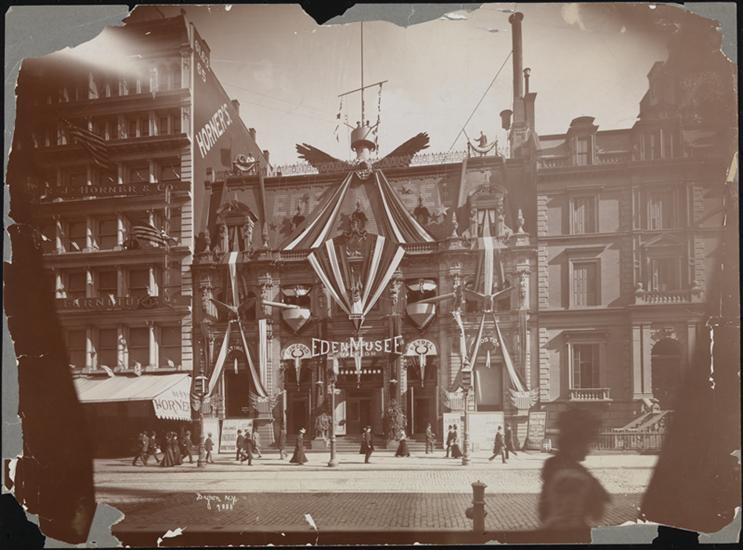
Eden Musée 1899, made out like a battleship, perhaps in honor of Admiral Dewey’s return
“The plague of Little Lord Fauntleroys at this time was something of stupendous proportions and besides Wallace Eddinger, many another boy inwardly swore at his doting mama who rigged him up in the now well known costume immortalized by Reginald Birch in his famous illustrations of Mrs. Frances Hodgson Burnett’s story then running serially in St. Nicholas. While it would not be true to say that Mrs. Burnett’s story could not have scored the success it did without them, here was one case at least where the illustrations really helped and Birch’s interpretation of the Little Lord became second in popularity only to the story itself. A whole generation of boys would have been glad to see Birch hung, drawn and quartered. The “Little Lord Fauntleroy” suit with its insipid sash and wide ‘sissy’ collar peered from every shop window in the land and the streets were filled with quandom Fauntleroys.”
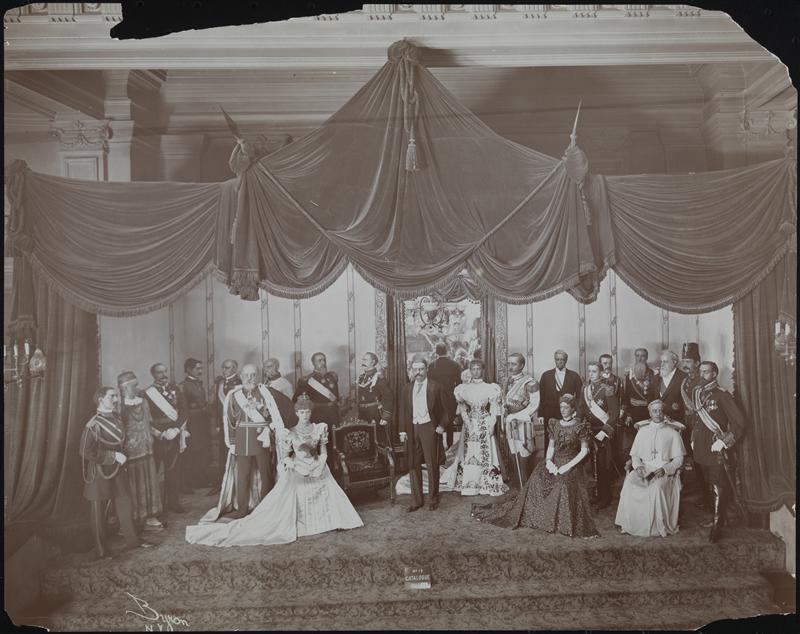
Eden Musée wax tableau: “Rulers of the World”
These wretched children and their mamas habituated the Eden Musée for its promoted “high-class” entertainments, while their charges drifted off to the more seedy attractions in the house: freaks, fire eaters, sword swallowers, waxworks, a Chamber of Horrors … and Ajeeb.
In the 1899 Eden Musée Catalogue, Ajeeb the Chess Player is described thus:
Visitors while on the gallery should not fail to see AJEEB, the mysterious chess and checker playing automaton. It represents a Moorish figure seated on a cushion, beneath which is a perfectly open table; in front is a small cabinet with doors, which are all open, as well as the back and chest of the figure. Any stranger is at liberty to play a game with the automaton; the movements of the figure are free and easy, and it shifts the pieces with as much accuracy as its living opponents and with much greater success, generally coming off the conqueror. In giving check to the king the automaton makes a sign by raising his head twice, and for checkmate three times.
The Eden Musée closed its doors in 1915 after 21 years in business. Ajeeb was sent to Coney Island. As of 1943, he is “stored in Queens, dissected into eight parts. Seven-eighths of him, done up in packing cases, rests in the back of a Cadillac touring car which is itself stored on blocks in an open-air parking lot in Astoria; the other eighth — his head — lies swathed in silk in a trunk in the Jackson Heights apartment of one of Ajeeb’s two present owners….”


The address is incorrect. Eden Musee was located at 55 West 23rd St (between 5th & 6th Aves.)
LikeLike
Thanks. Don’t know how 599 crept into my text. Will fix.
LikeLike
Hi ,
who are the 3 left Asian King’s represented please ?
LikeLike
on the tableau of the wax rulers of the world, 3 kings Asia who are they ?
LikeLike